

Close Menu
  • Home
  • Articles
    • Attacks
      • BEC
      • Data Breach
      • DDoS
      • Evasion Attacks
      • Injection
      • Malware
      • MITM
      • Phishing
      • Ransomware
      • RCE
      • Social Engineering
      • Spoofing
      • Spyware
    • Business and Policy
      • BCP and DRP
      • GRC
      • Regulations
    • Data Protection
      • DLP
      • DRM
      • Encryption
      • IAM
    • Future, Trends and Insight
      • AI
      • Events & Community
      • Emerging Tech
      • Expert Panel
      • Interviews With Experts
      • Insights
      • Study & Research
    • Resources
      • Guides
      • Tools
      • Training & Education
    • Security
      • API
      • Apps
      • Cloud
      • Critical Infrastructure
      • Endpoint
      • Hardware
      • IoT
      • Mobile
      • Network
      • OT
      • Port Security
      • Security Architecture
      • Software Development
      • Supply Chain
      • Zero Trust
    • Threats and Vulnerabilities
      • Emerging Threats
      • Insider Threats
      • Risk Management
      • Threat Intelligence
      • Zero Day
  • News and Exclusives
    • Latest News
    • ISB Exclusive
    • Positive News
  • Who We Are
    • About Us
    • Information Security Buzz Expert Panel​
    • Write for Us
    • Media Pack
  • Contact Us
  • Newsletter
Facebook X (Twitter) LinkedIn
Information Security BuzzInformation Security Buzz
  • Home
  • Articles
    • Attacks
      • BEC
      • Data Breach
      • DDoS
      • Evasion Attacks
      • Injection
      • Malware
      • MITM
      • Phishing
      • Ransomware
      • RCE
      • Social Engineering
      • Spoofing
      • Spyware
    • Business and Policy
      • BCP and DRP
      • GRC
      • Regulations
    • Data Protection
      • DLP
      • DRM
      • Encryption
      • IAM
    • Future, Trends and Insight
      • AI
      • Events & Community
      • Emerging Tech
      • Expert Panel
      • Interviews With Experts
      • Insights
      • Study & Research
    • Resources
      • Guides
      • Tools
      • Training & Education
    • Security
      • API
      • Apps
      • Cloud
      • Critical Infrastructure
      • Endpoint
      • Hardware
      • IoT
      • Mobile
      • Network
      • OT
      • Port Security
      • Security Architecture
      • Software Development
      • Supply Chain
      • Zero Trust
    • Threats and Vulnerabilities
      • Emerging Threats
      • Insider Threats
      • Risk Management
      • Threat Intelligence
      • Zero Day
  • News and Exclusives
    • Latest News
    • ISB Exclusive
    • Positive News
  • Who We Are
    • About Us
    • Information Security Buzz Expert Panel​
    • Write for Us
    • Media Pack
  • Contact Us
  • Newsletter
Subscribe
Information Security BuzzInformation Security Buzz
Home - Articles - Email Gateway – Best Defend Against External Email Threats
Articles

Email Gateway – Best Defend Against External Email Threats

By January 5, 2017Updated:July 4, 20243 Mins Read
Share LinkedIn Twitter Facebook Copy Link Email
Share
Facebook Twitter LinkedIn Email Copy Link
Quick AI Summary
ChatGPTClaudeGeminiGrokPerplexityDeepSeekCopilot

An email gateway (aka external SMTP server) is a server where all incoming and outgoing emails are processed and typically provide the following service:

  • Anti-virus scanning on all inbound and outbound emails
  • Anti-spam Management
  • Quarantine Email
  • Company email policy implementation such as message size permitted, allowable type of attachments, etc.
  • Automatic logging and archiving of usage logs.

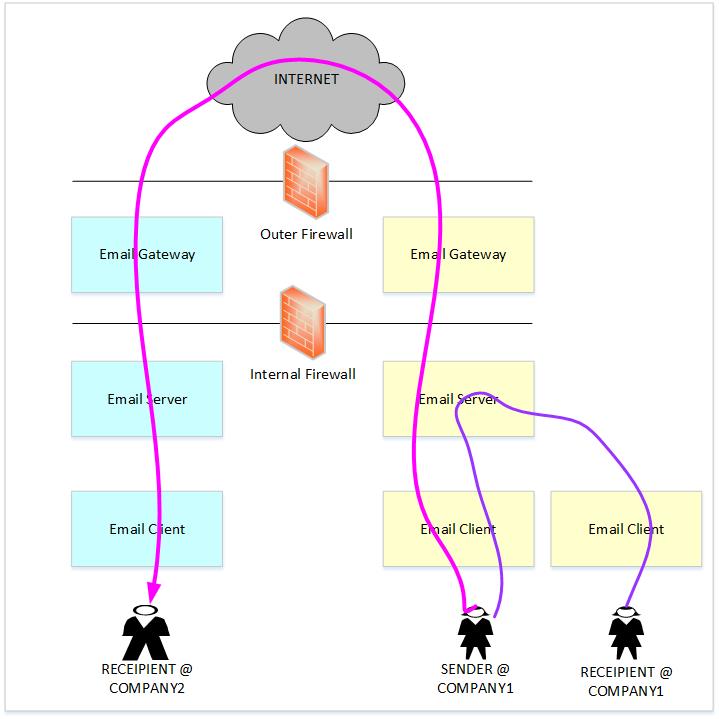
A typical email gateway architecture is shown below. All outgoing or incoming external emails are routed through email gateway whereas all internal email stay within company internal network and are handled by email server such as Microsoft Exchange.
email-gateway-1

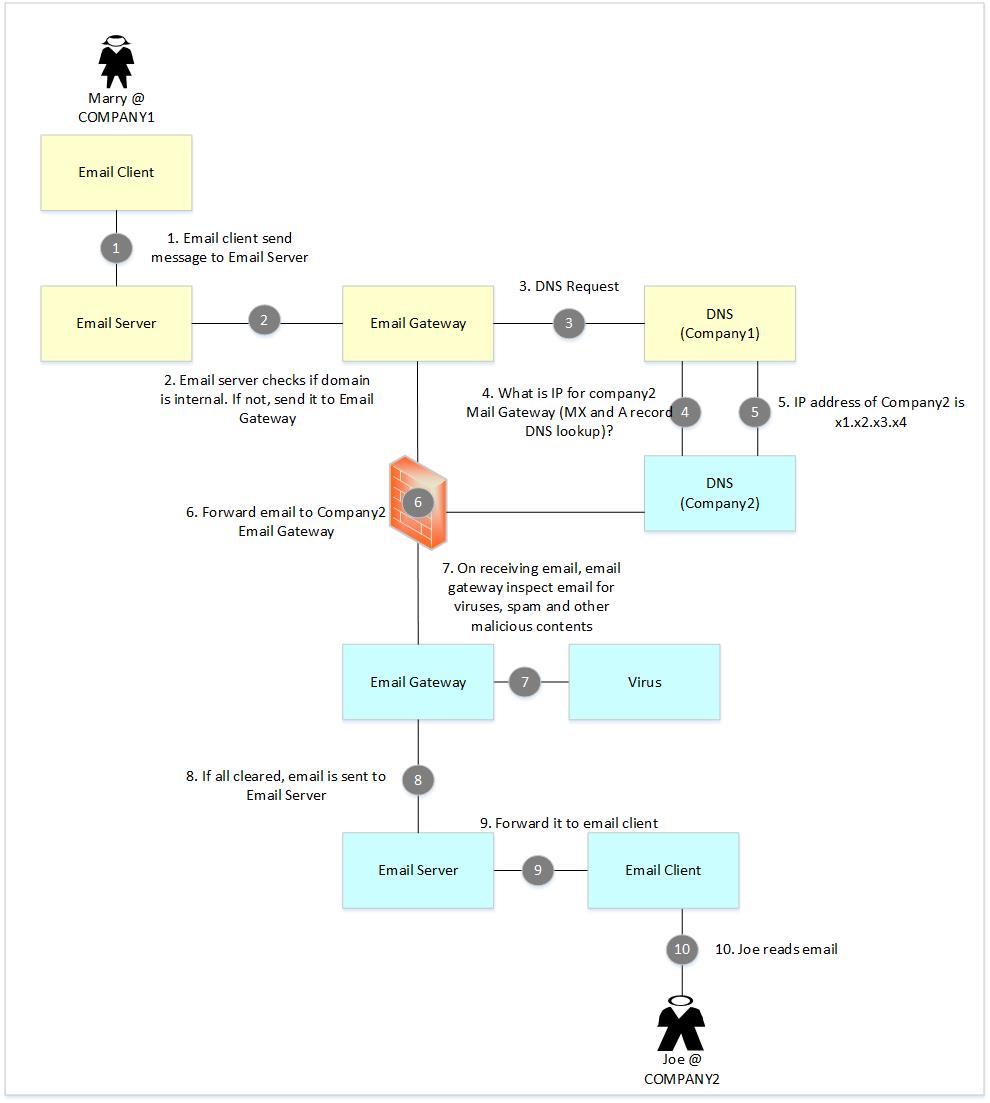
The email message flow from Mary in Company1 to Joe in company2 is shown below.
email-gateway-2

There are many risks associated with unsecured email services and it is important to configure email gateway to minimize these risks. Some of the recommendations are:

  • Every company should have email policy such as message size which needs to be implemented at Email gateway. The employees also need to be aware of this policy.
  • The email policy should be monitored at Email gateway to make sure employees are compliance with Email policy.
  • Most the social engineering attacks are spread using email and it is vital for company to make sure its employees are aware of these risks and know how to report them.
  • Government agencies normally make use of email marking to make sure that sensitive emails are not sent over the internet. Email gateway can be configured to make sure that emails are processed as per agency marking policy.
  • All outgoing and incoming emails must pass through the email gateway.
  • Company should configured Sender Policy Framework (SPF) and DomainKeys Identified Mail (DKIM) on email gateway to detect email spoofing.
  • Company can enable Transport Layer Security (TLS) encryption as per RFC3207.

Email gateway solutions are offered by number of vendors and some notable are:

  • Cisco Email Security Appliance
  • Proofpoint Email Protection solutions
  • Microsoft Exchange Online Protection
  • Symantec Messaging Gateway
  • Trend Micro InterScan Messaging Security
  • Fortinet FortiMail
  • Sophos Secure Email Gateway

Followings are the criteria you can use to select the best vendor for your email gateway solution:

  • Check that email gateway solution offered by the vendors offer antimalware, antispam, antivirus and antiphishing as part of their standard offering.
  • Optional security offering such as Data Loss Prevention (DLP), email encryption, email attachment security and advanced threat protection (ATP) mechanism.
  • User friendly interface and easy to manage.
  • Sophisticated reporting functionality – useful for higher management or clients.

[su_box title=”About Dr. Muhammad Malik” style=”noise” box_color=”#336588″][short_info id=’100137′ desc=”true” all=”false”][/su_box]

    This author does not have any more posts.

The opinions expressed in this post belong to the individual contributors and do not necessarily reflect the views of Information Security Buzz.

Share. Facebook Twitter LinkedIn Email Copy Link

Related Posts

Visual data is the blind spot in enterprise security: that’s about to change

May 4, 20267 Mins Read

Making stolen data worthless: why security must start with the data

March 30, 20265 Mins Read

Meta’s Smart Glasses Privacy Scandal Expands After Sama Credentials Found on the Dark Web

March 10, 20264 Mins Read
ISB-Bora-Side-Bar

 
ISB-Bora-Side-Bar
Black ISB Logo

Information Security Buzz is an independent resource that provides the experts’ comments, analysis, and opinion on the latest Cybersecurity news and topics

X (Twitter) LinkedIn Facebook RSS

Working With Us

  • About Us
  • Advertise With Us
  • Contact Us

Write For Us

  • How To Contribute

The Pages

  • Privacy Policy
  • Cookie Policy
  • AI Policy
  • Terms & Conditions
  • Copyright Notice

Information Security Buzz and all its contents are copyright © 2014-2025. All rights reserved. All third-party trademarks are recognized.

Type above and press Enter to search. Press Esc to cancel.

Manage Consent
To provide the best experiences, we use technologies like cookies to store and/or access device information. Consenting to these technologies will allow us to process data such as browsing behavior or unique IDs on this site. Not consenting or withdrawing consent, may adversely affect certain features and functions.
Functional Always active
The technical storage or access is strictly necessary for the legitimate purpose of enabling the use of a specific service explicitly requested by the subscriber or user, or for the sole purpose of carrying out the transmission of a communication over an electronic communications network.
Preferences
The technical storage or access is necessary for the legitimate purpose of storing preferences that are not requested by the subscriber or user.
Statistics
The technical storage or access that is used exclusively for statistical purposes. The technical storage or access that is used exclusively for anonymous statistical purposes. Without a subpoena, voluntary compliance on the part of your Internet Service Provider, or additional records from a third party, information stored or retrieved for this purpose alone cannot usually be used to identify you.
Marketing
The technical storage or access is required to create user profiles to send advertising, or to track the user on a website or across several websites for similar marketing purposes.
  • Manage options
  • Manage services
  • Manage {vendor_count} vendors
  • Read more about these purposes
View preferences
  • {title}
  • {title}
  • {title}