

Close Menu
  • Home
  • Articles
    • Attacks
      • BEC
      • Data Breach
      • DDoS
      • Evasion Attacks
      • Injection
      • Malware
      • MITM
      • Phishing
      • Ransomware
      • RCE
      • Social Engineering
      • Spoofing
      • Spyware
    • Business and Policy
      • BCP and DRP
      • GRC
      • Regulations
    • Data Protection
      • DLP
      • DRM
      • Encryption
      • IAM
    • Future, Trends and Insight
      • AI
      • Events & Community
      • Emerging Tech
      • Expert Panel
      • Interviews With Experts
      • Insights
      • Study & Research
    • Resources
      • Guides
      • Tools
      • Training & Education
    • Security
      • API
      • Apps
      • Cloud
      • Critical Infrastructure
      • Endpoint
      • Hardware
      • IoT
      • Mobile
      • Network
      • OT
      • Port Security
      • Security Architecture
      • Software Development
      • Supply Chain
      • Zero Trust
    • Threats and Vulnerabilities
      • Emerging Threats
      • Insider Threats
      • Risk Management
      • Threat Intelligence
      • Zero Day
  • News and Exclusives
    • Latest News
    • ISB Exclusive
    • Positive News
  • Who We Are
    • About Us
    • Information Security Buzz Expert Panel​
    • Write for Us
    • Media Pack
  • Contact Us
  • Newsletter
Facebook X (Twitter) LinkedIn
Information Security BuzzInformation Security Buzz
  • Home
  • Articles
    • Attacks
      • BEC
      • Data Breach
      • DDoS
      • Evasion Attacks
      • Injection
      • Malware
      • MITM
      • Phishing
      • Ransomware
      • RCE
      • Social Engineering
      • Spoofing
      • Spyware
    • Business and Policy
      • BCP and DRP
      • GRC
      • Regulations
    • Data Protection
      • DLP
      • DRM
      • Encryption
      • IAM
    • Future, Trends and Insight
      • AI
      • Events & Community
      • Emerging Tech
      • Expert Panel
      • Interviews With Experts
      • Insights
      • Study & Research
    • Resources
      • Guides
      • Tools
      • Training & Education
    • Security
      • API
      • Apps
      • Cloud
      • Critical Infrastructure
      • Endpoint
      • Hardware
      • IoT
      • Mobile
      • Network
      • OT
      • Port Security
      • Security Architecture
      • Software Development
      • Supply Chain
      • Zero Trust
    • Threats and Vulnerabilities
      • Emerging Threats
      • Insider Threats
      • Risk Management
      • Threat Intelligence
      • Zero Day
  • News and Exclusives
    • Latest News
    • ISB Exclusive
    • Positive News
  • Who We Are
    • About Us
    • Information Security Buzz Expert Panel​
    • Write for Us
    • Media Pack
  • Contact Us
  • Newsletter
Subscribe
Information Security BuzzInformation Security Buzz
Home - Articles - Smartphones? Credit Cards Are the Most Mobile Payment Method!
Articles

Smartphones? Credit Cards Are the Most Mobile Payment Method!

ISB Editorial StaffBy ISB Editorial StaffMarch 17, 20165 Mins Read
Share LinkedIn Twitter Facebook Copy Link Email
Share
Facebook Twitter LinkedIn Email Copy Link
Quick AI Summary
ChatGPTClaudeGeminiGrokPerplexityDeepSeekCopilot

The world has been talking about “mobile payments” for years, but the phrase means different things to different people. So what exactly are mobile payments? And how much more mobile than cash or cards can payments actually get?

Some people believe that mobile payments are those made using mobile phones. Others, myself included, understand the phrase to mean the most mobile, cash-independent payment method possible—although I consider cash to be more mobile than many other forms of payment. But let’s leave those alone for the moment. The second most mobile payment type is the credit card: electricity doesn’t always work, and as Barclaycard demonstrated so effectively in its ad[1], you can even use your card on a waterslide.

Now let’s take a look at the much-lauded smartphone. Of course, people have their smartphones with them most of the time, but, as the majority of business travellers at airports have demonstrated, they will seize any opportunity to extract just one more drop of power from any source—even the most inaccessible ones—to ensure that their smartphone batteries will survive the day. I’m not convinced that relying on your smartphone (and thus, its battery) for your payment options is a good idea. Ultimately, you’d still have to carry a credit card—or at least a battery charger—to ensure that you weren‘t left high and dry if the worst happened. This begs the question, though: if you’re going to be carrying a credit card anyway, why do you need a smartphone to make payments?

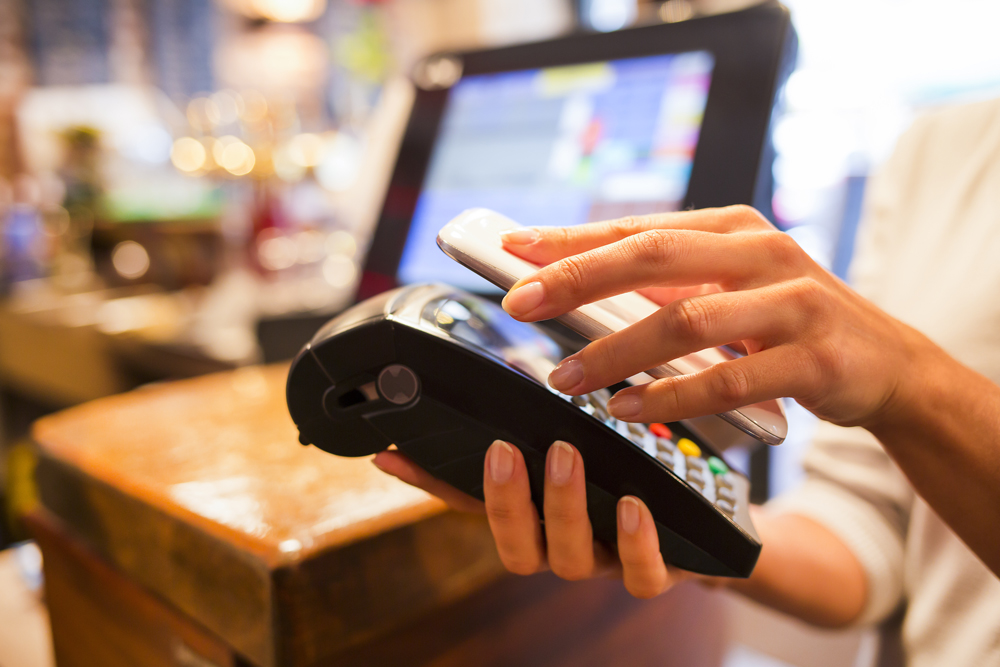
Many people, on the other hand, would say: “Ah, but with a smartphone I can make contactless payments”. While this statement is perfectly true, it applies equally to credit cards. When it comes down to it, smartphones are nothing more than a medium for storing credit card data. Any credit card can also be equipped with a contactless function; and unlike a smartphone, it won’t break if it‘s dropped into water or onto a concrete floor. There are also NFC credit card stickers which you can, for example, stick onto your mobile phone. Paradoxically, doing this allows you to add mobile payment functions to even the oldest Nokia.

In any critical review, it is important to remember that smartphone operating systems incorporate a wide range of functions. By their very nature, therefore, smartphones will always contain security vulnerabilities which can, in extreme cases, even jeopardise the security of your payment data. It’s not just payment data that is at stake here (although a fraudster could use it to go shopping), but all the data pertaining to user purchasing patterns. You’re probably thinking: “What’s wrong with someone seeing what I’m buying?” Now, though, imagine that you were on holiday in the USA and that someone could use your phone to see that you were currently making all your purchases there. Wouldn’t that be the best time for them to burgle your flat?

I don’t understand why developers feel compelled to include payment functions in smartphones. Why don’t we just use credit cards? They’re the most widespread, most mobile of all mobile options and—most importantly—they’re the least breakable. Ultimately, it doesn’t matter whether the NFC chip is embedded into a rectangular plastic card, a cufflink, an earring or a sticker; I’ve simply yet to be convinced of the consumer benefits of using a smartphone. The facts are:

–          Mobile payment systems’ success is determined by the availability of NFC-capable terminals and the acceptance of credit cards by retailers.

–          Local card systems, like, for example, Carte Bleu or Girocard, are becoming less popular among retailers due to the European interchange regulation. Retailers are losing the cost benefits they have hitherto enjoyed, and are being forced to accept more complex payment processes.

–          NFC is now effectively the standard. As of 2016, all POS terminals must be NFC-capable.

Why, then, haven’t NFC payments taken off in countries outside the UK, for example, Germany? There is, in theory, nothing technical or structural standing in the way of mobile—or even, contactless—payments. Except, of course, the Germans themselves. In a country where frugality is still considered a virtue, customers are unwilling to pay for banking services. Instead, they believe that everything should be free, from the cards themselves to cash machine withdrawals, account maintenance and loans. Nowhere else in the world is “free banking” as ingrained into the culture as it is in Germany.

Contactless cards are only slightly more expnsive to produce than standard ones. Banks in Germany tend not to offer them, however, because they’re afraid customers won’t want to pay the difference. For this reason, contactless payments using credit cards are still largely unknown in Germany, whereas they’ve become the norm in countries like the UK and Sweden.

Perhaps this is precisely the advantage of making mobile payments via smartphones: adding credit card data to a smartphone is cheaper than adding an NFC chip to every customer’s card. This means, though, that it’s not the consumers who are reaping the benefits of smartphone payments: it’s the card-issuing banks.

In future, NFC-capable credit cards will be the standard for mobile payments—even outside the UK. Alternative “mobile” payment systems, which use options like QR codes rather than NFC, will never achieve this level of popularity. It’s not just the technology vendors and the hugely diverse operators of all kinds of “mobile payment types” who are to blame for this state of affairs; instead, it’s fear and lack of knowledge on the part of retailers. It no longer matters whether chips are embedded in smartphones, stickers, or body parts. Instead, convenience and cost will determine which option consumers prefer.

[1] https://www.youtube.com/watch?v=1WlRcXIO5ik

[su_box title=”About Philipp Nieland” style=”noise” box_color=”#336588″][short_info id=”64692″ desc=”true” all=”false”][/su_box]

ISB Editorial Staff
  • ISB Editorial Staff
    Navigating the Cyber Threat Landscape: Key Insights from Trellix ARC’s Q1 2023 Report
  • ISB Editorial Staff
    Experts’ Responses: Cyber Security Predictions 2022
  • ISB Editorial Staff
    ISB Virtual Conference: Key Cyber Security Challenges and Solutions in 2021
  • ISB Editorial Staff
    Cyber Security Predictions 2021: Experts’ Responses

The opinions expressed in this post belong to the individual contributors and do not necessarily reflect the views of Information Security Buzz.

Share. Facebook Twitter LinkedIn Email Copy Link

Related Posts

Roundcube RCE Vulnerability Disclosed Early Amid Active Exploitation

June 10, 20255 Mins Read

Fake Indian Government Portal Used to Spread Cross-Platform Malware in Suspected APT36 Campaign

May 13, 20253 Mins Read

New Federal Alert Warns U.S. Businesses of Medusa Ransomware Surge

March 13, 20254 Mins Read
ISB-Bora-Side-Bar

No se ha podido establecer conexión. Error 429

 
ISB-Bora-Side-Bar
Black ISB Logo

Information Security Buzz is an independent resource that provides the experts’ comments, analysis, and opinion on the latest Cybersecurity news and topics

X (Twitter) LinkedIn Facebook RSS

Working With Us

  • About Us
  • Advertise With Us
  • Contact Us

Write For Us

  • How To Contribute

The Pages

  • Privacy Policy
  • Cookie Policy
  • AI Policy
  • Terms & Conditions
  • Copyright Notice

Information Security Buzz and all its contents are copyright © 2014-2025. All rights reserved. All third-party trademarks are recognized.

Type above and press Enter to search. Press Esc to cancel.

Manage Consent
To provide the best experiences, we use technologies like cookies to store and/or access device information. Consenting to these technologies will allow us to process data such as browsing behavior or unique IDs on this site. Not consenting or withdrawing consent, may adversely affect certain features and functions.
Functional Always active
The technical storage or access is strictly necessary for the legitimate purpose of enabling the use of a specific service explicitly requested by the subscriber or user, or for the sole purpose of carrying out the transmission of a communication over an electronic communications network.
Preferences
The technical storage or access is necessary for the legitimate purpose of storing preferences that are not requested by the subscriber or user.
Statistics
The technical storage or access that is used exclusively for statistical purposes. The technical storage or access that is used exclusively for anonymous statistical purposes. Without a subpoena, voluntary compliance on the part of your Internet Service Provider, or additional records from a third party, information stored or retrieved for this purpose alone cannot usually be used to identify you.
Marketing
The technical storage or access is required to create user profiles to send advertising, or to track the user on a website or across several websites for similar marketing purposes.
  • Manage options
  • Manage services
  • Manage {vendor_count} vendors
  • Read more about these purposes
View preferences
  • {title}
  • {title}
  • {title}