


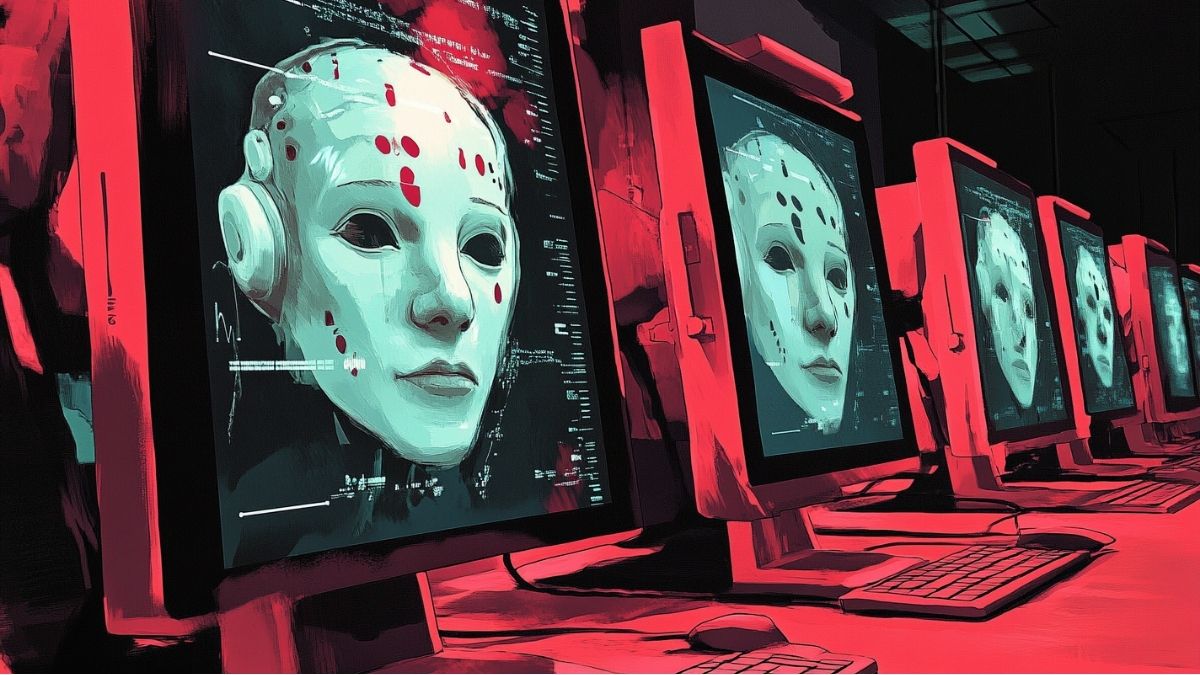
In early 2024, a finance director at a multinational company in Singapore joined what appeared to be a routine video call with senior colleagues. The CFO was there. The leadership team was there. Every face and voice felt familiar. Yet none of them were real. Within minutes, the director had approved a transfer of nearly half a million dollars, all on the instruction of a group of AI-generated impostors. This incident has become one of the most striking examples of a threat that is evolving faster than most organizations can comprehend. Deepfake technology, once regarded as little more than low-quality digital trickery, has evolved into a powerful tool capable of orchestrating large-scale deception. This isn’t just a story about deception; it’s a story about identity. Deepfakes have redefined what it means to trust who’s on the other end of the call.
Deepfake technology is particularly damaging because it exposes a critical vulnerability that no firewall or training workshop can fix: the assumption that human presence equals truth. Generative AI has lowered the barrier to producing convincing audio-visual forgeries, enabling attackers to scale impersonation across calls, messages, and entire workflows. The very cues that once confirmed authenticity, such as live conversations, familiar voices, and recognizable faces, are now the easiest to counterfeit. So, if seeing isn’t necessarily believing, where does that leave organizations?
From authenticity to assurance
The conversation around deepfakes often centers on the authenticity of what we see and hear. It used to be easy to figure out whether an image or video is genuine, or whether a recording had been tampered with. That’s becoming increasingly difficult, but the real challenge goes even deeper. Every instance of synthetic impersonation is, at its core, an identity problem. When a fraudster uses an AI model to recreate someone’s likeness, voice, or writing style, they aren’t forging content – they’re forging a real person. This has given way to a new form of identity theft that doesn’t rely on stolen passwords or data breaches but on the ability to replicate trust itself. No amount of phishing awareness training can stop an adversary who walks into a conversation looking and sounding like a colleague.
So instead of leaning on traditional perimeter-based defensive tools and human awareness, organizations need to think critically about how identity is verified in digital interactions. In other words, stop verifying the medium and start verifying the entity behind it. If authenticity is no longer about matching visual or vocal patterns, because they’re so easily replicated by deepfake technology, it has to be about validating the context in which those patterns occur. A genuine user leaves a trail of consistent signals – including device integrity, location data, behavioral norms, and access patterns – that can be continuously assessed to confirm their identity. This is where identity security becomes a dynamic process rather than a static checkpoint. By anchoring verification in a real-time context, organizations can defend against deepfakes not by spotting every forged pixel, but by ensuring that every interaction, login, or transaction is backed by provable identity. Again, focus must shift away from the medium and toward the entity behind it.
Defining trust in a synthetic world
Deepfakes have forced security teams to reconsider what it truly means to verify trust. Traditional authentication relies on fixed credentials, namely passwords, tokens, or biometric markers, all of which assume a stable link between a user and their identity. But when AI can generate those same signals, the concept of verification needs to evolve. In a post-AI world, static identity checks only provide a snapshot in time, which can be easily undermined by synthetic replicas. Instead, we need a living form of identity assurance that can evaluate risk continuously, drawing on behavioral, environmental, and contextual signals that are far harder to falsify.
Thankfully, identity platforms are beginning to catch up. By analyzing factors such as device reputation, session patterns, and the history of access behavior, they can build a baseline understanding of “normal” identity activity. When an anomaly emerges, such as an access request from a new device, a voice pattern slightly misaligned with prior recordings, or a login sequence that doesn’t match typical user frequency, the system can demand additional proof or trigger step-up verification. Instead of having to detect every deepfake on sight, organizations can continuously validate trust to thwart it at the gate. This is what transforms verification from the static gateway many organizations are familiar with into an adaptive trust engine, capable of keeping pace with a risk factor that never stops coming.
Identity is the new front line
Identity is quickly emerging as the unifying control layer for cyber resilience. Every interaction, transaction, and access request now flows through the same trust channel, making it the logical place to detect and contain impersonation before damage is done. The line between fraud, cybersecurity, and compliance is blurring, and organizations are beginning to view deepfake defense as a shared responsibility across teams, rather than an isolated function. Protecting data or systems alone won’t cut it. The real measure of security is how effectively an organization can prove who, or what, is operating inside its environment at any given time.
Achieving that requires a governance model grounded in evidence. Enterprises are beginning to replace static attestations with continuous validation, not just declaring compliance, but demonstrating it through real-time audit trails. These trails record who granted access, under what context, and for how long, creating a living record of trust decisions that can stand up to scrutiny. These zero-trust principles are also extending to non-human identities, as AI agents, automation tools, and digital bots increase in number on our networks. Each of these bot actors must be authenticated, authorized, and observed just like a human user, following the same rules of least privilege and continuous verification. The identity layer, once a backend administrative function, has become the frontline where modern attacks are intercepted and trust is maintained. In the age of synthetic reality, identity is not just a technical system; it’s the business’s truth layer.

Andrew Hartnett
With a diverse background spanning startups, large institutions, and major corporations, Andrew brings extensive experience in developing, running, and maintaining products at the intersection of massive-scale data, cybersecurity, and observability. He is uniquely qualified to lead R&D at One Identity, having co-founded and led engineering and development teams at managed security organizations for accelerated growth. As we seek to achieve accelerated and consistent growth at One Identity, Andrew’s focus on driving innovation and creating a collaborative engineering culture rooted in excellence and delivery will be key.
The opinions expressed in this post belong to the individual contributors and do not necessarily reflect the views of Information Security Buzz.