



Sextortion is a form of extortion or blackmail in which a criminals threaten to share private or intimate information or images unless a victim gives them money. Criminals can get hold of these images by compromising credentials or coercing someone into sending the images or create deepfakes (i.e., images created with the help of AI) that depict the victim. Additionally, some forms of sextortion include phishing emails stating that the victim has been filmed without their knowledge. Even though this is typically a lie, many victims are sufficiently scared and end up complying with the scammers’ demands.
Evolution of Sextortion
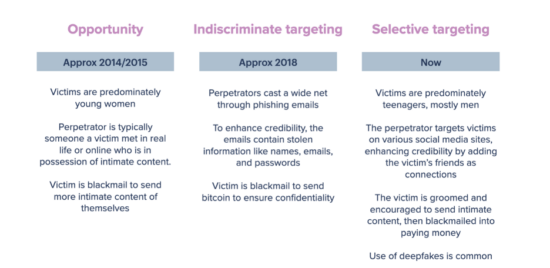
Sextortion scams have changed over time. Early cases usually involved women being blackmailed by someone they knew, such as an ex-partner, or by someone they met online who obtained private images. The goal was not always money; victims were often pressured into providing more sexual content. Around 2018, sextortion shifted toward mass phishing emails that used stolen passwords or personal details to seem credible. These messages relied on psychological tactics like shame, fear, and threats of exposure to friends and family. Scammers exaggerated their technical skills, dismissed poor grammar, discouraged contacting authorities, and framed sextortion as routine work, all to make victims feel helpless and comply.
As awareness of sextortion phishing grew, scammers shifted tactics again and now increasingly target teenagers on social media. Victims are persuaded to share intimate images with someone they believe is a romantic interest, then blackmailed for more content or money. In some cases, deepfakes are used. Many victims are as young as 13 or younger and are predominantly male.
Psychological Tactics
Victims are often contacted through realistic-looking social media accounts that are socially engineered or hijacked, making the interaction feel normal and natural, rather than suspicious. Conversations are friendly and quickly become flirtatious, relying on psychological tactics rather than long-term grooming techniques.
Scammers pressure victims to switch to encrypted messaging apps to avoid account suspensions and often send intimate images first to create a false sense of trust, make the victim feel they have control over the situation and encourage reciprocity. Once the victim complies and sends pictures of themselves back, threats start. Threats involve exposing images to friends and family, but some are more sinister. A scammer may tell the victim that the images were sent to a child, and the victim then receives messages from someone posing as a parent or police officer.
The aim is to trigger fear and shame, overwhelm rational thinking, and make the victim send money before the fear subsides. Fear impairs memory retrieval and reduces the capacity for logical reasoning, making us compelled to make rapid, often irrational decisions to avoid discomfort
Naturally, there is a careful layering of different social engineering techniques to encourage compliance.
1. Social proof
Scammers often connect with a group of friends, adding credibility to initial conversations (e.g., a friend of a friend connecting).
2. Reciprocity
This is how scammers encourage victims to send intimate content. Reciprocity is a persuasion technique based on social norms. It creates an expectation to return favors. When someone does something for us, even if unrequested, we often feel obligated to reciprocate.
3. Visual priming
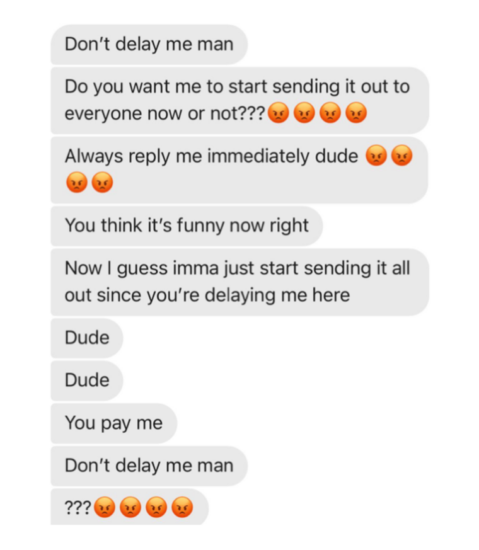
Once threats start, scammers use red anger emojis in the texts they send to their victims. Visual elements in scams can bypass careful reasoning and directly influence emotions. Red emojis serve two purposes: they signal emotional escalation, such as anger or intense passion, and they leverage the psychological impact of the color red, which captures attention, increases arousal, signals danger, and creates urgency.
4. Verbal threats
Threats are used to trigger fear, shame, and desperation. Fear is a powerful visceral response that increases arousal and panic, often impairing rational thinking and memory.
5. Urgency
Scammers are now working against the clock. When fear subsides, rational thinking returns. They have to pressure victims to act, ensuring decisions are made while judgment is still compromised.
Why do Scammers Focus on Young People?
One evolutionary theory suggests that children are naturally open, trusting, and even gullible because those traits provided them with an evolutionary advantage. In earlier times, people lacked structured childcare and often had to leave children alone while working. Children who blindly trusted warnings were more likely to survive (Dawkins, 2006). As we grow up, we lose this gullibility. Scammers likely know this and now exploit this for their own gain. This may also be a reason why grooming is typically shorter for this type of scam, as opposed to classic romance scams affecting adults.
Additionally, younger generations are comfortable with online friendships and communication, making it easier for scammers to imitate the natural ways young people connect with others while staying anonymous.
Sextortion is a serious crime with long-lasting effects on victims. Because it evokes intense fear and impairs judgment, some young people tragically feel trapped and unable to see a way out. This can result in devastating consequences, including self-harm or suicide.
The following victims’ quotes, taken from Reddit, illustrate the state of mind victims find themselves in.
“Can someone help me, what do I do? Is my life over? I know this sounds beyond dumb but I’m on the verge of jumping off the nearest cliff…”
“Looking back, I still don’t know how I could’ve been so stupid as to not see the signs. I was almost in a trance-like state where I mindlessly succumb to the time limits and pressure, they were giving me and kept sending them money.”
Preventing Harm Through Understanding
Scams are now increasingly sophisticated and carefully engineered. Scammers study human behavior, learning what makes people vulnerable, irrational, and compliant, and then exploit these psychological and behavioral principles to their advantage. As a result, simple warnings are no longer sufficient. What is needed is a deeper understanding of how these scams operate beneath the surface, so people can recognize their own vulnerabilities across different stages of life.
The methods outlined in this article provide insight into how scammers use psychological and visual tricks to keep victims in a state of fear. Educators and parents should encourage open conversations about online dangers, especially sextortion, which can inflict significant harm and often leads to secrecy. Teenagers should be encouraged to seek advice from a trusted adult if they feel uncomfortable or threatened online.
Here is advice for reflection and protection to share with young people
S – Seek help straight away from parents, friends, trusted adult or police. They will be able to guide you through this.
E – End all communication with a person threatening you to let the fear subside. If a scammer has access to you through communication, they have control over your emotions too. Creating distance leads to a more rational outlook and helps you recover from fear.
X – Extra caution is needed. The scammer may try to contact you from different numbers and on different platforms. Make your social media as private as possible and block any future contact requests.
T– Tell trusted friends. Sharing your experience can help you feel less alone. There are online communities where people discuss their stories, and this collective sharing brings awareness and comfort.
O – Only interact with verified contacts. If you get a new connection who appears to be friends with your friends, verify with your friends whether they actually know this person before engaging. Unfortunately, scammers often use social proof to make their scams seem more credible.
R – Remember that this was not your fault. Sextortion is an organized crime that uses specific and highly effective targeting and manipulation tactics.
T – Take screenshots to gather evidence and report. Reporting doesn’t always produce instant justice, but it helps legislators understand the scale and breadth of the problem and allocate appropriate funding for future investigations and prosecutions.
I – Ignore requests for intimate content. Sometimes scammers send private content first to manipulate you into feeling like you have to reciprocate. Remember, you don’t have to do anything you don’t want to do. Trust your instincts.
O – Outsmart emotional manipulation. Scammers often use strong emotions and fear to get what they want, sometimes in subtle ways. Pay attention to how messages make you feel, and if you feel anxious or pressured to comply online, seek advice from trusted friends or family.
N – Network wisely. We all communicate with people we’ve only met online and not in real life. Online communication can create a level of intimacy often missing in face-to-face relationships, which can make us vulnerable. Scammers exploit this natural need for human connection. Stay safe.

Martina Dove is a researcher and a published author specializing in scam psychology. This incorporates persuasion and social engineering techniques, as well as errors in judgment and other individual factors that increase scam vulnerability. She combines psychological science, behavioral insight, and real-world scam examples to explore how scammers influence decision-making and how victims can better protect themselves. Beyond academic writing, she works in the tech industry as a strategic product researcher, with focus on cybersecurity, observability and AI, including the responsible use of AI.
The opinions expressed in this post belong to the individual contributors and do not necessarily reflect the views of Information Security Buzz.