



The proliferation of data breaches and cyberattacks has underscored the importance of robust data protection mechanisms. Encryption is a cornerstone of modern cybersecurity. It provides confidentiality, integrity, and authentication, safeguarding sensitive information from unauthorized access and manipulation. Existing literature extensively covers various aspects of encryption.
Schneier’s “Applied Cryptography” (1996) provides a foundational understanding of cryptographic principles and algorithms. Stallings and Brown’s “Cryptography and Network Security” (2018) comprehensively explores modern cryptographic techniques, including symmetric and asymmetric encryption, hash functions, and digital signatures. Research papers on specific algorithms, such as AES (NIST, 2001) and RSA (Rivest, Shamir, and Adleman, 1978), detail their mathematical foundations and security properties.
Furthermore, studies on practical implementations, such as those focusing on key management, such as Boneh, and Franklin, 2003 and performance optimization, as explained in Blaze, Ioannidis, and Keromytis, 2000, highlight the challenges and best practices in real-world deployments. Recent research conducted by Peter Shor also explores the impact of quantum computing on existing cryptographic algorithms and the development of post-quantum cryptography.
Encryption Fundamentals
Encryption is the process of transforming readable data, known as plaintext, into an unreadable format called ciphertext. A cryptographic algorithm and a cryptographic key govern this transformation. Decryption is the reverse process, where ciphertext is converted back into plaintext. The fundamental goal of encryption is to ensure confidentiality, meaning that only authorized parties can access the protected information. Beyond confidentiality, encryption can also contribute to data integrity (ensuring data hasn’t been tampered with) and authentication (verifying the origin of the data).
Cryptographic Algorithms
A cryptographic algorithm is a set of mathematical rules and procedures used for encryption and decryption. These algorithms are designed to be computationally secure, meaning it is practically infeasible for an unauthorized party to reverse the encryption process without the correct key. The strength of an encryption algorithm depends on factors like the complexity of the mathematical operations involved, the length of the key, and its resistance to known cryptanalytic attacks.
Cryptographic Keys
A cryptographic key is a piece of secret information that controls the encryption and decryption processes. It’s analogous to a physical key that unlocks a lock. The security of encrypted data heavily relies on the secrecy and proper management of cryptographic keys. Key size is crucial; larger keys generally provide stronger security as they increase the number of possible key combinations, reducing the likelihood of guessing the decryption key.
Types of Encryption
Encryption algorithms are broadly classified into two main categories:
- Symmetric Encryption (Secret-key Cryptography): Symmetric encryption uses the same key for both encryption and decryption. Think of it as a lock that uses the same key to lock and unlock, just like the lock on a door. Because the same key is used for both operations, it must be kept secret. Symmetric encryption is generally fast and efficient, making it well-suited for encrypting large volumes of data. Common symmetric algorithms include:
- Advanced Encryption Standard (AES): A widely used and highly secure block cipher.
- Data Encryption Standard (DES): An older algorithm, now considered insecure due to its small key size.
- Blowfish: A fast and flexible block cipher.
- Twofish: A strong and versatile block cipher.
The primary challenge with symmetric encryption is key distribution. How can the sender and receiver securely exchange the secret key without it being intercepted?
- Asymmetric Encryption (Public-key Cryptography): Asymmetric encryption uses two distinct keys: a public key and a private key. The public key can be freely shared and is used for encryption. The private key, which must be kept secret, is used for decryption.
As an example, imagine a mailbox with a slot for depositing letters (encryption using the public key). Anyone can drop a letter in, but only the mailbox owner with the private key can open it and read the contents. Asymmetric encryption simplifies key distribution because the public key can be widely disseminated without compromising the security of the private key. Standard asymmetric algorithms include:
- RSA: A widely used algorithm based on the difficulty of factoring large numbers.
- Elliptic Curve Cryptography (ECC): A more modern approach that offers comparable security to RSA with smaller key sizes.
- Digital Signature Algorithm (DSA): Primarily used for digital signatures, which provide authentication and non-repudiation.
Asymmetric encryption is computationally more intensive than symmetric encryption. Therefore, it is typically used for smaller amounts of data, such as key exchange or digital signatures, rather than encrypting large files.
Hybrid Encryption
In practice, a combination of symmetric and asymmetric encryption is often used. This approach leverages the speed of symmetric encryption for bulk data encryption and the ease of key distribution provided by asymmetric encryption. For example, a message might be encrypted using a symmetric algorithm with a randomly generated key. Then, that symmetric key is encrypted using the recipient’s public key and sent with the ciphertext. The recipient can then decrypt the symmetric key using their private key to decrypt the message.
Comparative Analysis of Algorithms
Choosing the correct encryption algorithm is crucial for ensuring data security. A detailed comparison of symmetric and asymmetric encryption algorithms, highlighting their strengths, weaknesses, and suitability for different use cases can help to make sure that you chose the mechanism that is best suited to your needs.
Symmetric Encryption
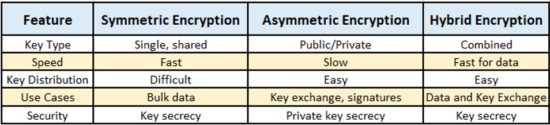
- Key: Symmetric encryption uses a single, shared secret key for both encryption and decryption. This key must be securely distributed and kept secret, as its compromise would render the encrypted data vulnerable.
- Speed: Symmetric encryption algorithms are generally fast and efficient, making them suitable for encrypting large volumes of data. They are often implemented in hardware for even more excellent performance.
- Key Distribution: The primary challenge with symmetric encryption is key distribution. Securely exchanging the secret key between communicating parties can be complex, especially over insecure channels. Key exchange protocols like Diffie-Hellman have been developed to address this issue.
- Use Cases: Symmetric encryption is well-suited for bulk data encryption, such as encrypting files stored on a hard drive or data transmitted over a network. Its speed and efficiency make it ideal for protecting large amounts of information.
- Security: The security of symmetric encryption relies heavily on the secrecy of the key. If the key is compromised, the encrypted data is easily decrypted. Therefore, robust key management practices are essential. The strength of the encryption also depends on the algorithm’s resistance to cryptanalytic attacks and the key length. Larger key sizes generally provide greater security.
Examples of symmetric encryption include Advanced Encryption Standard (AES), Data Encryption Standard (DES), Blowfish, and Twofish.
Asymmetric Encryption
Key: Asymmetric encryption uses two keys: a public key and a private key. The public key can be freely shared and is used for encryption. The private key, which must be kept secret, is used for decryption. These keys are mathematically related, but it is computationally infeasible to derive the private key from the public key.
- Speed: Asymmetric encryption algorithms are significantly slower than symmetric encryption algorithms. They are computationally more intensive and unsuitable for encrypting large data volumes.
- Key Distribution: Asymmetric encryption simplifies key distribution. The public key can be freely distributed, eliminating the need for the secure exchange of a shared secret key. This makes it ideal for scenarios where communicating parties do not have prior contact.
- Use Cases: Asymmetric encryption is primarily used for key exchange, digital signatures, and encrypting small amounts of data, such as session keys for symmetric encryption.
- Security: The security of asymmetric encryption relies on the secrecy of the private key. Even if the public key is compromised, the encrypted data remains secure as long as the private key is protected. The strength of the encryption depends on the algorithm’s resistance to mathematical attacks, such as factoring large numbers (in the case of RSA) or solving discrete logarithms (in the case of ECC).
Examples of asymmetric encryption include RSA, Elliptic Curve Cryptography (ECC), and Digital Signature Algorithm (DSA).
Hybrid Encryption
A combination of symmetric and asymmetric encryption, known as hybrid encryption, is commonly used. This approach leverages the speed of symmetric encryption for bulk data encryption and the ease of key distribution provided by asymmetric encryption. A randomly generated symmetric key is typically used to encrypt the data. This symmetric key is then encrypted using the recipient’s public key and sent with the ciphertext. The recipient can then decrypt the symmetric key using their private key, which can be used to decrypt the data. This approach offers both speed and security.
Summary Table:
Implementation Considerations
Implementing encryption is not simply a matter of choosing and applying an algorithm. Several critical considerations must be addressed to ensure the security and effectiveness of the encryption system.
Key Management
Key management is arguably the most crucial aspect of encryption implementation. It encompasses the entire lifecycle of cryptographic keys, including:
- Key Generation: Keys must be generated using Cryptographically Secure Pseudorandom Number Generators (CSPRNGs). The randomness of the key is paramount; attackers can easily exploit predictable keys.
- Key Storage: Securely storing keys is essential. Keys should be protected from unauthorized access and disclosure. Hardware Security Modules (HSMs) provide a high level of security for key storage. Other options include encrypted key vaults or secure key management software.
- Key Distribution: Securely distributing keys is a significant challenge, especially for symmetric encryption.
- Key Rotation: It is the best practice to rotate keys regularly. Changing keys periodically limits the potential damage from a compromised key.
- Key Revocation: Mechanisms must be in place to revoke compromised keys. In public key infrastructure (PKI), this is done using Certificate Revocation Lists (CRLs) or the Online Certificate Status Protocol (OCSP).
- Key Backup and Recovery: Procedures for backing up and recovering keys are necessary to prevent data loss in case of key corruption or system failure. However, these procedures must be carefully designed to avoid introducing security vulnerabilities.
Performance
Encryption can introduce performance overhead, especially for large volumes of data or real-time applications. Considerations include:
- Algorithm Selection: Choosing an efficient algorithm is crucial. Symmetric encryption is generally faster than asymmetric encryption.
- Hardware Acceleration: Hardware acceleration can significantly improve encryption performance. Many modern processors include instructions for cryptographic operations.
- Software Optimization: Optimizing the software implementation of the encryption algorithm can also improve performance.
- Caching: Caching frequently used keys or encrypted data can reduce the overhead of repeated encryption/decryption operations.
Security Vulnerabilities
Even with strong algorithms, implementation flaws can introduce vulnerabilities. Common issues include:
- Side-Channel Attacks: These attacks exploit information leaked during the encryption process, such as timing information, power consumption, or electromagnetic emissions.
- Implementation Errors: Bugs in the code implementing the encryption algorithm can create vulnerabilities.
- Protocol Weaknesses: Flaws in the cryptographic protocols used can be exploited by attackers.
- Backdoors: Intentional weaknesses introduced into the encryption system can compromise security.
Regular security audits and penetration testing are essential to identify and address potential vulnerabilities.
Integration
- Integrating encryption into existing systems can be complex. Considerations include:
- Compatibility: Ensuring compatibility with existing hardware and software.
- Usability: Making the encryption system easy to use for authorized users.
- Maintainability: Designing the system to be easily maintained and updated.
Emerging Trends and Future Directions
- Post-Quantum Cryptography: Research is underway to develop cryptographic algorithms that resist attacks from future quantum computers.
- Homomorphic Encryption: Allows computations on ciphertext without decryption, enabling privacy-preserving data processing.
- Blockchain and Encryption: Blockchain technology leverages encryption to secure transactions and ensure data integrity.
- Quantum Key Distribution (QKD): This method uses quantum mechanics to secure key exchange and offers potentially unbreakable encryption.
Conclusion
Encryption is indispensable for protecting sensitive data in today’s interconnected world. Choosing the correct encryption algorithm and implementing it securely are essential for ensuring data confidentiality, integrity, and authentication. As technology evolves, ongoing research and development in cryptography are crucial for staying ahead of emerging threats and maintaining robust data protection. The future of encryption lies in exploring new algorithms, improving key management practices, and addressing the challenges of quantum computing.

Arfi Siddik Mollashaik
Arfi Siddik Mollashaik is a Solution Architect at Securiti.ai, USA, a leading enterprise data
security, privacy, and compliance firm. The firm specializes in implementing data classification,
discovery, privacy, and data subject rights and protection software for organizations worldwide.
Having worked with many Fortune 500 companies, he has vast experience enhancing the data
protection and privacy programs of healthcare, banking, and financial companies.
The opinions expressed in this post belong to the individual contributors and do not necessarily reflect the views of Information Security Buzz.