



Table of Contents
Nobody questions the fact that today’s SOC analysts are drowning. AI-driven threats, sophisticated malware variants, and geopolitical tensions are enough to overwhelm any team.
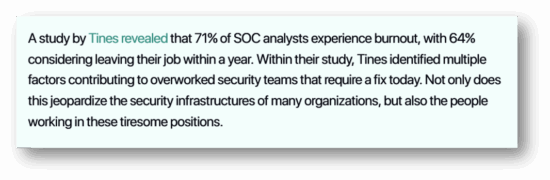
Enter AI SOC Analysts. An AI SOC Analyst platform does all the “dirty work” of triaging alerts and investigating potential incidents. It can even run remediations when there’s high confidence true positive alert.
This reduces the manual workload, leaving humans to review the AI’s findings, hunt for hidden threats that detections miss, and focus on incident response.
The intersection of human and AI-based SOC marks a turning point for the marketplace. But as more vendors step into this niche, it can be hard to tell which offering is best.
This blog helps you parse out the difference.
1. Prophet Security (Best Overall)
Prophet Security, an AI-native SOC platform, deploys an “Agentic AI SOC Analyst” to eliminate the manual tedium of alert triage and investigations. It runs entirely on agentic AI capabilities, mitigating the need for constant human prompts.
Strengths:
- Autonomous Reasoning: Automatically runs investigations by correlating evidence, reconstructing timelines, and prioritizing severe threats.
- Full-Stack Integration: Ingests security alerts and contextual information from across a range of solutions: SIEM, EDR, identity tools, and cloud.
- Privacy-First Approach: Customer data is never used to train LLMs. Additionally, it offers a single-architecture deployment model for maximum data separation and control.
- 10x Faster Response Times: Mean time to response (MTTR) is reduced by up to 10X while leaving an audit trail of explainable, recordable actions.
Limitations:
- Prophet AI SOC Analyst may not be immediately supported across all niche ecosystems. However, the company states that “for highly customized environments, new integrations are added quickly based on customer demand and use case priority.”
2. Microsoft Security Copilot
Microsoft Security Copilot recently introduced agentic capabilities into a prompt-only AI copilot tool. Chat-based Copilots augment analyst workflows with a question-and-answer style user interface that speeds up security investigations of high-volume tasks like identity protection, phishing response, and vulnerability remediation.
Strengths:
- Strong Microsoft Integration: Integrates deeply across the Microsoft ecosystem: Defender, Sentinel, Purview, and more.
- Expanding Agentic Abilities: The number of agentic tasks it can perform is currently increasing.
- Compliance Prioritization: Dedicated to strong privacy and compliance commitments.
Limitations:
- Microsoft Security Copilot is rooted in a chat-based, prompt-style framework, with limited case studies around its agentic AI capabilities.
- This tool is limited to the Microsoft ecosystem, raising concerns about vendor lock-in.
3. Palo Alto Networks Cortex XSIAM
Palo Alto Networks XSIAM features an intuitive human-AI interaction approach. Users can prompt it in natural language, making it easy to harness its AI automation capabilities.
Strengths:
- Seamless Palo Alto Integration: Integrates effortlessly with Palo Alto EDR and firewalls for a unified security ecosystem.
- Agentic Abilities in Development: AgentiX will soon be added to Copilot to expand the agentic abilities of the platform.
- AI/ML Cloud Visibility (Beta): Visibility into AI-specific threats in the cloud is in beta, with new detectors to analyze AWS, Azure and GCP cloud audit logs.
Limitations:
- Palo Alto XSIAM struggles to ingest logs from third parties such as cloud services and SaaS applications, leaving potential gaps in visibility.
- Primarily a prompt-based, copilot-style AI tool with agentic AI available for early access.
4. Google SecOps (Formerly known as Google Chronicle)
Google SecOps (formerly known as Google Chronicle) is an AI-powered AI SOC Analyst platform built as a specialized layer over Google infrastructure. It gives analysts the tools they need to analyze and respond to threats when they arise.
Strengths:
- Raw Log Scan: SOC analysts can use regular expressions to search raw unparsed logs.
- Universal Data Model: Data is normalized based on the Universal Data Model (UDM).
- Strong in Cloud and Hybrid Environments: SecOps is designed to thrive in cloud and hybrid environments, aggregating data from Google Cloud, private data centers, other cloud platforms, and more.
Limitations:
- Dependence on Google Cloud Platform-only deployment architecture limits performance in multi-cloud environments.
- Difficult to plug-and-play; an advanced solution with significant configuration and customization needs.
- Agentic AI agents still in development.
5. Purple AI (SentinelOne)
SentinelOne’s Purple AI, powered by agentic “Athena”, leverages its Singularity Hyperautomation platform to pull data from third-party security tools and provide deep security reasoning at machine speed.
Strengths:
- Strong Integration Capabilities: Purple AI supports third-party and data source agnostic integration.
- Natural Language Compatible: Responds to natural language queries in several languages.
- Standardized Data Structure: Leverages OCSF-normalized data at ingest to facilitate access to instant querying across native and third-party sources.
Limitations:
- Purple AI works best when paired with SentinelOne’s native tools.
- Uses a community score of similar alerts to determine false positives rather than native reasoning.
- Agentic AI capabilities are still maturing compared to other AI SOC Analyst platforms.
6. IBM (QRadar + Watson)
The QRadar Advisor with Watson analysis leverages IBM Cognitive Artificial Intelligence to assist users with risk analysis, triage, and response. This AI SOC tool supports multitenant investigations and integrates smoothly with other IBM applications.
Strengths:
- Cognitive Computing: IBM Watson uses Natural Language Processing (NLP) and machine learning to analyze and draw conclusions from various data types; text, images, audio.
- X-Force Integration: Integrates with X-Force Exchange for access to a wide-ranging database of external threat information.
Limitations:
- Integrates only within IBM applications. Must configure webhooks to send QRadar Advisor with Watson analysis to external services.
- Can be costly and complex to set up for organizations.
| Company | AI Capability Type | Strengths | Limitations | Ecosystem Fit | Agentic AI Maturity |
| Prophet Security | Agentic, AI-native | – Autonomous investigations- Full-stack integration- Privacy-first- 10x faster MTTR | – Limited out-of-box support for niche ecosystems- Requires custom integrations in some cases | Broad, multi-tool environments | Fully Mature |
| Microsoft Security Copilot | Prompt-first with agents | – Deep Microsoft integration- Expanding agentic tasks- Compliance-focused | – Microsoft-only scope- Chat-based experience may hinder automation | Microsoft-centric | Growing |
| Palo Alto Cortex XSIAM | Prompt-first, agentic coming | – Integrates with Palo Alto stack- AI/ML cloud threat visibility- Natural language prompting | – Poor 3rd-party log ingestion- Agentic AI still in early access | Palo Alto environments | Early Access Phase |
| Google SecOps | AI-enhanced, in development | – Raw log search- Universal data model- Cloud and hybrid support | – GCP-dependent architecture- High complexity and customization- Agentic AI still in development | Google Cloud environments | In Development |
| Purple AI (SentinelOne) | Agentic with Hyperautomation | – Strong 3rd-party integration- Multi-language support- Normalized data structure (OCSF) | – Best with SentinelOne stack- Relies on community scores over reasoning- Agentic AI still maturing | SentinelOne-friendly, diverse | Maturing |
| IBM QRadar + Watson | Cognitive AI with NLP/ML | – Multimodal data analysis- Strong external threat data (X-Force)- Multitenancy support | – IBM-only integrations- Complex and expensive setup | IBM environments | Stable, Not Fully Agentic |
Conclusions
The AI SOC Analyst space promises to get confusing fast, but if buyers keep their eyes on a few key priorities, they can find their way through. The best approach is to find your particular pain points when it comes to meeting the threat intelligence mark.
- Are your SOCs overwhelmed?
- Do you have a diverse ecosystem that drowns your team with alerts?
- Do you need a way to clamp down on threats fast without dealing with false positives and more noise?
- What about improving the efficiency and mental well-being of your human analysts that deal with alert fatigue and burnout?
AI SOC Analyst platforms evolved as a way to fill these gaps; the one you choose will have the power to impact your security posture in trajectory-altering ways.
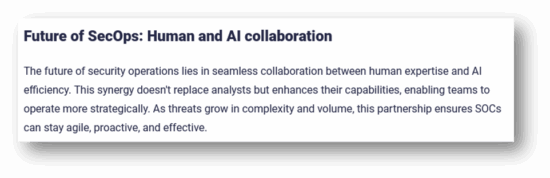
Getting clear on priorities now will not only set your course but determine what your SOC analysts are able to do – and not do – in the critical years to come.
AI SOC Platform FAQs:
1. Do AI SOC tools integrate with my current solutions?
The answer varies depending on the AI SOC tool you use. Some integrate mainly within their own ecosystem (Microsoft, Google, and IBM) while others feature strong cross-vendor and third-party support (Prophet Security, Purple AI).
2. Are AI SOC platforms black box or transparent?
Often, LLM-based tools can be black boxes, offering little insight into how analysis is performed. Look for AI SOC solutions that offer native reasoning, not community scoring, when looking for explainable inner workings.
3. Can AI SOC solutions incorporate user feedback to improve investigations?
Yes, AI SOC analyst tools can “learn” from user feedback, improving the accuracy and quality of investigations. Users can evaluate how the platforms assess alerts, prioritize threats, decipher false positives, and more. These adjustments fine-tune performance to the unique needs of each environment.
4. How well can AI SOC analyst tools identify true positives and false positives?
AI SOC platforms leverage machine learning and human-led investigations to constantly improve their ability to identify true positives and false positives. The more AI SOC solutions operate in a single environment, the more accurate their true and false positive identification will be.
5. Do AI SOC tools really reduce mean-time-to-investigate and mean-time-to-resolve?
Yes. By using AI to analyze and correlate large amounts of threat intelligence at machine speed, AI SOC solutions significantly reduce mean-time-to-investigate and mean-time-to-resolve. Machine learning drastically lowers the number of alerts on backlog and false positives for analysts to review, delivering actionable intelligence faster than humans can alone. This takes task timeframes down from days to minutes.

An ardent believer in personal data privacy and the technology behind it, Katrina Thompson is a freelance writer leaning into encryption, data privacy legislation, and the intersection of information technology and human rights. She has written for Bora, Venafi, Tripwire, and many other sites.
The opinions expressed in this post belong to the individual contributors and do not necessarily reflect the views of Information Security Buzz.