


Close Menu
  • Home
  • Articles
    • Attacks
      • BEC
      • Data Breach
      • DDoS
      • Evasion Attacks
      • Injection
      • Malware
      • MITM
      • Phishing
      • Ransomware
      • RCE
      • Social Engineering
      • Spoofing
      • Spyware
    • Business and Policy
      • BCP and DRP
      • GRC
      • Regulations
    • Data Protection
      • DLP
      • DRM
      • Encryption
      • IAM
    • Future, Trends and Insight
      • AI
      • Events & Community
      • Emerging Tech
      • Expert Panel
      • Interviews With Experts
      • Insights
      • Study & Research
    • Resources
      • Guides
      • Tools
      • Training & Education
    • Security
      • API
      • Apps
      • Cloud
      • Critical Infrastructure
      • Endpoint
      • Hardware
      • IoT
      • Mobile
      • Network
      • OT
      • Port Security
      • Security Architecture
      • Software Development
      • Supply Chain
      • Zero Trust
    • Threats and Vulnerabilities
      • Emerging Threats
      • Insider Threats
      • Risk Management
      • Threat Intelligence
      • Zero Day
  • News and Exclusives
    • Latest News
    • ISB Exclusive
    • Positive News
  • Who We Are
    • About Us
    • Information Security Buzz Expert Panel​
    • Write for Us
    • Media Pack
  • Contact Us
  • Newsletter
Facebook X (Twitter) LinkedIn
Information Security BuzzInformation Security Buzz
  • Home
  • Articles
    • Attacks
      • BEC
      • Data Breach
      • DDoS
      • Evasion Attacks
      • Injection
      • Malware
      • MITM
      • Phishing
      • Ransomware
      • RCE
      • Social Engineering
      • Spoofing
      • Spyware
    • Business and Policy
      • BCP and DRP
      • GRC
      • Regulations
    • Data Protection
      • DLP
      • DRM
      • Encryption
      • IAM
    • Future, Trends and Insight
      • AI
      • Events & Community
      • Emerging Tech
      • Expert Panel
      • Interviews With Experts
      • Insights
      • Study & Research
    • Resources
      • Guides
      • Tools
      • Training & Education
    • Security
      • API
      • Apps
      • Cloud
      • Critical Infrastructure
      • Endpoint
      • Hardware
      • IoT
      • Mobile
      • Network
      • OT
      • Port Security
      • Security Architecture
      • Software Development
      • Supply Chain
      • Zero Trust
    • Threats and Vulnerabilities
      • Emerging Threats
      • Insider Threats
      • Risk Management
      • Threat Intelligence
      • Zero Day
  • News and Exclusives
    • Latest News
    • ISB Exclusive
    • Positive News
  • Who We Are
    • About Us
    • Information Security Buzz Expert Panel​
    • Write for Us
    • Media Pack
  • Contact Us
  • Newsletter
Subscribe
Information Security BuzzInformation Security Buzz
Home - Articles - Nasty Adware Hiding In Apps On Google Play Store
Articles

Nasty Adware Hiding In Apps On Google Play Store

ISBuzz TeamBy ISBuzz TeamMarch 28, 2017Updated:July 4, 20247 Mins Read
Share LinkedIn Twitter Facebook Copy Link Email
Goldoson Malware Hits 100 Million Downloads On Google Play Store
Share
Facebook Twitter LinkedIn Email Copy Link
Quick AI Summary
ChatGPTClaudeGeminiGrokPerplexityDeepSeekCopilot

The adware would like to be your device administrator if you let it

In our ongoing hunt for malicious apps on Google Play Store, we have come across more than a dozen apps that we have confirmed to be aggressive adware strains, with the ability to add themselves as device administrator on a victim’s mobile device.

After a primary analysis of these apps, we confirmed that they do not have any features that require critical device administration privileges. A common theme among all these apps is that they do not display any suspicious activity for the first six hours after installation. This may be an attempt to evade Googles Bouncer. (Bouncer is Google’s antivirus system, which executes an app for few minutes and analyses its behavior before publishing the app on Play Store.)

Four out of the 12 apps that were reported for this suspicious activity have been downloaded between 10,000 and 50,000 times:
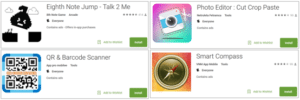
12 App 1
                            Figure 1: Apps with 10,000 to 50,000 downloads

Device admin privileges

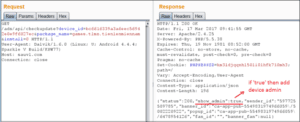
Upon successful installation, these apps will communicate with a preconfigured Command & Control (C&C) server and act in accordance with C&C directions.
Device 2
                                Figure 2: C&C server communication

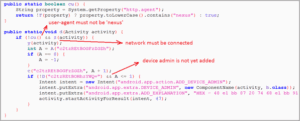
 If the response contains the “show_admin” parameter to be “true,” the following code is executed, which asks the user for admin privileges.
Show Admin 3
                             Figure 3: Code to add device administrator

Observation

We continued our analysis on apps that were removed as well as those that were still live on Play Store, sharing the same piece of code, and observed that the majority of the live apps were receiving “show_admin” as “false,” whereas the removed apps were receiving a value of “true.” Although it’s just a matter of time when the C&C server may respond with “true,” causing all these apps to prompt for device admin privileges.

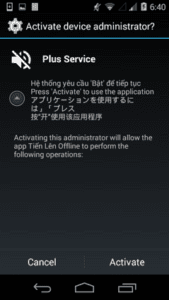
Here’s what the device admin prompt looks like:
Observation 4
  Figure 4: Device admin prompt

Advertisement activitiesAs seen in Figure 4, the activation message is displayed to the user in four languages: Vietnamese, English, Japanese, and Chinese. Once the user grants device admin privileges to the app, the app cannot be uninstalled until the user withdraws admin privileges for this app.

The C&C server will send commands instructing the app to perform different advertisement activities on the device. The type of activity we have seen from these apps during our analysis include:

  • Full screen ads
  • Open a link in mobile browser
  • Launch a YouTube video
  • Launch an already installed app on the phone
  • Create a new shortcut on the home screen for a given URL

 Code piracy

Most of the apps in this report are examples of source code piracy. The app with the package name com.ndk.taskkiller, for example, is a pirated version of com.batterysaver.taskkiller. (Note that com.batterysaver.taskkiller was not found to be malicious.)
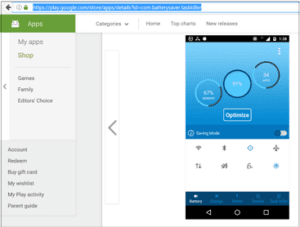
Code Piracy 5
                                            Figure 5: Original app


The package called com.ndk.taskkiller shown below not only uses the same code as the original app, from which it was pirated, but also has the same appearance.
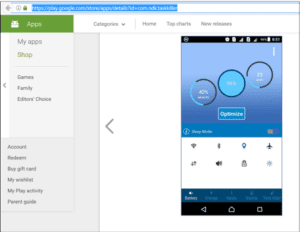
Package 6
                                           Figure 6: Pirated app

Injected code

The pirated app has injected a new package named “logs” into the copied source code.

Injected code 7
    Figure 7: Difference in packages between       original and pirated app

Analysis of injected code

The location of injected code is interesting. The com.google.android.gms package is Android’s genuine package for Google Mobile Services (GMS). A complete list of Google GMS packages can be found here. In this case, a package named “logs” is injected inside the GMS packages to evade detection.

All the strings in the code were obfuscated, which makes them difficult to understand. The encryption technique leveraged here is trivial but served its purpose. After decrypting all the strings, the de-obfuscated code revealed the secrets hidden within, as shown in Figure 9.
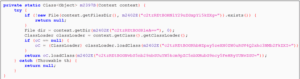
Figure 8
                                    Figure 8: Obfuscated code
Analysis 9
                            Figure 9: De-obfuscated code

It is clear from the de-obfuscated code that the app is trying to load another dex (secondlib.dex) file dynamically. But where does this secondary dex come from? As we analysed the app’s network traffic, we confirmed that this dex file was being downloaded at runtime.
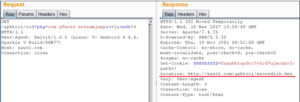
Figure 10
                        Figure 10: Downloading secondlib.dex

One of this app’s more interesting features is its ability to hide and unhide its icon based on the C&C server instructions. To avoid user suspicion, the app does not hide its icon as soon as the user opens the app for the first time — a common behavior in most malware families. The app’s icon is only hidden if the app is not used for five days. In most cases, if an average user does not open an app for five days, after which the app icon is concealed, the user will probably have no idea where those annoying ads are coming from and is unlikely to suspect the now-hidden app.The secondlib.dex file has code that, when executed, plays a particular YouTube video. This function would generate revenue for the video uploader by increasing its number of views. It’s notable that this dex file is not embedded in the original app, but is downloaded at runtime. This means that the app developer can change the code of secondlib.dex at any time and it will be executed on the user’s device without requiring the user to update the app.
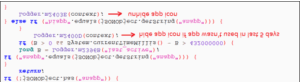
Figure 11
                                       Figure 11: Code to hide app icon

Spreading

Although we haven’t observed any phishing or spam attempts to deliver these apps, we found an interesting way by which one of the apps is advertising itself outside the Google Play Store through a YouTube gameplay video for the “Eighth Note Jump” game. The uploader has added a download link in the discription of the video that points to the app “Eighth Note Jump – Talk 2 Me” on Play Store, which is one of the 12 malicious apps that we found.
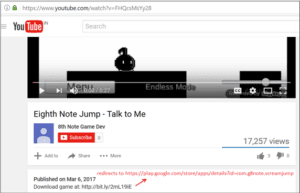
Figure 12
          Figure 12: YouTube video promoting an app with the adware

Full list of malicious package names found on Google Play Store

com.barcodescannertvc.vnm
com.fastchargertie.vnm
com.g8note.screamjump
com.lichviet.lichvannien.lichamduong
com.photoeditor.cutphoto.pastephotos
com.qrbarcodescanneranh.vn
com.qrbarcodescanneroeh.vnm
com.qrbarcodescannertva.vnm
com.qrcodereader.htr.hcm
com.smartcompassproto.vnm
com.smartcompasstvc.vnm
game.danhbaidoithe.winday

 Conclusion:

Despite the precautionary measures taken by Google, malware developers are finding new ways to upload their apps on Google Play Store. More and more malware strains – and now adware – are becoming sophisticated and more adept at staying under the radar.

Zscaler ThreatlabZ reported these apps to Google’s Android security team on Mar 20, 2017, and the apps have been taken down from Play Store as of Mar 22, 2017.

ThreatLabZ continuously monitors and blocks threats, such as those that use hidden code to communicate to C&C servers, to protect Zscaler customers.

ISBuzz Team
  • ISBuzz Team
    Air Canada Data Breach: BianLian Extortion Group Claims A Massive Heist Contrary To Airline’s Earlier Statement
  • ISBuzz Team
    Unprecedented DDoS Attack Rocks The Web: Tech Giants Reveal A Digital Tsunami
  • ISBuzz Team
    CISA Flags High-Severity Adobe Acrobat Reader Flaw Amid Active Exploits
  • ISBuzz Team
    Curl Security Alert: Patching A Critical Bug Averting Potential Cyber Catastrophe

The opinions expressed in this post belong to the individual contributors and do not necessarily reflect the views of Information Security Buzz.

Share. Facebook Twitter LinkedIn Email Copy Link

Related Posts

Visual data is the blind spot in enterprise security: that’s about to change

May 4, 20267 Mins Read

Making stolen data worthless: why security must start with the data

March 30, 20265 Mins Read

Meta’s Smart Glasses Privacy Scandal Expands After Sama Credentials Found on the Dark Web

March 10, 20264 Mins Read
ISB-Bora-Side-Bar

No se ha podido establecer conexión. Error 429

 
ISB-Bora-Side-Bar
Black ISB Logo

Information Security Buzz is an independent resource that provides the experts’ comments, analysis, and opinion on the latest Cybersecurity news and topics

X (Twitter) LinkedIn Facebook RSS

Working With Us

  • About Us
  • Advertise With Us
  • Contact Us

Write For Us

  • How To Contribute

The Pages

  • Privacy Policy
  • Cookie Policy
  • AI Policy
  • Terms & Conditions
  • Copyright Notice

Information Security Buzz and all its contents are copyright © 2014-2025. All rights reserved. All third-party trademarks are recognized.

Type above and press Enter to search. Press Esc to cancel.

Manage Consent
To provide the best experiences, we use technologies like cookies to store and/or access device information. Consenting to these technologies will allow us to process data such as browsing behavior or unique IDs on this site. Not consenting or withdrawing consent, may adversely affect certain features and functions.
Functional Always active
The technical storage or access is strictly necessary for the legitimate purpose of enabling the use of a specific service explicitly requested by the subscriber or user, or for the sole purpose of carrying out the transmission of a communication over an electronic communications network.
Preferences
The technical storage or access is necessary for the legitimate purpose of storing preferences that are not requested by the subscriber or user.
Statistics
The technical storage or access that is used exclusively for statistical purposes. The technical storage or access that is used exclusively for anonymous statistical purposes. Without a subpoena, voluntary compliance on the part of your Internet Service Provider, or additional records from a third party, information stored or retrieved for this purpose alone cannot usually be used to identify you.
Marketing
The technical storage or access is required to create user profiles to send advertising, or to track the user on a website or across several websites for similar marketing purposes.
  • Manage options
  • Manage services
  • Manage {vendor_count} vendors
  • Read more about these purposes
View preferences
  • {title}
  • {title}
  • {title}