


Close Menu
  • Home
  • Articles
    • Attacks
      • BEC
      • Data Breach
      • DDoS
      • Evasion Attacks
      • Injection
      • Malware
      • MITM
      • Phishing
      • Ransomware
      • RCE
      • Social Engineering
      • Spoofing
      • Spyware
    • Business and Policy
      • BCP and DRP
      • GRC
      • Regulations
    • Data Protection
      • DLP
      • DRM
      • Encryption
      • IAM
    • Future, Trends and Insight
      • AI
      • Events & Community
      • Emerging Tech
      • Expert Panel
      • Interviews With Experts
      • Insights
      • Study & Research
    • Resources
      • Guides
      • Tools
      • Training & Education
    • Security
      • API
      • Apps
      • Cloud
      • Critical Infrastructure
      • Endpoint
      • Hardware
      • IoT
      • Mobile
      • Network
      • OT
      • Port Security
      • Security Architecture
      • Software Development
      • Supply Chain
      • Zero Trust
    • Threats and Vulnerabilities
      • Emerging Threats
      • Insider Threats
      • Risk Management
      • Threat Intelligence
      • Zero Day
  • News and Exclusives
    • Latest News
    • ISB Exclusive
    • Positive News
  • Who We Are
    • About Us
    • Information Security Buzz Expert Panel​
    • Write for Us
    • Media Pack
  • Contact Us
  • Newsletter
Facebook X (Twitter) LinkedIn
Information Security BuzzInformation Security Buzz
  • Home
  • Articles
    • Attacks
      • BEC
      • Data Breach
      • DDoS
      • Evasion Attacks
      • Injection
      • Malware
      • MITM
      • Phishing
      • Ransomware
      • RCE
      • Social Engineering
      • Spoofing
      • Spyware
    • Business and Policy
      • BCP and DRP
      • GRC
      • Regulations
    • Data Protection
      • DLP
      • DRM
      • Encryption
      • IAM
    • Future, Trends and Insight
      • AI
      • Events & Community
      • Emerging Tech
      • Expert Panel
      • Interviews With Experts
      • Insights
      • Study & Research
    • Resources
      • Guides
      • Tools
      • Training & Education
    • Security
      • API
      • Apps
      • Cloud
      • Critical Infrastructure
      • Endpoint
      • Hardware
      • IoT
      • Mobile
      • Network
      • OT
      • Port Security
      • Security Architecture
      • Software Development
      • Supply Chain
      • Zero Trust
    • Threats and Vulnerabilities
      • Emerging Threats
      • Insider Threats
      • Risk Management
      • Threat Intelligence
      • Zero Day
  • News and Exclusives
    • Latest News
    • ISB Exclusive
    • Positive News
  • Who We Are
    • About Us
    • Information Security Buzz Expert Panel​
    • Write for Us
    • Media Pack
  • Contact Us
  • Newsletter
Subscribe
Information Security BuzzInformation Security Buzz
Home - News & Analysis - DoubleLocker: Innovative Android Malware With A Cunning Infection Vector
News & Analysis

DoubleLocker: Innovative Android Malware With A Cunning Infection Vector

ISBuzz TeamBy ISBuzz TeamOctober 13, 20174 Mins Read
Share LinkedIn Twitter Facebook Copy Link Email
Malicious Android App
Share
Facebook Twitter LinkedIn Email Copy Link
Quick AI Summary
ChatGPTClaudeGeminiGrokPerplexityDeepSeekCopilot

ESET researchers have spotted the first-ever ransomware misusing Android accessibility services. On top of encrypting data, the ransomware also locks the device.

Detected by ESET products as Android/DoubleLocker, it is based on the foundations of a particular banking Trojan, renowned for misusing accessibility services of the Android operating system. However, DoubleLocker lacks the functions related to harvesting users’ banking credentials and wiping out their accounts. Instead, it has two other powerful tools for extorting money from its victims.

DoubleLocker can change the device’s PIN, preventing victims from accessing their devices, and also encrypts the data it finds in it – a combination that has not been seen to date in the Android ecosystem.

“Given its banking malware roots, DoubleLocker may well be turned into what can be called ransom-bankers. Two-stage malware that first tries to wipe your bank or PayPal account and subsequently locks your device and data to request a ransom… Speculation aside, we spotted a test version of such a ransom-banker in the wild as long ago as May, 2017,” comments Lukáš Štefanko, the ESET malware researcher who discovered DoubleLocker.

Distribution

DoubleLocker spreads in the very same way as its banking parent does. It is distributed mostly as a fake Adobe Flash Player through compromised websites.

Once launched, the app requests activation of the malware’s accessibility service, named “Google Play Service”. After the malware obtains the accessibility permissions, it uses them to activate device administrator rights and set itself as the default Home application, in both cases without the user’s consent.

“Setting itself as a default home app – a launcher – is a trick that improves the malware’s persistence. Whenever the user clicks on the Home button, the ransomware gets activated and the device gets locked again. Thanks to using the accessibility service, the user doesn’t know that they launched malware by hitting Home,” explains Lukáš Štefanko.

Locking both device and data

DoubleLocker, once executed on the device, creates two reasons for the victims to pay.

First, it changes the device’s PIN, effectively blocking the victim from using it.  The new PIN is set to a random value which is neither stored on the device nor sent anywhere, so it’s impossible for the user or a security expert to recover it. After the ransom is paid, the attacker can remotely reset the PIN and unlock the device.

Second, DoubleLocker encrypts all files from the device’s primary storage directory. It utilizes the AES encryption algorithm, appending the filename extension “.cryeye”.

The ransom has been set to 0.0130 BTC (approximately USD 54 at time of writing) and the message highlights that it must be paid within 24 hours. However, if the ransom is not paid, the data will remain encrypted and will not be deleted.
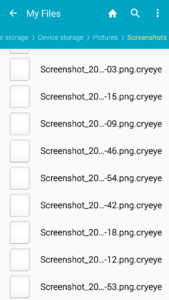
Figure 1: Encrypted files on a device infected with DoubleLocker
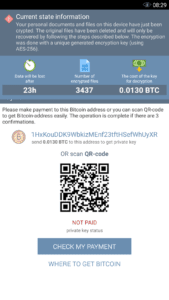
Figure 2: DoubleLocker ransom message

How to get rid of it?

In the ransom note, the user is warned against removing or otherwise blocking DoubleLocker: “Without [the software], you will never be able to get your original files back”. To prevent unwanted removal of the “software”, the crooks even recommend disabling the user’s antivirus software.

“Such advice is irrelevant: all those with a quality security solution installed on their devices are safe from DoubleLocker,” comments Lukáš Štefanko.

For users who want to have their device cleaned of the DoubleLocker ransomware, Lukáš Štefanko recommends the following:

For devices that are not rooted and that don’t have a mobile device management solution installed capable of resetting the PIN, the only way to remove the PIN lock screen is via a factory reset.

If the device is rooted then the user can connect to the device by ADB and remove the file where the PIN is stored. For this to work, the device needs to have debugging enabled (Settings -> Developer options -> USB Debugging).

The PIN or password lock screen will be removed and the user can access the device. Then, working in safe mode, the user can deactivate device administrator rights for the malware and uninstall it. In some cases, a device reboot is needed.

“DoubleLocker serves as just another reason for mobile users to have a quality security solution installed, and to backup their data on a regular basis,” concludes Lukáš Štefanko.

ISBuzz Team
  • ISBuzz Team
    Air Canada Data Breach: BianLian Extortion Group Claims A Massive Heist Contrary To Airline’s Earlier Statement
  • ISBuzz Team
    Unprecedented DDoS Attack Rocks The Web: Tech Giants Reveal A Digital Tsunami
  • ISBuzz Team
    CISA Flags High-Severity Adobe Acrobat Reader Flaw Amid Active Exploits
  • ISBuzz Team
    Curl Security Alert: Patching A Critical Bug Averting Potential Cyber Catastrophe

The opinions expressed in this post belong to the individual contributors and do not necessarily reflect the views of Information Security Buzz.

Share. Facebook Twitter LinkedIn Email Copy Link

Related Posts

Visual data is the blind spot in enterprise security: that’s about to change

May 4, 20267 Mins Read

Making stolen data worthless: why security must start with the data

March 30, 20265 Mins Read

Meta’s Smart Glasses Privacy Scandal Expands After Sama Credentials Found on the Dark Web

March 10, 20264 Mins Read
ISB-Bora-Side-Bar

No se ha podido establecer conexión. Error 429

 
ISB-Bora-Side-Bar
Black ISB Logo

Information Security Buzz is an independent resource that provides the experts’ comments, analysis, and opinion on the latest Cybersecurity news and topics

X (Twitter) LinkedIn Facebook RSS

Working With Us

  • About Us
  • Advertise With Us
  • Contact Us

Write For Us

  • How To Contribute

The Pages

  • Privacy Policy
  • Cookie Policy
  • AI Policy
  • Terms & Conditions
  • Copyright Notice

Information Security Buzz and all its contents are copyright © 2014-2025. All rights reserved. All third-party trademarks are recognized.

Type above and press Enter to search. Press Esc to cancel.

Manage Consent
To provide the best experiences, we use technologies like cookies to store and/or access device information. Consenting to these technologies will allow us to process data such as browsing behavior or unique IDs on this site. Not consenting or withdrawing consent, may adversely affect certain features and functions.
Functional Always active
The technical storage or access is strictly necessary for the legitimate purpose of enabling the use of a specific service explicitly requested by the subscriber or user, or for the sole purpose of carrying out the transmission of a communication over an electronic communications network.
Preferences
The technical storage or access is necessary for the legitimate purpose of storing preferences that are not requested by the subscriber or user.
Statistics
The technical storage or access that is used exclusively for statistical purposes. The technical storage or access that is used exclusively for anonymous statistical purposes. Without a subpoena, voluntary compliance on the part of your Internet Service Provider, or additional records from a third party, information stored or retrieved for this purpose alone cannot usually be used to identify you.
Marketing
The technical storage or access is required to create user profiles to send advertising, or to track the user on a website or across several websites for similar marketing purposes.
  • Manage options
  • Manage services
  • Manage {vendor_count} vendors
  • Read more about these purposes
View preferences
  • {title}
  • {title}
  • {title}