


Close Menu
  • Home
  • Articles
    • Attacks
      • BEC
      • Data Breach
      • DDoS
      • Evasion Attacks
      • Injection
      • Malware
      • MITM
      • Phishing
      • Ransomware
      • RCE
      • Social Engineering
      • Spoofing
      • Spyware
    • Business and Policy
      • BCP and DRP
      • GRC
      • Regulations
    • Data Protection
      • DLP
      • DRM
      • Encryption
      • IAM
    • Future, Trends and Insight
      • AI
      • Events & Community
      • Emerging Tech
      • Expert Panel
      • Interviews With Experts
      • Insights
      • Study & Research
    • Resources
      • Guides
      • Tools
      • Training & Education
    • Security
      • API
      • Apps
      • Cloud
      • Critical Infrastructure
      • Endpoint
      • Hardware
      • IoT
      • Mobile
      • Network
      • OT
      • Port Security
      • Security Architecture
      • Software Development
      • Supply Chain
      • Zero Trust
    • Threats and Vulnerabilities
      • Emerging Threats
      • Insider Threats
      • Risk Management
      • Threat Intelligence
      • Zero Day
  • News and Exclusives
    • Latest News
    • ISB Exclusive
    • Positive News
  • Who We Are
    • About Us
    • Information Security Buzz Expert Panel​
    • Write for Us
    • Media Pack
  • Contact Us
  • Newsletter
Facebook X (Twitter) LinkedIn
Information Security BuzzInformation Security Buzz
  • Home
  • Articles
    • Attacks
      • BEC
      • Data Breach
      • DDoS
      • Evasion Attacks
      • Injection
      • Malware
      • MITM
      • Phishing
      • Ransomware
      • RCE
      • Social Engineering
      • Spoofing
      • Spyware
    • Business and Policy
      • BCP and DRP
      • GRC
      • Regulations
    • Data Protection
      • DLP
      • DRM
      • Encryption
      • IAM
    • Future, Trends and Insight
      • AI
      • Events & Community
      • Emerging Tech
      • Expert Panel
      • Interviews With Experts
      • Insights
      • Study & Research
    • Resources
      • Guides
      • Tools
      • Training & Education
    • Security
      • API
      • Apps
      • Cloud
      • Critical Infrastructure
      • Endpoint
      • Hardware
      • IoT
      • Mobile
      • Network
      • OT
      • Port Security
      • Security Architecture
      • Software Development
      • Supply Chain
      • Zero Trust
    • Threats and Vulnerabilities
      • Emerging Threats
      • Insider Threats
      • Risk Management
      • Threat Intelligence
      • Zero Day
  • News and Exclusives
    • Latest News
    • ISB Exclusive
    • Positive News
  • Who We Are
    • About Us
    • Information Security Buzz Expert Panel​
    • Write for Us
    • Media Pack
  • Contact Us
  • Newsletter
Subscribe
Information Security BuzzInformation Security Buzz
Home - News & Analysis - ESET Research: Appearances Are Deceiving With Turla’s Backdoor-Laced Flash Player Installer
News & Analysis

ESET Research: Appearances Are Deceiving With Turla’s Backdoor-Laced Flash Player Installer

ISBuzz TeamBy ISBuzz TeamJanuary 10, 20184 Mins Read
Share LinkedIn Twitter Facebook Copy Link Email
Share
Facebook Twitter LinkedIn Email Copy Link
Quick AI Summary
ChatGPTClaudeGeminiGrokPerplexityDeepSeekCopilot

As ever: With Turla, nothing is quite what it seems.

ESET researchers have found that Turla, the notorious state-sponsored cyberespionage group, has added a fresh weapon to its arsenal that is being used in new campaigns targeting embassies and consulates in the post-Soviet states. This new tool attempts to dupe victims into installing malware that is ultimately aimed at siphoning off sensitive information from Turla’s targets.

The group has long used social engineering to lure unsuspecting targets into executing faux Adobe Flash Player installers. However, it doesn’t rest on its laurels and continues to innovate, as shown by recent ESET research.

Not only does the gang now bundle its backdoors together with a legitimate Flash Player installer but, compounding things further, it ensures that URLs and the IP addresses it uses appear to correspond to Adobe’s legitimate infrastructure. In other words, the victims are made to believe that the only thing that they are downloading is authentic software from adobe.com. However, nothing could be further from the truth.

The campaigns, which have been leveraging the new tool since at least July 2016, bear several hallmarks associated with the group, including Mosquito, a backdoor believed to be the group’s creation, and the use of IP addresses previously linked with the group. The new malicious tool also shares similarities with other malware families spread by the group.

Attack vectors

ESET researchers have come up with several hypotheses (shown in Figure 1) for how Turla-related malware can make it onto a victim’s computer via the new method of compromise. Before we proceed, however, it should be noted that Turla’s malware is not known to have tainted any legitimate Flash Player updates, nor is it associated with any known Adobe product vulnerabilities.
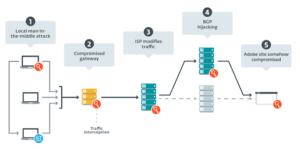
Figure 1: Possible interception points on the path between the potential victim’s machine and the Adobe servers.

The possible attack vectors ESET researchers considered are:

  • A machine within the network of the victim’s organization could be hijacked so that it acts as a springboard for a local Man-in-the-Middle (MitM) attack. This would effectively involve on-the-fly redirection of the traffic of the targeted machine to a compromised machine on the local network.
  • The attackers could also compromise the network gateway of an organization, enabling them to intercept all the incoming and outgoing traffic between that organization’s intranet and the internet.
  • The traffic interception could also occur at the level of internet service providers (ISPs), a tactic that – as evidenced by recent ESET research into surveillance campaigns deploying FinFisher spyware– is not unheard of. All the known victims are located in different countries, and we identified them using at least four different ISPs.
  • The attackers could have used a Border Gateway Protocol (BGP) hijack to re-route the traffic to a server controlled by Turla, although this tactic would probably rather quickly set off alarm bells with Adobe or BGP monitoring services.

Once the fake Flash installer is downloaded and launched, one of several backdoors is dropped. It could be Mosquito, which is a piece of Win32 malware, a malicious JavaScript file communicating with a web app hosted on Google Apps Script, or an unknown file downloaded from a bogus and non-existent Adobe URL.

The stage is then set for the mission’s main goal – exfiltration of sensitive data. This information includes the unique ID of the compromised machine, the username, and the list of security products installed on the device. ‘Only’ the username and device name are exfiltrated by Turla’s backdoor Snake on macOS.

At the final stage of the process, the fake installer drops – or downloads – and then runs a legitimate Flash Player application. The latter’s installer is either embedded in its fake counterpart or is downloaded from a Google Drive web address.

Mosquito and JavaScript backdoors

ESET researchers have seen in the wild, new samples of the backdoor known as Mosquito. The more recent iterations are more heavily obfuscated with what appears to be a custom crypter, to make analysis more difficult both for malware researchers and for security software’s code.

In order to establish persistence on the system, the installer tampers with the operating system’s registry. It also creates an administrative account that allows remote access.

The main backdoor CommanderDLL has the .pdb extension. It uses a custom encryption algorithm and can execute certain predefined actions. The backdoor keeps track of everything it does on the compromised machine in an encrypted log file.

Turla has been operating for a number of years and its activities have been monitored and analyzed by ESET research laboratories. Last year, the analysts released pieces covering new versions of another Turla backdoor called Carbon, watering hole campaigns misusing a Firefox browser extension and, most recently, a backdoor called Gazer.

ESET’s latest findings about Turla are available in this white paper.

ISBuzz Team
  • ISBuzz Team
    Air Canada Data Breach: BianLian Extortion Group Claims A Massive Heist Contrary To Airline’s Earlier Statement
  • ISBuzz Team
    Unprecedented DDoS Attack Rocks The Web: Tech Giants Reveal A Digital Tsunami
  • ISBuzz Team
    CISA Flags High-Severity Adobe Acrobat Reader Flaw Amid Active Exploits
  • ISBuzz Team
    Curl Security Alert: Patching A Critical Bug Averting Potential Cyber Catastrophe

The opinions expressed in this post belong to the individual contributors and do not necessarily reflect the views of Information Security Buzz.

Share. Facebook Twitter LinkedIn Email Copy Link

Related Posts

Visual data is the blind spot in enterprise security: that’s about to change

May 4, 20267 Mins Read

Making stolen data worthless: why security must start with the data

March 30, 20265 Mins Read

Meta’s Smart Glasses Privacy Scandal Expands After Sama Credentials Found on the Dark Web

March 10, 20264 Mins Read
ISB-Bora-Side-Bar

No se ha podido establecer conexión. Error 429

 
ISB-Bora-Side-Bar
Black ISB Logo

Information Security Buzz is an independent resource that provides the experts’ comments, analysis, and opinion on the latest Cybersecurity news and topics

X (Twitter) LinkedIn Facebook RSS

Working With Us

  • About Us
  • Advertise With Us
  • Contact Us

Write For Us

  • How To Contribute

The Pages

  • Privacy Policy
  • Cookie Policy
  • AI Policy
  • Terms & Conditions
  • Copyright Notice

Information Security Buzz and all its contents are copyright © 2014-2025. All rights reserved. All third-party trademarks are recognized.

Type above and press Enter to search. Press Esc to cancel.

Manage Consent
To provide the best experiences, we use technologies like cookies to store and/or access device information. Consenting to these technologies will allow us to process data such as browsing behavior or unique IDs on this site. Not consenting or withdrawing consent, may adversely affect certain features and functions.
Functional Always active
The technical storage or access is strictly necessary for the legitimate purpose of enabling the use of a specific service explicitly requested by the subscriber or user, or for the sole purpose of carrying out the transmission of a communication over an electronic communications network.
Preferences
The technical storage or access is necessary for the legitimate purpose of storing preferences that are not requested by the subscriber or user.
Statistics
The technical storage or access that is used exclusively for statistical purposes. The technical storage or access that is used exclusively for anonymous statistical purposes. Without a subpoena, voluntary compliance on the part of your Internet Service Provider, or additional records from a third party, information stored or retrieved for this purpose alone cannot usually be used to identify you.
Marketing
The technical storage or access is required to create user profiles to send advertising, or to track the user on a website or across several websites for similar marketing purposes.
  • Manage options
  • Manage services
  • Manage {vendor_count} vendors
  • Read more about these purposes
View preferences
  • {title}
  • {title}
  • {title}