

Close Menu
  • Home
  • Articles
    • Attacks
      • BEC
      • Data Breach
      • DDoS
      • Evasion Attacks
      • Injection
      • Malware
      • MITM
      • Phishing
      • Ransomware
      • RCE
      • Social Engineering
      • Spoofing
      • Spyware
    • Business and Policy
      • BCP and DRP
      • GRC
      • Regulations
    • Data Protection
      • DLP
      • DRM
      • Encryption
      • IAM
    • Future, Trends and Insight
      • AI
      • Events & Community
      • Emerging Tech
      • Expert Panel
      • Interviews With Experts
      • Insights
      • Study & Research
    • Resources
      • Guides
      • Tools
      • Training & Education
    • Security
      • API
      • Apps
      • Cloud
      • Critical Infrastructure
      • Endpoint
      • Hardware
      • IoT
      • Mobile
      • Network
      • OT
      • Port Security
      • Security Architecture
      • Software Development
      • Supply Chain
      • Zero Trust
    • Threats and Vulnerabilities
      • Emerging Threats
      • Insider Threats
      • Risk Management
      • Threat Intelligence
      • Zero Day
  • News and Exclusives
    • Latest News
    • ISB Exclusive
    • Positive News
  • Who We Are
    • About Us
    • Information Security Buzz Expert Panel​
    • Write for Us
    • Media Pack
  • Contact Us
  • Newsletter
Facebook X (Twitter) LinkedIn
Information Security BuzzInformation Security Buzz
  • Home
  • Articles
    • Attacks
      • BEC
      • Data Breach
      • DDoS
      • Evasion Attacks
      • Injection
      • Malware
      • MITM
      • Phishing
      • Ransomware
      • RCE
      • Social Engineering
      • Spoofing
      • Spyware
    • Business and Policy
      • BCP and DRP
      • GRC
      • Regulations
    • Data Protection
      • DLP
      • DRM
      • Encryption
      • IAM
    • Future, Trends and Insight
      • AI
      • Events & Community
      • Emerging Tech
      • Expert Panel
      • Interviews With Experts
      • Insights
      • Study & Research
    • Resources
      • Guides
      • Tools
      • Training & Education
    • Security
      • API
      • Apps
      • Cloud
      • Critical Infrastructure
      • Endpoint
      • Hardware
      • IoT
      • Mobile
      • Network
      • OT
      • Port Security
      • Security Architecture
      • Software Development
      • Supply Chain
      • Zero Trust
    • Threats and Vulnerabilities
      • Emerging Threats
      • Insider Threats
      • Risk Management
      • Threat Intelligence
      • Zero Day
  • News and Exclusives
    • Latest News
    • ISB Exclusive
    • Positive News
  • Who We Are
    • About Us
    • Information Security Buzz Expert Panel​
    • Write for Us
    • Media Pack
  • Contact Us
  • Newsletter
Subscribe
Information Security BuzzInformation Security Buzz
Home - News & Analysis - Wannacry Is Still Alive Hitting Almost 75,000 Users In Q3 2018
News & Analysis

Wannacry Is Still Alive Hitting Almost 75,000 Users In Q3 2018

ISBuzz TeamBy ISBuzz TeamNovember 12, 20185 Mins Read
Share LinkedIn Twitter Facebook Copy Link Email
Share
Facebook Twitter LinkedIn Email Copy Link
Quick AI Summary
ChatGPTClaudeGeminiGrokPerplexityDeepSeekCopilot

One and a half years after its epidemic, WannaCry ransomware tops the list of the most widespread cryptor families and the ransomware has attacked 74,621 unique users worldwide. These attacks accounted for 28.72% of all users targeted by cryptors in Q3 2018. The percentage has risen over the last year, demonstrating more than two thirds of growth against Q3 2017, when its share in cryptor attacks was 16.78%. This is just one of the main findings from Kaspersky Lab’s Q3 IT threat evolution report.

 A series of cyberattacks with WannaCry cryptor occurred in May 2017 and is still considered to be one of the biggest ransomware epidemics in history. Even though Microsoft released a patch for its operating system to close the vulnerability exploited by EternalBlue two months prior to the start of the attacks, WannaCry still affected hundreds of thousands devices around the globe. As cryptors do, WannaCry turned files on victims’ computers into encrypted data and demanded ransom for decryption keys (created by threat actors to decipher the files and transform them back into the original data), making it impossible to operate the infected device.

The consequences of the WannaCry epidemic were devastating, as the victims were mainly organisations with networked systems – the work of businesses, factories and hospitals was paralysed. Even though this case demonstrated the dangers that cryptors pose, and most of PCs around the world have been updated to resist the EternalBlue exploit, the statistics show that criminals still try to exploit those computers that weren’t patched and there are still plenty of them around the globe.
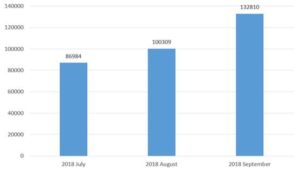
Number of unique users attacked by cryptors, Q3 2018

Overall, Kaspersky Lab security solution protected 259,867 unique users from cryptor attacks, showing a substantial rise of 39% since Q2 2018, when the figure was 158,921. The growth was rapid yet steady, with a monthly increase in the number of users.

“It is concerning to see that WannaCry attacks have grown by almost two thirds compared to the third quarter of last year. This is yet another reminder that epidemics don’t cease as rapidly as they begin – the consequences of these attacks are unavoidably long-lasting. Cyber-attacks of this type can be so severe that it’s necessary for companies to take adequate preventive measures before a cyber-criminal acts – rather than focus on recovery,” said David Emm, Principal Security Researcher at Kaspersky Lab.

Other online threat statistics from the Q3 2018 report include:

  • Kaspersky Lab solutions detected and repelled 947,027,517 malicious attacks from online resources located in around 200 countries and territories around the world (1.7% decrease against previous period)
  • 246,695,333 unique URLs were recognised as malicious by web antivirus components (29.9% decrease against previous period)
  • Attempted infections by malware that aims to steal money via online access to bank accounts were registered on 305,315 user computers (41.5% growth against previous period)
  • Kaspersky Lab’s file antivirus detected a total of 239,177,356 unique malicious and potentially unwanted objects (24.5% growth against previous period)
  • Kaspersky Lab mobile security products also detected 1,305,015 malicious installation packages (25.2% decrease against previous period)

To reduce the risk of infection by WannaCry and other cryptors, users are advised to:

  • Always update your operating system to eliminate recent vulnerabilities and use a robust security solution with updated databases. It is also important to use the security solution that has specialised technologies to protect your data from ransomware, as Kaspersky Lab’s solutions do. Even if the newest yet unknown malware does manage to sneak through, Kaspersky Lab’s System Watcher technology is able to block and roll back all malicious changes made on a device, including the encryption of files.
  • If you have bad luck and all your files are encrypted with cryptomalware, it is not recommended to pay cybercriminals, as it encourages them to continue their dirty business and infect more people’s devices. It is better to find a decryptor on the Internet – some of them are available for free here: https://noransom.kaspersky.com/
  • It is also important to always have fresh backup copies of your files to be able to replace them in case they are lost (e.g. due to malware or a broken device), and store them not only on the physical object but also in cloud storage for greater reliability (don’t forget to protect your cloud storage with strong hack-proof password!)
  • If you’re a business, enhance your preferred third-party security solution with the newest version of the free Kaspersky Anti-Ransomware Tool.
  • To protect the corporate environment, educate your employees and IT teams, keep sensitive data separate, restrict access, and always back up everything.
  • Use a dedicated security solution, such as Kaspersky Endpoint Security for Businessthat is powered by behavior detection and able to roll back malicious actions. It should also include Vulnerability and Patch management features that automatically eliminates vulnerabilities and installs updates. This reduces the risk of vulnerabilities in popular software being used by cybercriminals.
  • Last, but not least, remember that ransomware is a criminal offence. You shouldn’t pay. If you become a victim, report it to your local law enforcement agency.
ISBuzz Team
  • ISBuzz Team
    Air Canada Data Breach: BianLian Extortion Group Claims A Massive Heist Contrary To Airline’s Earlier Statement
  • ISBuzz Team
    Unprecedented DDoS Attack Rocks The Web: Tech Giants Reveal A Digital Tsunami
  • ISBuzz Team
    CISA Flags High-Severity Adobe Acrobat Reader Flaw Amid Active Exploits
  • ISBuzz Team
    Curl Security Alert: Patching A Critical Bug Averting Potential Cyber Catastrophe

The opinions expressed in this post belong to the individual contributors and do not necessarily reflect the views of Information Security Buzz.

Share. Facebook Twitter LinkedIn Email Copy Link

Related Posts

Visual data is the blind spot in enterprise security: that’s about to change

May 4, 20267 Mins Read

Making stolen data worthless: why security must start with the data

March 30, 20265 Mins Read

Meta’s Smart Glasses Privacy Scandal Expands After Sama Credentials Found on the Dark Web

March 10, 20264 Mins Read
ISB-Bora-Side-Bar

No se ha podido establecer conexión. Error 429

 
ISB-Bora-Side-Bar
Black ISB Logo

Information Security Buzz is an independent resource that provides the experts’ comments, analysis, and opinion on the latest Cybersecurity news and topics

X (Twitter) LinkedIn Facebook RSS

Working With Us

  • About Us
  • Advertise With Us
  • Contact Us

Write For Us

  • How To Contribute

The Pages

  • Privacy Policy
  • Cookie Policy
  • AI Policy
  • Terms & Conditions
  • Copyright Notice

Information Security Buzz and all its contents are copyright © 2014-2025. All rights reserved. All third-party trademarks are recognized.

Type above and press Enter to search. Press Esc to cancel.

Manage Consent
To provide the best experiences, we use technologies like cookies to store and/or access device information. Consenting to these technologies will allow us to process data such as browsing behavior or unique IDs on this site. Not consenting or withdrawing consent, may adversely affect certain features and functions.
Functional Always active
The technical storage or access is strictly necessary for the legitimate purpose of enabling the use of a specific service explicitly requested by the subscriber or user, or for the sole purpose of carrying out the transmission of a communication over an electronic communications network.
Preferences
The technical storage or access is necessary for the legitimate purpose of storing preferences that are not requested by the subscriber or user.
Statistics
The technical storage or access that is used exclusively for statistical purposes. The technical storage or access that is used exclusively for anonymous statistical purposes. Without a subpoena, voluntary compliance on the part of your Internet Service Provider, or additional records from a third party, information stored or retrieved for this purpose alone cannot usually be used to identify you.
Marketing
The technical storage or access is required to create user profiles to send advertising, or to track the user on a website or across several websites for similar marketing purposes.
  • Manage options
  • Manage services
  • Manage {vendor_count} vendors
  • Read more about these purposes
View preferences
  • {title}
  • {title}
  • {title}