


Close Menu
  • Home
  • Articles
    • Attacks
      • BEC
      • Data Breach
      • DDoS
      • Evasion Attacks
      • Injection
      • Malware
      • MITM
      • Phishing
      • Ransomware
      • RCE
      • Social Engineering
      • Spoofing
      • Spyware
    • Business and Policy
      • BCP and DRP
      • GRC
      • Regulations
    • Data Protection
      • DLP
      • DRM
      • Encryption
      • IAM
    • Future, Trends and Insight
      • AI
      • Events & Community
      • Emerging Tech
      • Expert Panel
      • Interviews With Experts
      • Insights
      • Study & Research
    • Resources
      • Guides
      • Tools
      • Training & Education
    • Security
      • API
      • Apps
      • Cloud
      • Critical Infrastructure
      • Endpoint
      • Hardware
      • IoT
      • Mobile
      • Network
      • OT
      • Port Security
      • Security Architecture
      • Software Development
      • Supply Chain
      • Zero Trust
    • Threats and Vulnerabilities
      • Emerging Threats
      • Insider Threats
      • Risk Management
      • Threat Intelligence
      • Zero Day
  • News and Exclusives
    • Latest News
    • ISB Exclusive
    • Positive News
  • Who We Are
    • About Us
    • Information Security Buzz Expert Panel​
    • Write for Us
    • Media Pack
  • Contact Us
  • Newsletter
Facebook X (Twitter) LinkedIn
Information Security BuzzInformation Security Buzz
  • Home
  • Articles
    • Attacks
      • BEC
      • Data Breach
      • DDoS
      • Evasion Attacks
      • Injection
      • Malware
      • MITM
      • Phishing
      • Ransomware
      • RCE
      • Social Engineering
      • Spoofing
      • Spyware
    • Business and Policy
      • BCP and DRP
      • GRC
      • Regulations
    • Data Protection
      • DLP
      • DRM
      • Encryption
      • IAM
    • Future, Trends and Insight
      • AI
      • Events & Community
      • Emerging Tech
      • Expert Panel
      • Interviews With Experts
      • Insights
      • Study & Research
    • Resources
      • Guides
      • Tools
      • Training & Education
    • Security
      • API
      • Apps
      • Cloud
      • Critical Infrastructure
      • Endpoint
      • Hardware
      • IoT
      • Mobile
      • Network
      • OT
      • Port Security
      • Security Architecture
      • Software Development
      • Supply Chain
      • Zero Trust
    • Threats and Vulnerabilities
      • Emerging Threats
      • Insider Threats
      • Risk Management
      • Threat Intelligence
      • Zero Day
  • News and Exclusives
    • Latest News
    • ISB Exclusive
    • Positive News
  • Who We Are
    • About Us
    • Information Security Buzz Expert Panel​
    • Write for Us
    • Media Pack
  • Contact Us
  • Newsletter
Subscribe
Information Security BuzzInformation Security Buzz
Home - News & Analysis - About One Third Of All Phishing Attacks Aimed At Stealing Money
News & Analysis

About One Third Of All Phishing Attacks Aimed At Stealing Money

ISBuzz TeamBy ISBuzz TeamApril 3, 2014Updated:July 30, 20244 Mins Read
Share LinkedIn Twitter Facebook Copy Link Email
Share
Facebook Twitter LinkedIn Email Copy Link
Quick AI Summary
ChatGPTClaudeGeminiGrokPerplexityDeepSeekCopilot

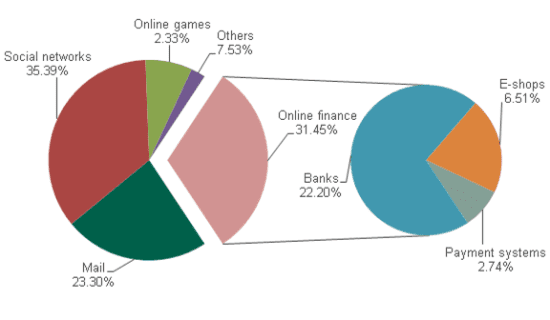
According to data collected as part of Kaspersky Lab’s ‘Financial cyber threats in 2013’ study, cybercriminals are trying harder than ever to acquire confidential user information and steal money from bank accounts by creating fake sites mimicking financial organisations. In 2013, 31.45 per cent of phishing attacks were trading on the names of leading banks, online stores and online payment systems – an increase of 8.5 percentage points from the previous year.

Phishing is a fraudulent scheme used by cybercriminals to obtain confidential user data with the help of fake web pages imitating Internet resources. Unlike malicious software created for particular operating systems, phishing attacks threaten all devices which can access web pages. That is why they are so popular with scammers – in 2013 alone Kaspersky Lab products protected about 39.6 million users from this cyber threat.

Phishing sites aimed at harvesting users’ financial details mainly use the brand names of popular online stores, online payment systems and online banking systems. In 2013, the most attractive targets were banks, which were used in 70.6 per cent of all financial phishing. That’s a sharp increase from 2012 when bank phishing represented just 52 per cent. Overall, fake bank websites were involved in twice as many (22.2 per cent) phishing attacks in 2013.
phishing_targets


Financial phishing targets in 2013

In 2013, Kaspersky Lab heuristic anti-phishing technologies blocked a total of 330 million attacks, an increase of 22.2 per cent from the previous year.

Fraudsters use the brand names of major companies with large client databases in search of a big criminal profit.  For example, about 60 per cent of all phishing attacks using fake bank pages exploited the names of just 25 organisations. Among online payment systems the phishers’ favourites are even more clearly-defined – 88.3 per cent of phishing attacks in this category involved one of four international brands: PayPal, American Express, MasterCard and Visa.

For several years in a row Amazon.com has been the most popular cover for phishing attacks exploiting the names of online stores. Over the reported period its name was used in 61 per cent of online trade-related phishing attacks. The Top 3 also included Apple and eBay, but both of them lagged well behind Amazon.

“Phishing attacks are so popular because they are simple to deploy and extremely effective. It is often not easy for even advanced Internet users to distinguish a well-designed fraudulent site from a legitimate page, which makes it even more important to install a specialised protection solution. In addition, phishing causes reputational and financial damage to organisations that see their brands exploited in phishing attacks,” commented Sergey Lozhkin, Senior Security Researcher at Kaspersky Lab.

The standard anti-phishing mechanisms in Kaspersky Lab security solutions for home users and small businesses are supplemented with Safe Money technology that reliably protects user data during online banking or payment sessions. The effectiveness of this technology is confirmed by special trials carried out by independent test labs such as AV-TEST, MRG Effitas and Matousec.

Companies which need to safeguard their clients from cybercriminals and to protect their own reputations may benefit from Kaspersky Lab’s comprehensive Kaspersky Fraud Prevention platform. It was developed to deliver rigorous, multi-layered security for online banking and includes programs for customer endpoints, a server solution to check customer transactions as well as a set of components to develop protected mobile applications.

Phishers don’t just imitate the websites of financial institutions – they also frequently attack via social networking sites. In 2013, the number of attacks using fake pages of Facebook and other social networking sites grew by 6.8 percentage points and accounted for 35.4 per cent of the total.

The ‘Financial cyber threats in 2013’ report used data obtained voluntarily from Kaspersky Security Network participants. Kaspersky Security Network is a globally distributed cloud-based infrastructure designed to quickly process depersonalised data about threats which users of Kaspersky Lab’s products encounter. Statistics about phishing attacks were obtained based on Kaspersky Lab web anti-phishing detections.

ISBuzz Team
  • ISBuzz Team
    Air Canada Data Breach: BianLian Extortion Group Claims A Massive Heist Contrary To Airline’s Earlier Statement
  • ISBuzz Team
    Unprecedented DDoS Attack Rocks The Web: Tech Giants Reveal A Digital Tsunami
  • ISBuzz Team
    CISA Flags High-Severity Adobe Acrobat Reader Flaw Amid Active Exploits
  • ISBuzz Team
    Curl Security Alert: Patching A Critical Bug Averting Potential Cyber Catastrophe

The opinions expressed in this post belong to the individual contributors and do not necessarily reflect the views of Information Security Buzz.

Share. Facebook Twitter LinkedIn Email Copy Link

Related Posts

New Phishing Kit Starkiller Defeats Multi-Factor Authentication

February 23, 20264 Mins Read

ReliaQuest Uncovers Social Media Phishing Campaign Built on Trusted Tools

January 22, 20266 Mins Read

What Happens after a Phishing Email Lands in Your Inbox?

January 5, 20266 Mins Read
ISB-Bora-Side-Bar

No se ha podido establecer conexión. Error 429

 
ISB-Bora-Side-Bar
Black ISB Logo

Information Security Buzz is an independent resource that provides the experts’ comments, analysis, and opinion on the latest Cybersecurity news and topics

X (Twitter) LinkedIn Facebook RSS

Working With Us

  • About Us
  • Advertise With Us
  • Contact Us

Write For Us

  • How To Contribute

The Pages

  • Privacy Policy
  • Cookie Policy
  • AI Policy
  • Terms & Conditions
  • Copyright Notice

Information Security Buzz and all its contents are copyright © 2014-2025. All rights reserved. All third-party trademarks are recognized.

Type above and press Enter to search. Press Esc to cancel.

Manage Consent
To provide the best experiences, we use technologies like cookies to store and/or access device information. Consenting to these technologies will allow us to process data such as browsing behavior or unique IDs on this site. Not consenting or withdrawing consent, may adversely affect certain features and functions.
Functional Always active
The technical storage or access is strictly necessary for the legitimate purpose of enabling the use of a specific service explicitly requested by the subscriber or user, or for the sole purpose of carrying out the transmission of a communication over an electronic communications network.
Preferences
The technical storage or access is necessary for the legitimate purpose of storing preferences that are not requested by the subscriber or user.
Statistics
The technical storage or access that is used exclusively for statistical purposes. The technical storage or access that is used exclusively for anonymous statistical purposes. Without a subpoena, voluntary compliance on the part of your Internet Service Provider, or additional records from a third party, information stored or retrieved for this purpose alone cannot usually be used to identify you.
Marketing
The technical storage or access is required to create user profiles to send advertising, or to track the user on a website or across several websites for similar marketing purposes.
  • Manage options
  • Manage services
  • Manage {vendor_count} vendors
  • Read more about these purposes
View preferences
  • {title}
  • {title}
  • {title}