



Survey of 10 to 18-year-old students shows cyberbullying is significantly more likely to originate from a friend than a stranger
Lavasoft today released the results of its 2015 Cyberbullying and Online Safety Study. Lavasoft surveyed more than 200 students aged 10 to 18 on their experiences with cyberbullying, as well as their online safety habits, including parental controls. As cyberbullying remains a present and growing threat to today’s constantly-connected children and teenagers, Lavasoft conducted this survey to gain insight into the online safety factors that play a potential role in cyberbullying.
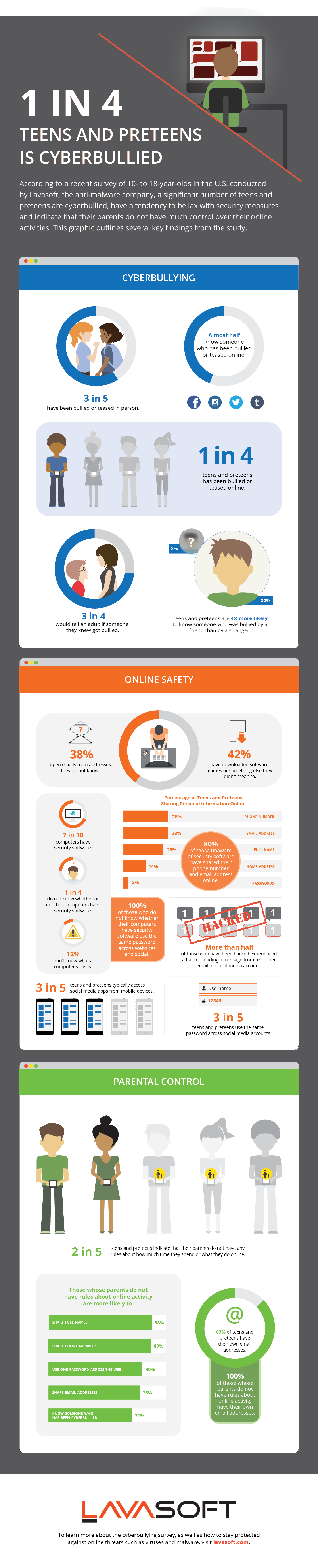
The study found that one in four students had been bullied or teased online in some way. Additionally, although nearly half of all respondents know someone who has been cyberbullied, less than 25 percent of students told an adult about the incident. The study also found that when it comes to online safety from cybercriminals, many students are unaware of best practices, with almost 60 percent of students saying they use the same password across all social media websites.
“Unfortunately, it seems like there’s a new story circulating in the news every day about a victim of cyberbullying and the awful ways they were treated by people on the other side of the screen,” said Daniel Assouline, CEO at Lavasoft. “At Lavasoft, our aim is to keep our customers safe from the growing breadth of online threats. Unfortunately, an antivirus program won’t stop a cyberbully – although we wish it could. Instead, with this survey, we’re aiming to educate parents about their children’s online behavior and the potential factors that could make them more susceptible to cyberbullying – either as a victim or an instigator.”
Cyberbullying by the Numbers
The study asked the children and young adults that were surveyed whether they or someone they know has been cyberbullied at any point in time. According to the respondents, 44 percent knew someone who had been bullied online, and 24 percent had been bullied online themselves. While cyberbullying is a growing concern, in-person bullying is still a larger issue, with three in five teens and preteens indicating that they have been bullied offline.
Unfortunately, even when students were aware of someone being bullied, most did not tell an adult. Although 73 percent of the teens and preteens surveyed claimed they would tell an adult if someone they knew was bullied, only 24 percent of respondents who actually knew someone who had been bullied online told an adult about the incident.
Parental Controls Are Lax
Beyond identifying the impact of cyberbullying and general online safety tactics, the study also took a look at the parental controls students have in place for their Internet usage. Nearly two in five respondents indicated their parents do not have any rules about how much time they spend online or what activities they do online.
Additionally, teens and preteens whose parents do not have rules about online activity are far more likely to share personal information online, with 78 percent sharing their email address, 83 percent sharing their phone number and 88 percent sharing their full name. Those students are also more likely to use the same password across websites, with 80 percent using the same password.
Teens and preteens whose parents do not have rules about online activity are about twice as likely as the average respondent to know someone who has been bullied online, with 71 percent knowing a victim of cyberbullying.
“It’s clear that lax parental controls online not only increase cyberbullying risks, but also put the student at an increased risk of general cybercrime,” said Assouline. “Children without rules about their online activity are more likely to engage in high-risk online behavior like information sharing and password repeating. The problem could be that parents are not educated enough about online threats themselves, so they aren’t passing that knowledge on to their children.”
Online Safety and Security Need More Emphasis
The study also looked into the online safety and security practices and knowledge of the survey respondents. More than two in five teens and preteens (42 percent) have downloaded software, games or some other program they did not intend to, and 38 percent have opened emails from addresses they did not recognize. In addition, one in four teens and preteens do not know whether or not their computers have security software installed. Of those who don’t know, 80 percent have shared their phone numbers and email addresses online, and 100 percent use the same password across websites.
The study also found 59 percent of students use the same password across social media websites and 16 percent have shared a password with a friend. And the sharing isn’t just taking place among friends – respondents also indicated they share a breadth of personal information online. Of the teens and preteens surveyed who said they have shared personal information online:
- 28 percent have shared their phone number
- 28 percent have shared their email address
- 25 percent have shared their full name
- 14 percent have shared their home address
- 3 percent have shared passwords
In addition to general online behavior, the survey asked respondents whether any of their social media profiles or email had been compromised by a hacker and found that of those who have been hacked, more than half (51 percent) experienced a hacker sending a message under his/her name.
“Many students are unaware of best practices for online security, with many engaging in activities that could result in their personal information being compromised, their devices being hacked and even make them more susceptible to bullies online,” said Assouline. “The best form of prevention in both cybercrime and cyberbullying is education, and many students seem to be unaware of the impact that their online behavior can have on their well-being.
To keep all consumers – including the teens and preteens who participated in this survey – protected online, Lavasoft recently released an update to Ad-Aware Web Companion, which provides lightweight protection against the latest malware and attacks, including anti-spyware, phishing and browser hijacking protection. While Lavasoft’s Ad-Aware Web Companion cannot change the online behavior that teens and preteens engage in, it can help prevent their online activity from being compromised by cybercriminals.
For more information about Lavasoft and its initiative to raise awareness of cyberbullying, visit Lavasoft’s blog.
About Lavasoft
 Lavasoft is the maker of Ad-Aware, the world’s No. 1 free antivirus software. Founded in 1999, Lavasoft is the original anti-malware company, creating award-winning, free security and privacy software. Born of the belief that online security should be available to everyone, Lavasoft offers millions of users maximum protection for their computers and online identities. With nearly 500 million downloads, its flagship product Ad-Aware has blocked and removed billions of threats, saving consumers from all forms of attacks and malware – including viruses, spyware, adware, phishing and drive-by downloads. Lavasoft is a global company with operations in North America and Europe. For more information, visit www.lavasoft.com.

The opinions expressed in this post belong to the individual contributors and do not necessarily reflect the views of Information Security Buzz.