


Close Menu
  • Home
  • Articles
    • Attacks
      • BEC
      • Data Breach
      • DDoS
      • Evasion Attacks
      • Injection
      • Malware
      • MITM
      • Phishing
      • Ransomware
      • RCE
      • Social Engineering
      • Spoofing
      • Spyware
    • Business and Policy
      • BCP and DRP
      • GRC
      • Regulations
    • Data Protection
      • DLP
      • DRM
      • Encryption
      • IAM
    • Future, Trends and Insight
      • AI
      • Events & Community
      • Emerging Tech
      • Expert Panel
      • Interviews With Experts
      • Insights
      • Study & Research
    • Resources
      • Guides
      • Tools
      • Training & Education
    • Security
      • API
      • Apps
      • Cloud
      • Critical Infrastructure
      • Endpoint
      • Hardware
      • IoT
      • Mobile
      • Network
      • OT
      • Port Security
      • Security Architecture
      • Software Development
      • Supply Chain
      • Zero Trust
    • Threats and Vulnerabilities
      • Emerging Threats
      • Insider Threats
      • Risk Management
      • Threat Intelligence
      • Zero Day
  • News and Exclusives
    • Latest News
    • ISB Exclusive
    • Positive News
  • Who We Are
    • About Us
    • Information Security Buzz Expert Panel​
    • Write for Us
    • Media Pack
  • Contact Us
  • Newsletter
Facebook X (Twitter) LinkedIn
Information Security BuzzInformation Security Buzz
  • Home
  • Articles
    • Attacks
      • BEC
      • Data Breach
      • DDoS
      • Evasion Attacks
      • Injection
      • Malware
      • MITM
      • Phishing
      • Ransomware
      • RCE
      • Social Engineering
      • Spoofing
      • Spyware
    • Business and Policy
      • BCP and DRP
      • GRC
      • Regulations
    • Data Protection
      • DLP
      • DRM
      • Encryption
      • IAM
    • Future, Trends and Insight
      • AI
      • Events & Community
      • Emerging Tech
      • Expert Panel
      • Interviews With Experts
      • Insights
      • Study & Research
    • Resources
      • Guides
      • Tools
      • Training & Education
    • Security
      • API
      • Apps
      • Cloud
      • Critical Infrastructure
      • Endpoint
      • Hardware
      • IoT
      • Mobile
      • Network
      • OT
      • Port Security
      • Security Architecture
      • Software Development
      • Supply Chain
      • Zero Trust
    • Threats and Vulnerabilities
      • Emerging Threats
      • Insider Threats
      • Risk Management
      • Threat Intelligence
      • Zero Day
  • News and Exclusives
    • Latest News
    • ISB Exclusive
    • Positive News
  • Who We Are
    • About Us
    • Information Security Buzz Expert Panel​
    • Write for Us
    • Media Pack
  • Contact Us
  • Newsletter
Subscribe
Information Security BuzzInformation Security Buzz
Home - Articles - The Anatomy of a DDoS Attack
Articles

The Anatomy of a DDoS Attack

ISBuzz TeamBy ISBuzz TeamJanuary 25, 20163 Mins Read
Share LinkedIn Twitter Facebook Copy Link Email
The Anatomy of a DDoS Attack
Share
Facebook Twitter LinkedIn Email Copy Link
Quick AI Summary
ChatGPTClaudeGeminiGrokPerplexityDeepSeekCopilot

The DDoS Environment

Before we look at how an attack affects you and everyone in your network, here’s a quick primer on what a DDoS attack is.

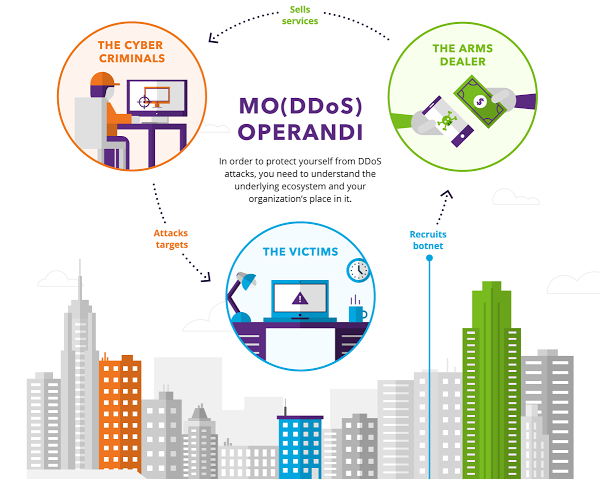
A typical brute force DDoS attack comes from a botnet – an enormous network of malware-infected devices, often numbering in the millions, that cyber criminals use to lock up your website. Many infected computers and mobile phones are unwitting components of a botnet as people browse the Internet unaware of enabling any malicious activity. This cycle perpetuates itself creating a self-sustaining chain of criminal activity.

At the center are the victims from whom the cyber criminal harvests data or leverages computing resources to conduct a DDoS attack.
The Victims

High-profile DDoS attacks are in the news constantly, but the truth is that anyone with a public web presence (small or large) is a potential target, including:

  • Large corporations
  • Mid-sized corporations
  • Small businesses
  • Political entities
  • Controversial leaders
  • Online personalities

The Arms Dealers

We know the damage a botnet attack can cause. But who creates the traffic surge and how do they do it?

  • The Kit Maker builds user-friendly toolkits that make botnets easily accessible.
  • The Builder uses malware kits to build botnets for herders and booters.
  • The Bot Herder controls botnets via remote command-and-control servers.
  • The Booter sells botnets and toolkits under the guise of server stressers.

The Cyber Criminals

After the malware has been built and distributed, who uses it? And for what purpose? Here’s a short list of perpetrators:

  • The Hacktivist expresses criticism to politicians, governments, or controversial persons or organizations
  • The Intimidator threatens free speech and political discussions
  • The Harasser bullies online users
  • The Extortionist ransoms sites (take a tip from us: don’t give it to them)
  • The Hired Gun makes a living out of DDoSing others
  • The Script Kiddie thrives on the thrill of it or the rights to brag to their peers

Cybercrime and the Bottom Line

DDoS is serious business affecting e-commerce sites and corporate and online assets.

Even though DDoS attacks are often associated with large organizations, research shows that 51 percent of all companies (no matter the size) have experienced a distributed denial of service attack. And on average, all companies face nearly two successful cyberattacks per week.

Seventy percent of DDoS attack victims are targeted more than once. And surprisingly, 35 percent of all cybercrime comes from insiders like employees, contractors, and various business partners.

The Cost of Unlawful Entry

The fallout from a DDoS attack is substantial. The average cost to mitigate an attack is $408,292. In other words, it takes about 19 days (and over $21,000 per day) to resolve the problem. That’s a substantial amount of time, money, and energy.

To break it down even further, here’s a list of areas most financially impacted by a DDoS attack:

  • IT: 35 percent
  • Sales: 23 percent
  • Security: 22 percent
  • Customer service: 12 percent

[su_box title=”About Imperva®” style=”noise” box_color=”#336588″]ImpervaImperva® (NYSE:IMPV), is a leading provider of cyber security solutions that protect business-critical data and applications. The company’s SecureSphere, Incapsula and Skyfence product lines enable organizations to discover assets and risks, protect information wherever it lives – in the cloud and on-premises – and comply with regulations. The Imperva Application Defense Center, a research team comprised of some of the world’s leading experts in data and application security, continually enhances Imperva products with up-to-the-minute threat intelligence, and publishes reports that provide insight and guidance on the latest threats and how to mitigate them. Imperva is headquartered in Redwood Shores, California.[/su_box]

ISBuzz Team
  • ISBuzz Team
    Air Canada Data Breach: BianLian Extortion Group Claims A Massive Heist Contrary To Airline’s Earlier Statement
  • ISBuzz Team
    Unprecedented DDoS Attack Rocks The Web: Tech Giants Reveal A Digital Tsunami
  • ISBuzz Team
    CISA Flags High-Severity Adobe Acrobat Reader Flaw Amid Active Exploits
  • ISBuzz Team
    Curl Security Alert: Patching A Critical Bug Averting Potential Cyber Catastrophe

The opinions expressed in this post belong to the individual contributors and do not necessarily reflect the views of Information Security Buzz.

Share. Facebook Twitter LinkedIn Email Copy Link

Related Posts

Exploited Faster, Patched Slower: Verizon DBIR 2026 Shows Security Teams Losing Ground

May 20, 20265 Mins Read

Security’s Blind Spot: The Threats Hiding in “Low-Severity” Alerts

May 6, 20265 Mins Read

AppSec is dead, long live AI security

April 29, 20265 Mins Read
ISB-Bora-Side-Bar

No se ha podido establecer conexión. Error 429

 
ISB-Bora-Side-Bar
Black ISB Logo

Information Security Buzz is an independent resource that provides the experts’ comments, analysis, and opinion on the latest Cybersecurity news and topics

X (Twitter) LinkedIn Facebook RSS

Working With Us

  • About Us
  • Advertise With Us
  • Contact Us

Write For Us

  • How To Contribute

The Pages

  • Privacy Policy
  • Cookie Policy
  • AI Policy
  • Terms & Conditions
  • Copyright Notice

Information Security Buzz and all its contents are copyright © 2014-2025. All rights reserved. All third-party trademarks are recognized.

Type above and press Enter to search. Press Esc to cancel.

Manage Consent
To provide the best experiences, we use technologies like cookies to store and/or access device information. Consenting to these technologies will allow us to process data such as browsing behavior or unique IDs on this site. Not consenting or withdrawing consent, may adversely affect certain features and functions.
Functional Always active
The technical storage or access is strictly necessary for the legitimate purpose of enabling the use of a specific service explicitly requested by the subscriber or user, or for the sole purpose of carrying out the transmission of a communication over an electronic communications network.
Preferences
The technical storage or access is necessary for the legitimate purpose of storing preferences that are not requested by the subscriber or user.
Statistics
The technical storage or access that is used exclusively for statistical purposes. The technical storage or access that is used exclusively for anonymous statistical purposes. Without a subpoena, voluntary compliance on the part of your Internet Service Provider, or additional records from a third party, information stored or retrieved for this purpose alone cannot usually be used to identify you.
Marketing
The technical storage or access is required to create user profiles to send advertising, or to track the user on a website or across several websites for similar marketing purposes.
  • Manage options
  • Manage services
  • Manage {vendor_count} vendors
  • Read more about these purposes
View preferences
  • {title}
  • {title}
  • {title}