

Close Menu
  • Home
  • Articles
    • Attacks
      • BEC
      • Data Breach
      • DDoS
      • Evasion Attacks
      • Injection
      • Malware
      • MITM
      • Phishing
      • Ransomware
      • RCE
      • Social Engineering
      • Spoofing
      • Spyware
    • Business and Policy
      • BCP and DRP
      • GRC
      • Regulations
    • Data Protection
      • DLP
      • DRM
      • Encryption
      • IAM
    • Future, Trends and Insight
      • AI
      • Events & Community
      • Emerging Tech
      • Expert Panel
      • Interviews With Experts
      • Insights
      • Study & Research
    • Resources
      • Guides
      • Tools
      • Training & Education
    • Security
      • API
      • Apps
      • Cloud
      • Critical Infrastructure
      • Endpoint
      • Hardware
      • IoT
      • Mobile
      • Network
      • OT
      • Port Security
      • Security Architecture
      • Software Development
      • Supply Chain
      • Zero Trust
    • Threats and Vulnerabilities
      • Emerging Threats
      • Insider Threats
      • Risk Management
      • Threat Intelligence
      • Zero Day
  • News and Exclusives
    • Latest News
    • ISB Exclusive
    • Positive News
  • Who We Are
    • About Us
    • Information Security Buzz Expert Panel​
    • Write for Us
    • Media Pack
  • Contact Us
  • Newsletter
Facebook X (Twitter) LinkedIn
Information Security BuzzInformation Security Buzz
  • Home
  • Articles
    • Attacks
      • BEC
      • Data Breach
      • DDoS
      • Evasion Attacks
      • Injection
      • Malware
      • MITM
      • Phishing
      • Ransomware
      • RCE
      • Social Engineering
      • Spoofing
      • Spyware
    • Business and Policy
      • BCP and DRP
      • GRC
      • Regulations
    • Data Protection
      • DLP
      • DRM
      • Encryption
      • IAM
    • Future, Trends and Insight
      • AI
      • Events & Community
      • Emerging Tech
      • Expert Panel
      • Interviews With Experts
      • Insights
      • Study & Research
    • Resources
      • Guides
      • Tools
      • Training & Education
    • Security
      • API
      • Apps
      • Cloud
      • Critical Infrastructure
      • Endpoint
      • Hardware
      • IoT
      • Mobile
      • Network
      • OT
      • Port Security
      • Security Architecture
      • Software Development
      • Supply Chain
      • Zero Trust
    • Threats and Vulnerabilities
      • Emerging Threats
      • Insider Threats
      • Risk Management
      • Threat Intelligence
      • Zero Day
  • News and Exclusives
    • Latest News
    • ISB Exclusive
    • Positive News
  • Who We Are
    • About Us
    • Information Security Buzz Expert Panel​
    • Write for Us
    • Media Pack
  • Contact Us
  • Newsletter
Subscribe
Information Security BuzzInformation Security Buzz
Home - Study & Research - Ireland Safer Online than EU Average
Study & Research

Ireland Safer Online than EU Average

ISBuzz TeamBy ISBuzz TeamFebruary 15, 2016Updated:April 30, 20253 Mins Read
Share LinkedIn Twitter Facebook Copy Link Email
Ireland Safer Online than EU Average
Share
Facebook Twitter LinkedIn Email Copy Link
Quick AI Summary
ChatGPTClaudeGeminiGrokPerplexityDeepSeekCopilot

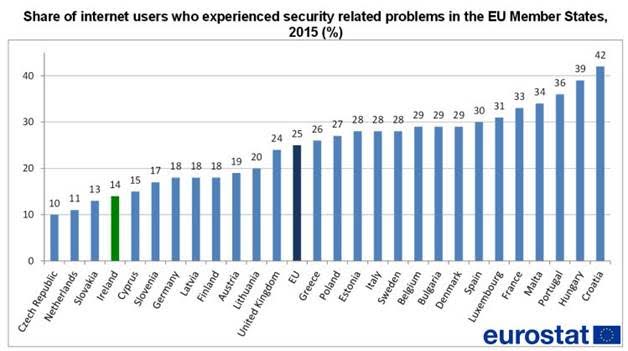
According to Eurostat research 1 out of 4 internet users in the EU experienced computer security related problems in 2015, but the Irish were safer.

The Safer Internet Day and Eurostat has released their research on the Europeans’ Internet security. According to Eurostat “the proportion of internet users having experienced certain common security issues over the internet – such as viruses affecting devices, abuse of personal information, financial losses or children accessing inappropriate websites – stood at 25% in 2015.”

Ireland has taken the excellent fourth place, just after Czech Republic (10%), Netherlands (11%) and Slovakia (13%), with only 14% of internet users having experienced security-related issues, while the worst performing was Croatia, where a staggering 42% have been infected by malware or suffered some other online calamity.
26a11c0a-f9eb-4f01-95e6-94f6ef609f4a

Compared with 2010, the share of internet users who caught a virus or other computer infection resulting in loss of information or time dropped in all Member States by 2015, except Croatia. The most remarkable fall was observed in Slovakia from 47% in 2010 to 9% in 2015, or a decrease by 38% which is a particularly interesting statistic for us at ESET, since ESET’s HQ is in Slovakia and ESET antivirus and security products have been steadily increasing their market share there (but we’re not claiming there’s correlation between the two).

At EU level, the proportion of internet users having caught a virus online decreased by 10%, from almost a third (31%) in 2010 to about a fifth (21%) in 2015. Statistical research done in the past shows that malware infections are also closely related to the use of pirated software, so additional research could show if piracy levels in EU have had any effect on the EU-wide malware infection decrease.

Eurostat’s research also found that at EU level security concerns discouraged users from certain activities. 19% of Europeans refrained from online shopping, 18% refused to bank online and 13% didn’t want to use WiFi on their mobile device outside of their home.

Overall, it would appear things are improving somewhat, at least on the malware front (while the privacy and social engineering side of things still leaves much to be desired, so you may want to see our top tips for staying safe on Facebook). And on that note ESET Ireland wishes you a safe and fun Safer Internet Day!

[su_box title=”About ESET Ireland” style=”noise” box_color=”#0e0d0d”]ESET IrelandESET Ireland will keep your hardware and software performing as it should. The company has hundreds of people around the world working hard every day so customers’ computers, tablets, smartphones and servers are properly protected. All with minimal impact on their performance.[/su_box]

ISBuzz Team
  • ISBuzz Team
    Air Canada Data Breach: BianLian Extortion Group Claims A Massive Heist Contrary To Airline’s Earlier Statement
  • ISBuzz Team
    Unprecedented DDoS Attack Rocks The Web: Tech Giants Reveal A Digital Tsunami
  • ISBuzz Team
    CISA Flags High-Severity Adobe Acrobat Reader Flaw Amid Active Exploits
  • ISBuzz Team
    Curl Security Alert: Patching A Critical Bug Averting Potential Cyber Catastrophe

The opinions expressed in this post belong to the individual contributors and do not necessarily reflect the views of Information Security Buzz.

Share. Facebook Twitter LinkedIn Email Copy Link

Related Posts

Roundcube RCE Vulnerability Disclosed Early Amid Active Exploitation

June 10, 20255 Mins Read

Roblox Under Fire: Lawsuit Alleges Secret Data Tracking of Kids

May 13, 20254 Mins Read

Fake Indian Government Portal Used to Spread Cross-Platform Malware in Suspected APT36 Campaign

May 13, 20253 Mins Read
ISB-Bora-Side-Bar

 
ISB-Bora-Side-Bar
Black ISB Logo

Information Security Buzz is an independent resource that provides the experts’ comments, analysis, and opinion on the latest Cybersecurity news and topics

X (Twitter) LinkedIn Facebook RSS

Working With Us

  • About Us
  • Advertise With Us
  • Contact Us

Write For Us

  • How To Contribute

The Pages

  • Privacy Policy
  • Cookie Policy
  • AI Policy
  • Terms & Conditions
  • Copyright Notice

Information Security Buzz and all its contents are copyright © 2014-2025. All rights reserved. All third-party trademarks are recognized.

Type above and press Enter to search. Press Esc to cancel.

Manage Consent
To provide the best experiences, we use technologies like cookies to store and/or access device information. Consenting to these technologies will allow us to process data such as browsing behavior or unique IDs on this site. Not consenting or withdrawing consent, may adversely affect certain features and functions.
Functional Always active
The technical storage or access is strictly necessary for the legitimate purpose of enabling the use of a specific service explicitly requested by the subscriber or user, or for the sole purpose of carrying out the transmission of a communication over an electronic communications network.
Preferences
The technical storage or access is necessary for the legitimate purpose of storing preferences that are not requested by the subscriber or user.
Statistics
The technical storage or access that is used exclusively for statistical purposes. The technical storage or access that is used exclusively for anonymous statistical purposes. Without a subpoena, voluntary compliance on the part of your Internet Service Provider, or additional records from a third party, information stored or retrieved for this purpose alone cannot usually be used to identify you.
Marketing
The technical storage or access is required to create user profiles to send advertising, or to track the user on a website or across several websites for similar marketing purposes.
  • Manage options
  • Manage services
  • Manage {vendor_count} vendors
  • Read more about these purposes
View preferences
  • {title}
  • {title}
  • {title}