


Close Menu
  • Home
  • Articles
    • Attacks
      • BEC
      • Data Breach
      • DDoS
      • Evasion Attacks
      • Injection
      • Malware
      • MITM
      • Phishing
      • Ransomware
      • RCE
      • Social Engineering
      • Spoofing
      • Spyware
    • Business and Policy
      • BCP and DRP
      • GRC
      • Regulations
    • Data Protection
      • DLP
      • DRM
      • Encryption
      • IAM
    • Future, Trends and Insight
      • AI
      • Events & Community
      • Emerging Tech
      • Expert Panel
      • Interviews With Experts
      • Insights
      • Study & Research
    • Resources
      • Guides
      • Tools
      • Training & Education
    • Security
      • API
      • Apps
      • Cloud
      • Critical Infrastructure
      • Endpoint
      • Hardware
      • IoT
      • Mobile
      • Network
      • OT
      • Port Security
      • Security Architecture
      • Software Development
      • Supply Chain
      • Zero Trust
    • Threats and Vulnerabilities
      • Emerging Threats
      • Insider Threats
      • Risk Management
      • Threat Intelligence
      • Zero Day
  • News and Exclusives
    • Latest News
    • ISB Exclusive
    • Positive News
  • Who We Are
    • About Us
    • Information Security Buzz Expert Panel​
    • Write for Us
    • Media Pack
  • Contact Us
  • Newsletter
Facebook X (Twitter) LinkedIn
Information Security BuzzInformation Security Buzz
  • Home
  • Articles
    • Attacks
      • BEC
      • Data Breach
      • DDoS
      • Evasion Attacks
      • Injection
      • Malware
      • MITM
      • Phishing
      • Ransomware
      • RCE
      • Social Engineering
      • Spoofing
      • Spyware
    • Business and Policy
      • BCP and DRP
      • GRC
      • Regulations
    • Data Protection
      • DLP
      • DRM
      • Encryption
      • IAM
    • Future, Trends and Insight
      • AI
      • Events & Community
      • Emerging Tech
      • Expert Panel
      • Interviews With Experts
      • Insights
      • Study & Research
    • Resources
      • Guides
      • Tools
      • Training & Education
    • Security
      • API
      • Apps
      • Cloud
      • Critical Infrastructure
      • Endpoint
      • Hardware
      • IoT
      • Mobile
      • Network
      • OT
      • Port Security
      • Security Architecture
      • Software Development
      • Supply Chain
      • Zero Trust
    • Threats and Vulnerabilities
      • Emerging Threats
      • Insider Threats
      • Risk Management
      • Threat Intelligence
      • Zero Day
  • News and Exclusives
    • Latest News
    • ISB Exclusive
    • Positive News
  • Who We Are
    • About Us
    • Information Security Buzz Expert Panel​
    • Write for Us
    • Media Pack
  • Contact Us
  • Newsletter
Subscribe
Information Security BuzzInformation Security Buzz
Home - Articles - Scammers Evolving: Top 5 Most Sophisticated Olympic Scams We’ve Seen So Far
Articles

Scammers Evolving: Top 5 Most Sophisticated Olympic Scams We’ve Seen So Far

ISBuzz TeamBy ISBuzz TeamAugust 8, 20165 Mins Read
Share LinkedIn Twitter Facebook Copy Link Email
Share
Facebook Twitter LinkedIn Email Copy Link
Quick AI Summary
ChatGPTClaudeGeminiGrokPerplexityDeepSeekCopilot

There’s a sucker born every minute. And for each sucker there are hundreds of scammers waiting to take advantage of them. Now, with the Olympic Games fast-approaching, fraudsters are lining up to take advantage of unwitting consumers interested in attending or simply sharing in a little bit of the excitement from the comfort of their home. A variety of scams abound from fraudulent sites selling fake tickets to the opening games to “lotteries” giving “winners” hundreds of thousands in cash and prizes. Here are the five most sophisticated scams we’ve seen to date:

Lotto: The Scam of Choice
According to the UK’s National Fraud Intelligence Bureau, two lottery-related scams are making the rounds. In the first case, “winners” are notified that they have been selected from among 10 million email addresses as the winner of an online lottery prize of £650,000 as well as a trip to Brazil to see the Olympics. The second lottery scam alerts recipients that their lottery picks have won them a trip to Brazil to attend Carnival and the Olympics, and even includes a large cash payout of £820,000. In either case, the so-called winners are asked to contact a Lottery official (whose contact info, not surprisingly, is riddled with typos) where upon they are asked to provide the details of their bank account in order to facilitate the transfer of funds. Tempting as it may be, consumers would be well advised to remember that if they didn’t play, they didn’t win.

Have a Coke and a Scam
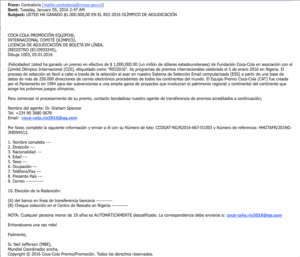
“Congratulations! You’ve won a cash prize of $ 1,000,000.00 (one million US dollars) of Coca-Cola Foundation in partnership with the International Olympic Committee (IOC), labeled ‘RIO2016’.” That’s the opening line to one of the many email scams surrounding the upcoming Olympics that are floating around at present. The premise is simple: The recipient has been selected at random from a database of more than 250,000 email addresses, and in order to collect the prize, the “lucky” winner need only fill in some personal information and elect whether they prefer a bank transfer or to pick up their check in person in Nigeria. Given the choices, most will opt for a bank transfer, and that’s where the trouble begins.

The example above is written in Spanish and proof positive that when it comes to scams surrounding the Olympics, everyone needs to be cautious, no matter the nationality or language.
1

Buyer Beware
Whether you’re attending the Olympics or planning on being an armchair tourist, those in search of Olympic paraphernalia should remember “caveat emptor.” If the 2014 Olympics are anything to go by, sales of fraudulent merchandise will be rampant. According to the Better Business Bureau, a quick search for “Sochi 2014,” for example, found 5,693 items in 2014, including a $4,000 “Olympic Torch Sochi 2014.” Consumers in the market for Olympic swag are well advised to make purchases on the official Olympic site and to always use a credit card. While both debit and credit cards offer protection, in the event of a scam money lost via a debit card may take several days to be replaced, and who has that kind of time … or cash?

Phishing: An Oldie But a Goldie
When it comes to perfecting their craft, fraudsters have an endless well of creativity. Nevertheless, fraudsters continue to rely on tried-and-true phishing scams because they work. Now with the Games almost upon us, scammers are registering domains using terms such as “Rio” and “rio2016” and using low-cost SSL certificates to ensure their scam sites appear to be legitimate.

Malicious Rogue Apps

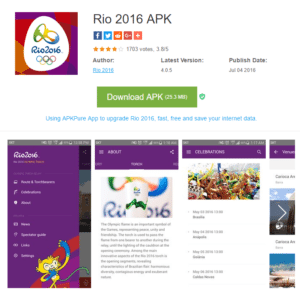
It seems as if the whole world is glued to their smartphones. That trend, in part, is thanks the abundance of useful and entertaining mobile applications available through authorized and unauthorized app stores. No doubt people will turn to apps to stay up-to-date on scores and news about the Olympics. However, not all apps about the Olympics are legitimate. In fact, downloading the app pictured below can expose the user to Trojans, viruses and other malicious code created by scammers. This app looks official enough, but our malware analysts determined this app has the same properties of Trojan apps and other fraudulent apps.  Moreover, this app was found in a third-party store, which means it was subjected to less security oversight than if it had been offered through authorized stores such as the Apple Store and Google Play Store.
rio

When it comes to staying safe online, consumers should follow the following tips:

  • Be leery of unsolicited emails, especially those claiming that you are a winner, and never give out personal information in response to these emails.
  • Always pay with credit cards as they afford consumers greater protection.
  • Only do business with encrypted sites (those starting with “https”).
  • Open attachments only when they come from known sources, and even then be aware of what you are opening. Sophisticated fraudsters can create emails that appear to be from legitimate companies but that direct recipients to fraudulent sites or introduce malware onto their system.
  • Keep your password protected and never re-use the same password across multiple sites.
  • Secure access to your bank and critical applications with a locked-down personal web browser such as the Detect Safe Browsing mobile app.
  • Only download mobile apps from authorized app stores.

[su_box title=”About Easy Solutions” style=”noise” box_color=”#336588″][short_info id=’61384′ desc=”true” all=”false”][/su_box]

ISBuzz Team
  • ISBuzz Team
    Air Canada Data Breach: BianLian Extortion Group Claims A Massive Heist Contrary To Airline’s Earlier Statement
  • ISBuzz Team
    Unprecedented DDoS Attack Rocks The Web: Tech Giants Reveal A Digital Tsunami
  • ISBuzz Team
    CISA Flags High-Severity Adobe Acrobat Reader Flaw Amid Active Exploits
  • ISBuzz Team
    Curl Security Alert: Patching A Critical Bug Averting Potential Cyber Catastrophe

The opinions expressed in this post belong to the individual contributors and do not necessarily reflect the views of Information Security Buzz.

Share. Facebook Twitter LinkedIn Email Copy Link

Related Posts

Exploited Faster, Patched Slower: Verizon DBIR 2026 Shows Security Teams Losing Ground

May 20, 20265 Mins Read

Security’s Blind Spot: The Threats Hiding in “Low-Severity” Alerts

May 6, 20265 Mins Read

Why OSINT deserves the same status as other intelligence disciplines

March 17, 20266 Mins Read
ISB-Bora-Side-Bar

No se ha podido establecer conexión. Error 429

 
ISB-Bora-Side-Bar
Black ISB Logo

Information Security Buzz is an independent resource that provides the experts’ comments, analysis, and opinion on the latest Cybersecurity news and topics

X (Twitter) LinkedIn Facebook RSS

Working With Us

  • About Us
  • Advertise With Us
  • Contact Us

Write For Us

  • How To Contribute

The Pages

  • Privacy Policy
  • Cookie Policy
  • AI Policy
  • Terms & Conditions
  • Copyright Notice

Information Security Buzz and all its contents are copyright © 2014-2025. All rights reserved. All third-party trademarks are recognized.

Type above and press Enter to search. Press Esc to cancel.

Manage Consent
To provide the best experiences, we use technologies like cookies to store and/or access device information. Consenting to these technologies will allow us to process data such as browsing behavior or unique IDs on this site. Not consenting or withdrawing consent, may adversely affect certain features and functions.
Functional Always active
The technical storage or access is strictly necessary for the legitimate purpose of enabling the use of a specific service explicitly requested by the subscriber or user, or for the sole purpose of carrying out the transmission of a communication over an electronic communications network.
Preferences
The technical storage or access is necessary for the legitimate purpose of storing preferences that are not requested by the subscriber or user.
Statistics
The technical storage or access that is used exclusively for statistical purposes. The technical storage or access that is used exclusively for anonymous statistical purposes. Without a subpoena, voluntary compliance on the part of your Internet Service Provider, or additional records from a third party, information stored or retrieved for this purpose alone cannot usually be used to identify you.
Marketing
The technical storage or access is required to create user profiles to send advertising, or to track the user on a website or across several websites for similar marketing purposes.
  • Manage options
  • Manage services
  • Manage {vendor_count} vendors
  • Read more about these purposes
View preferences
  • {title}
  • {title}
  • {title}