


Close Menu
  • Home
  • Articles
    • Attacks
      • BEC
      • Data Breach
      • DDoS
      • Evasion Attacks
      • Injection
      • Malware
      • MITM
      • Phishing
      • Ransomware
      • RCE
      • Social Engineering
      • Spoofing
      • Spyware
    • Business and Policy
      • BCP and DRP
      • GRC
      • Regulations
    • Data Protection
      • DLP
      • DRM
      • Encryption
      • IAM
    • Future, Trends and Insight
      • AI
      • Events & Community
      • Emerging Tech
      • Expert Panel
      • Interviews With Experts
      • Insights
      • Study & Research
    • Resources
      • Guides
      • Tools
      • Training & Education
    • Security
      • API
      • Apps
      • Cloud
      • Critical Infrastructure
      • Endpoint
      • Hardware
      • IoT
      • Mobile
      • Network
      • OT
      • Port Security
      • Security Architecture
      • Software Development
      • Supply Chain
      • Zero Trust
    • Threats and Vulnerabilities
      • Emerging Threats
      • Insider Threats
      • Risk Management
      • Threat Intelligence
      • Zero Day
  • News and Exclusives
    • Latest News
    • ISB Exclusive
    • Positive News
  • Who We Are
    • About Us
    • Information Security Buzz Expert Panel​
    • Write for Us
    • Media Pack
  • Contact Us
  • Newsletter
Facebook X (Twitter) LinkedIn
Information Security BuzzInformation Security Buzz
  • Home
  • Articles
    • Attacks
      • BEC
      • Data Breach
      • DDoS
      • Evasion Attacks
      • Injection
      • Malware
      • MITM
      • Phishing
      • Ransomware
      • RCE
      • Social Engineering
      • Spoofing
      • Spyware
    • Business and Policy
      • BCP and DRP
      • GRC
      • Regulations
    • Data Protection
      • DLP
      • DRM
      • Encryption
      • IAM
    • Future, Trends and Insight
      • AI
      • Events & Community
      • Emerging Tech
      • Expert Panel
      • Interviews With Experts
      • Insights
      • Study & Research
    • Resources
      • Guides
      • Tools
      • Training & Education
    • Security
      • API
      • Apps
      • Cloud
      • Critical Infrastructure
      • Endpoint
      • Hardware
      • IoT
      • Mobile
      • Network
      • OT
      • Port Security
      • Security Architecture
      • Software Development
      • Supply Chain
      • Zero Trust
    • Threats and Vulnerabilities
      • Emerging Threats
      • Insider Threats
      • Risk Management
      • Threat Intelligence
      • Zero Day
  • News and Exclusives
    • Latest News
    • ISB Exclusive
    • Positive News
  • Who We Are
    • About Us
    • Information Security Buzz Expert Panel​
    • Write for Us
    • Media Pack
  • Contact Us
  • Newsletter
Subscribe
Information Security BuzzInformation Security Buzz
Home - News & Analysis - Cyber Security Incident Response: Are We As Prepared As We Think?
News & Analysis

Cyber Security Incident Response: Are We As Prepared As We Think?

ISBuzz TeamBy ISBuzz TeamJanuary 22, 2014Updated:January 22, 20143 Mins Read
Share LinkedIn Twitter Facebook Copy Link Email
BlackSprut: Darknet Drug Market Advertises On Billboards In Moscow
Share
Facebook Twitter LinkedIn Email Copy Link
Quick AI Summary
ChatGPTClaudeGeminiGrokPerplexityDeepSeekCopilot

Lancope, Inc., a leader in network visibility and security intelligence, today announced the results of a Ponemon Institute report entitled, “Cyber Security Incident Response: Are we as prepared as we think?” Findings show that while security threats are imminent, CEOs and other members of the management team are in the dark about potential cyber-attacks against their companies. The research also shows that, as a result, Computer Security Incident Response Teams (CSIRTs) often lack the resources necessary to fend off the continuous onslaught of advanced threats facing today’s organisations.

Commissioned by Lancope, the Ponemon Institute research surveyed 674 IT and IT security professionals in the United States and the United Kingdom who are involved in their organisation’s CSIRT activities. The study concludes with key recommendations for organizations looking to improve their incident response process.

Key findings from the study include:

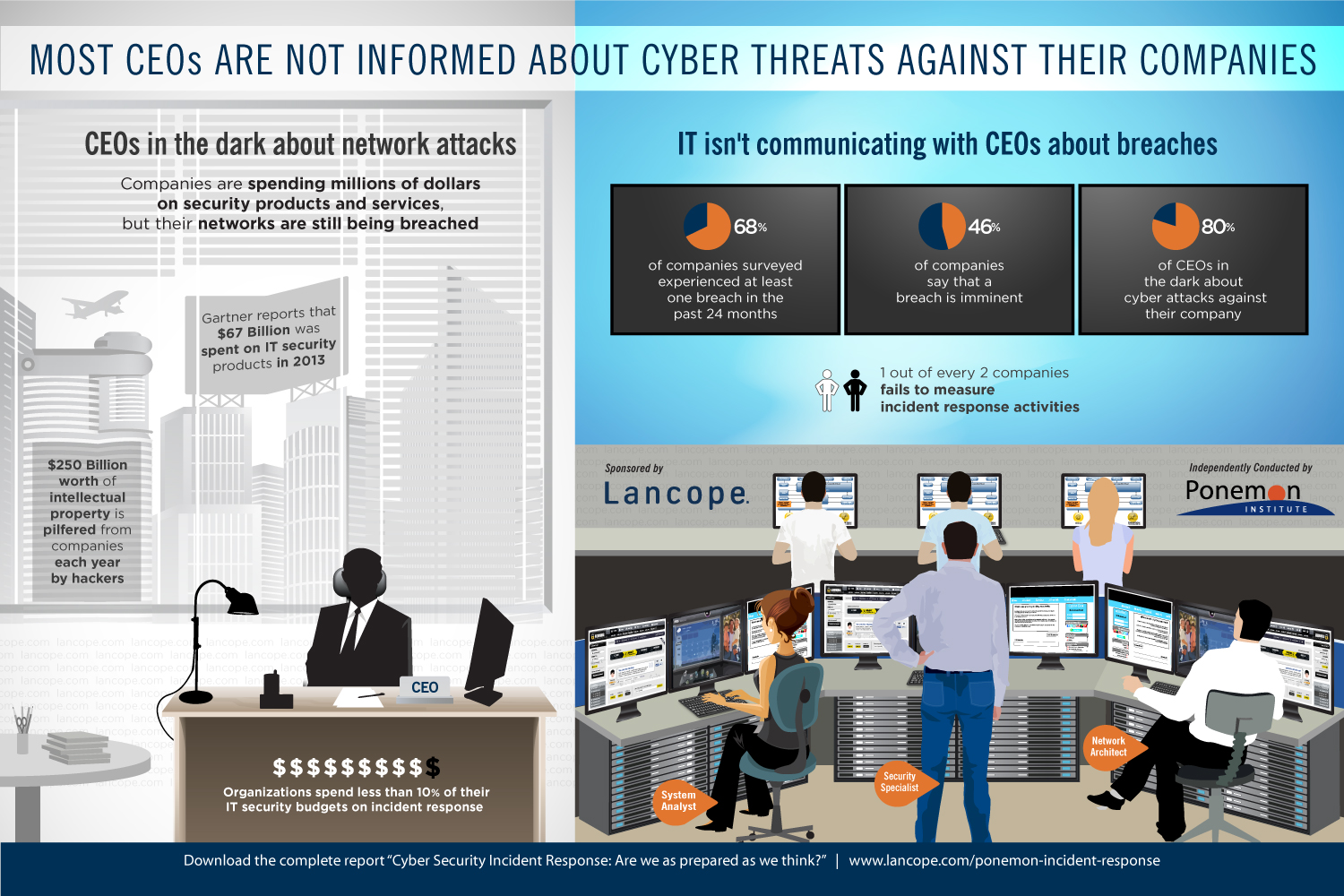
– Security incidents are imminent – Sixty-eight percent of respondents say their organisation experienced a security breach or incident in the past 24 months. Forty-six percent say another incident is imminent and could happen within the next six months.

– Management is largely unaware of cyber security threats – Eighty percent of respondents reported that they don’t frequently communicate with executive management about potential cyber-attacks against their organisation.

– Organisations are not measuring the effectiveness of their incident response efforts – Fifty percent of respondents do not have meaningful operational metrics to measure the overall effectiveness of incident response.

– Breaches remain unresolved for an entire month – While most organisations said they could identify a security incident within a matter of hours, it takes an entire month on average to work through the process of incident investigation, service restoration and verification.

– CSIRTs lack adequate investments – Half of all respondents say that less than 10 percent of their security budgets are used for incident response activities, and most say their incident response budgets have not increased in the past 24 months.

– Network audit trails are the most effective tool for incident response – Eighty percent of respondents say that analysis of audit trails from sources like NetFlow and packet captures is the most effective approach for detecting security incidents and breaches. This choice was more popular than intrusion detection systems and anti-virus software.

“The findings of our research suggest that companies are not always making the right investments in incident response,” said Dr. Larry Ponemon, chairman and founder of the Ponemon Institute. “As a result, they may not be as prepared as they should be to respond to security incidents. One recommendation is for organisations to elevate the importance of incident response and make it a critical component of their overall business strategy.”

“If 2013 is any indication, today’s enterprises are ill-equipped to identify and halt sophisticated attacks launched by nation-states, malicious outsiders and determined insiders,” said Mike Potts, president and CEO of Lancope. “Now is the time for C-level executives and IT decision-makers to come together and develop stronger, more comprehensive plans for incident response. This communication is critical if we want to reduce the astounding frequency of high-profile data breaches and damaging corporate losses we are seeing in the media on a near-daily basis.”

For a full copy of the study, “Cyber Security Incident Response: Are we as prepared as we think?” please visit: http://www.lancope.com/ponemon-incident-response/.

 Click to see the full infographicLancope-Slider
ISBuzz Team
  • ISBuzz Team
    Air Canada Data Breach: BianLian Extortion Group Claims A Massive Heist Contrary To Airline’s Earlier Statement
  • ISBuzz Team
    Unprecedented DDoS Attack Rocks The Web: Tech Giants Reveal A Digital Tsunami
  • ISBuzz Team
    CISA Flags High-Severity Adobe Acrobat Reader Flaw Amid Active Exploits
  • ISBuzz Team
    Curl Security Alert: Patching A Critical Bug Averting Potential Cyber Catastrophe

The opinions expressed in this post belong to the individual contributors and do not necessarily reflect the views of Information Security Buzz.

Share. Facebook Twitter LinkedIn Email Copy Link

Related Posts

Exploited Faster, Patched Slower: Verizon DBIR 2026 Shows Security Teams Losing Ground

May 20, 20265 Mins Read

Security’s Blind Spot: The Threats Hiding in “Low-Severity” Alerts

May 6, 20265 Mins Read

Why OSINT deserves the same status as other intelligence disciplines

March 17, 20266 Mins Read
ISB-Bora-Side-Bar

 
ISB-Bora-Side-Bar
Black ISB Logo

Information Security Buzz is an independent resource that provides the experts’ comments, analysis, and opinion on the latest Cybersecurity news and topics

X (Twitter) LinkedIn Facebook RSS

Working With Us

  • About Us
  • Advertise With Us
  • Contact Us

Write For Us

  • How To Contribute

The Pages

  • Privacy Policy
  • Cookie Policy
  • AI Policy
  • Terms & Conditions
  • Copyright Notice

Information Security Buzz and all its contents are copyright © 2014-2025. All rights reserved. All third-party trademarks are recognized.

Type above and press Enter to search. Press Esc to cancel.

Manage Consent
To provide the best experiences, we use technologies like cookies to store and/or access device information. Consenting to these technologies will allow us to process data such as browsing behavior or unique IDs on this site. Not consenting or withdrawing consent, may adversely affect certain features and functions.
Functional Always active
The technical storage or access is strictly necessary for the legitimate purpose of enabling the use of a specific service explicitly requested by the subscriber or user, or for the sole purpose of carrying out the transmission of a communication over an electronic communications network.
Preferences
The technical storage or access is necessary for the legitimate purpose of storing preferences that are not requested by the subscriber or user.
Statistics
The technical storage or access that is used exclusively for statistical purposes. The technical storage or access that is used exclusively for anonymous statistical purposes. Without a subpoena, voluntary compliance on the part of your Internet Service Provider, or additional records from a third party, information stored or retrieved for this purpose alone cannot usually be used to identify you.
Marketing
The technical storage or access is required to create user profiles to send advertising, or to track the user on a website or across several websites for similar marketing purposes.
  • Manage options
  • Manage services
  • Manage {vendor_count} vendors
  • Read more about these purposes
View preferences
  • {title}
  • {title}
  • {title}