

Close Menu
  • Home
  • Articles
    • Attacks
      • BEC
      • Data Breach
      • DDoS
      • Evasion Attacks
      • Injection
      • Malware
      • MITM
      • Phishing
      • Ransomware
      • RCE
      • Social Engineering
      • Spoofing
      • Spyware
    • Business and Policy
      • BCP and DRP
      • GRC
      • Regulations
    • Data Protection
      • DLP
      • DRM
      • Encryption
      • IAM
    • Future, Trends and Insight
      • AI
      • Events & Community
      • Emerging Tech
      • Expert Panel
      • Interviews With Experts
      • Insights
      • Study & Research
    • Resources
      • Guides
      • Tools
      • Training & Education
    • Security
      • API
      • Apps
      • Cloud
      • Critical Infrastructure
      • Endpoint
      • Hardware
      • IoT
      • Mobile
      • Network
      • OT
      • Port Security
      • Security Architecture
      • Software Development
      • Supply Chain
      • Zero Trust
    • Threats and Vulnerabilities
      • Emerging Threats
      • Insider Threats
      • Risk Management
      • Threat Intelligence
      • Zero Day
  • News and Exclusives
    • Latest News
    • ISB Exclusive
    • Positive News
  • Who We Are
    • About Us
    • Information Security Buzz Expert Panel​
    • Write for Us
    • Media Pack
  • Contact Us
  • Newsletter
Facebook X (Twitter) LinkedIn
Information Security BuzzInformation Security Buzz
  • Home
  • Articles
    • Attacks
      • BEC
      • Data Breach
      • DDoS
      • Evasion Attacks
      • Injection
      • Malware
      • MITM
      • Phishing
      • Ransomware
      • RCE
      • Social Engineering
      • Spoofing
      • Spyware
    • Business and Policy
      • BCP and DRP
      • GRC
      • Regulations
    • Data Protection
      • DLP
      • DRM
      • Encryption
      • IAM
    • Future, Trends and Insight
      • AI
      • Events & Community
      • Emerging Tech
      • Expert Panel
      • Interviews With Experts
      • Insights
      • Study & Research
    • Resources
      • Guides
      • Tools
      • Training & Education
    • Security
      • API
      • Apps
      • Cloud
      • Critical Infrastructure
      • Endpoint
      • Hardware
      • IoT
      • Mobile
      • Network
      • OT
      • Port Security
      • Security Architecture
      • Software Development
      • Supply Chain
      • Zero Trust
    • Threats and Vulnerabilities
      • Emerging Threats
      • Insider Threats
      • Risk Management
      • Threat Intelligence
      • Zero Day
  • News and Exclusives
    • Latest News
    • ISB Exclusive
    • Positive News
  • Who We Are
    • About Us
    • Information Security Buzz Expert Panel​
    • Write for Us
    • Media Pack
  • Contact Us
  • Newsletter
Subscribe
Information Security BuzzInformation Security Buzz
Home - Articles - The Theoretical World Of Known Knowns And The Tesco Heist
Articles

The Theoretical World Of Known Knowns And The Tesco Heist

Professor John WalkerBy Professor John WalkerNovember 15, 2016Updated:December 30, 20214 Mins Read
Share LinkedIn Twitter Facebook Copy Link Email
Share
Facebook Twitter LinkedIn Email Copy Link
Quick AI Summary
ChatGPTClaudeGeminiGrokPerplexityDeepSeekCopilot

The interesting thing about Incident Response, and the Discipline of Digital Forensics is the need to attempt to backtrack on 1) How a security breach occurred? 2) What Actors were in play? And 3) Where any vulnerabilities or points of exposure present which supported the breach to play? – or more the point, do they still exist?

In the case of the recent Tesco Bank Breach, I am expectant that a Major Incident Review [MIR] was put in full swing post incident to work out just what exposure(s) allowed such an expansive on-mass breach of multiplications of customer accounts, manifesting in the illicit transfer of funds into the pockets of criminality. And let us not forget that it was only in February 2016 when Tesco also suffered a reported breach involving the compromise of credit card and banking details of its customers.

Now clearly in my case I only have access to information which is residing within the view of the public – along with the employment of some OSINT [Open Source Intelligence] discovery missions. However, I would like to offer a possible theory as to how this, and other such successful breaches did, or may have occurred.

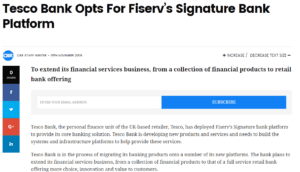
So, based on the known knowns about the bank, a little OSINT digging soon located several points of intelligence on the web which verbosely outline how this leading edge bank is seeking cost reductions, applying the approach of outsourcing, with over £60 million spent in 2016 on such Third-Party support. So, at this stage we can deduce that there is a high probability that some of their Banking Platforms are sitting upon such technological support – some of which may not be under the direct control of the Bank. Second discovery of interest. One of the documents published by Tesco commented on the banking platform of choice the bank had chosen to run it operations. So here we have yet another lead to test the theory.
tesco

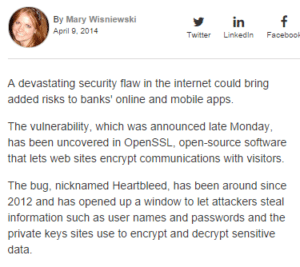
The next step in our discovery mission was to check out the actual banking platform in use, and the associated supporting organisation which was inferred to support Tesco – and as if by magic, there it was – this very company (Platform) had been reported to have suffered from a Heartbleed vulnerability!
mary

My external theory here is it is a probability that:

  1. Client credentials and sensitive information could have been harvested over a period of opportunity
  1. There is of course the related probability that of the multiples of millions of other security breached accounts which have occurred in the last 12 months played a part. Some of which also suffered from the Heartbleed exposure, and may have also allowed unauthorised access to sensitive objects which may have been leveraged
  1. That a well-planned, offline Project was put in place to identify, extract, and to feed into the attack stream the compromised credentials to be invoked
  1. That the attack plan included a well built, automated mechanism to maximise the point-and-click data entry replay
  1. The inbuilt thresholds to extract funds were kept at a sensible level, so as not to tempt raising any alarms [imagine multiples of alerts being generated by an overzealous transfer requests]
  1. The weekend was chosen for two reasons 1) It is a time when staffing levels are lower than the normal operational week, and 2) The weekend period would most likely offer up the camouflage of maximised end-user activity against their legitimate bank account

Of course, this is only a theory based on some facts I have discovered, However, I, my family members who have an account with Tesco, and no doubt all the other multiples of unfortunates who suffered loss would no doubt welcome an explanation as to just how this breach did occur.

To close – you may have noticed from breaches going back over 30 years, from the well documented Cuckoo’s Egg attack [Clifford Stoll] up to some more recent well documented breaches, Third Parties and their Platforms have played their part as the hackers back-door to the associated crown jewels. This why if you do utilise Third Parity support, it is so very important to proactively manage that relationship.

[su_box title=”About Professor John Walker” style=”noise” box_color=”#336588″][short_info id=’66024′ desc=”true” all=”false”][/su_box]

Professor John Walker

John is the Principle at Shadow-Intelligence (Si), partnering with PALISCOPE, BreachAware and iStorage. He is a Visiting Professor at the School of Science and Technology, Nottingham, Trent University (NTU) and holds the appointment of Editor in Chief for the International Journal of Cyber Forensics and Advanced Threat Investigations (CFATI). For the last decade he has delivered training courses in the Middle, and Far East to Commercial, Industrial, the Financial Services Sector, and Military Agencies, including the UAE, US, Pakistan, Saudi Arabia, Malaysia (KL), Singapore, Argentina, and Sao Paulo

He served in the Royal Air Force 22 years’, specialising in Counterintelligence, working with UK Agencies such as GCHQ/CESG, and others in the fields of SIGINT, COMINT and Satellite Communications, holding appointments such as System ITSO for a CIA SCIF.

In the commercials sectors of IT/Cyber he has worked for/with Logica, Bae, T5, GM, Experian, Betfair, Palace of Westminster, House of Lords/Commons, TSol (Treasury Solicitors) and provided Consultancy to the Saudi Arabian MOD, TRA (Telecommunications Authority (Dubai) and the Military Academy of Malaysia (KL) on SOC, CSIRT, Digital Forensics and OSINT. Within the last 5 years he has focused on Geopolitics, with global expertise around the UAE and Russia, Anti-Terrorist Operations (ATO), Cyber-Warfare, Dezinformatsiya (Disinformation) and Maskirovka (Military Deception).

  • Professor John Walker
    China Threat Recap: A Deeper Insight
  • Professor John Walker
    Missing The Point In The Current Age Of Cyber
  • Professor John Walker
    Part 1: Historic To 2022 – The APT And Logical Threats
  • Professor John Walker
    A Hairs Breadth

The opinions expressed in this post belong to the individual contributors and do not necessarily reflect the views of Information Security Buzz.

Share. Facebook Twitter LinkedIn Email Copy Link

Related Posts

Exploited Faster, Patched Slower: Verizon DBIR 2026 Shows Security Teams Losing Ground

May 20, 20265 Mins Read

Security’s Blind Spot: The Threats Hiding in “Low-Severity” Alerts

May 6, 20265 Mins Read

Why OSINT deserves the same status as other intelligence disciplines

March 17, 20266 Mins Read
ISB-Bora-Side-Bar

No se ha podido establecer conexión. Error 429

 
ISB-Bora-Side-Bar
Black ISB Logo

Information Security Buzz is an independent resource that provides the experts’ comments, analysis, and opinion on the latest Cybersecurity news and topics

X (Twitter) LinkedIn Facebook RSS

Working With Us

  • About Us
  • Advertise With Us
  • Contact Us

Write For Us

  • How To Contribute

The Pages

  • Privacy Policy
  • Cookie Policy
  • AI Policy
  • Terms & Conditions
  • Copyright Notice

Information Security Buzz and all its contents are copyright © 2014-2025. All rights reserved. All third-party trademarks are recognized.

Type above and press Enter to search. Press Esc to cancel.

Manage Consent
To provide the best experiences, we use technologies like cookies to store and/or access device information. Consenting to these technologies will allow us to process data such as browsing behavior or unique IDs on this site. Not consenting or withdrawing consent, may adversely affect certain features and functions.
Functional Always active
The technical storage or access is strictly necessary for the legitimate purpose of enabling the use of a specific service explicitly requested by the subscriber or user, or for the sole purpose of carrying out the transmission of a communication over an electronic communications network.
Preferences
The technical storage or access is necessary for the legitimate purpose of storing preferences that are not requested by the subscriber or user.
Statistics
The technical storage or access that is used exclusively for statistical purposes. The technical storage or access that is used exclusively for anonymous statistical purposes. Without a subpoena, voluntary compliance on the part of your Internet Service Provider, or additional records from a third party, information stored or retrieved for this purpose alone cannot usually be used to identify you.
Marketing
The technical storage or access is required to create user profiles to send advertising, or to track the user on a website or across several websites for similar marketing purposes.
  • Manage options
  • Manage services
  • Manage {vendor_count} vendors
  • Read more about these purposes
View preferences
  • {title}
  • {title}
  • {title}