

Close Menu
  • Home
  • Articles
    • Attacks
      • BEC
      • Data Breach
      • DDoS
      • Evasion Attacks
      • Injection
      • Malware
      • MITM
      • Phishing
      • Ransomware
      • RCE
      • Social Engineering
      • Spoofing
      • Spyware
    • Business and Policy
      • BCP and DRP
      • GRC
      • Regulations
    • Data Protection
      • DLP
      • DRM
      • Encryption
      • IAM
    • Future, Trends and Insight
      • AI
      • Events & Community
      • Emerging Tech
      • Expert Panel
      • Interviews With Experts
      • Insights
      • Study & Research
    • Resources
      • Guides
      • Tools
      • Training & Education
    • Security
      • API
      • Apps
      • Cloud
      • Critical Infrastructure
      • Endpoint
      • Hardware
      • IoT
      • Mobile
      • Network
      • OT
      • Port Security
      • Security Architecture
      • Software Development
      • Supply Chain
      • Zero Trust
    • Threats and Vulnerabilities
      • Emerging Threats
      • Insider Threats
      • Risk Management
      • Threat Intelligence
      • Zero Day
  • News and Exclusives
    • Latest News
    • ISB Exclusive
    • Positive News
  • Who We Are
    • About Us
    • Information Security Buzz Expert Panel​
    • Write for Us
    • Media Pack
  • Contact Us
  • Newsletter
Facebook X (Twitter) LinkedIn
Information Security BuzzInformation Security Buzz
  • Home
  • Articles
    • Attacks
      • BEC
      • Data Breach
      • DDoS
      • Evasion Attacks
      • Injection
      • Malware
      • MITM
      • Phishing
      • Ransomware
      • RCE
      • Social Engineering
      • Spoofing
      • Spyware
    • Business and Policy
      • BCP and DRP
      • GRC
      • Regulations
    • Data Protection
      • DLP
      • DRM
      • Encryption
      • IAM
    • Future, Trends and Insight
      • AI
      • Events & Community
      • Emerging Tech
      • Expert Panel
      • Interviews With Experts
      • Insights
      • Study & Research
    • Resources
      • Guides
      • Tools
      • Training & Education
    • Security
      • API
      • Apps
      • Cloud
      • Critical Infrastructure
      • Endpoint
      • Hardware
      • IoT
      • Mobile
      • Network
      • OT
      • Port Security
      • Security Architecture
      • Software Development
      • Supply Chain
      • Zero Trust
    • Threats and Vulnerabilities
      • Emerging Threats
      • Insider Threats
      • Risk Management
      • Threat Intelligence
      • Zero Day
  • News and Exclusives
    • Latest News
    • ISB Exclusive
    • Positive News
  • Who We Are
    • About Us
    • Information Security Buzz Expert Panel​
    • Write for Us
    • Media Pack
  • Contact Us
  • Newsletter
Subscribe
Information Security BuzzInformation Security Buzz
Home - News & Analysis - A Commercial Malware Boutique Operating on Land, Air and Sea
News & Analysis

A Commercial Malware Boutique Operating on Land, Air and Sea

ISBuzz TeamBy ISBuzz TeamFebruary 11, 20164 Mins Read
Share LinkedIn Twitter Facebook Copy Link Email
A Commercial Malware Boutique Operating on Land, Air and Sea
Share
Facebook Twitter LinkedIn Email Copy Link
Quick AI Summary
ChatGPTClaudeGeminiGrokPerplexityDeepSeekCopilot

First ever publicly-known Brazilian Portuguese-speaking campaign targeting financial institutions as well as telecommunications, manufacturing, energy and media companies

[su_note note_color=”#ffffcc” text_color=”#00000″]Global Research and Analysis Team at Kaspersky Lab:

Kaspersky Lab’s Global Research and Analysis Team has announced the discovery of the Poseidon Group, an advanced threat actor active in global cyber-espionage operations since at least 2005. What makes the Poseidon Group stand out is that it’s a commercial entity, whose attacks involve custom malware digitally signed with rogue certificates deployed to steal sensitive data from victims to coerce them into a business relationship. In addition, the malware is designed to function specifically on English and Brazilian Portuguese Windows machines, a first for a targeted attack.

At least 35 victim companies have been identified with primary targets including financial and government institutions, telecommunications, manufacturing, energy and other service utility companies, as well as media and public relations firms. Kaspersky Lab experts have also detected attacks on service companies that cater to top corporate executives.

Victims of this group have been found in the following countries:

  • United States
  • France
  • Kazakhstan
  • United Arab Emirates
  • India
  • Russia

However, the victim spread is heavily skewed towards Brazil, where many of the victims have joint ventures or partner operations.
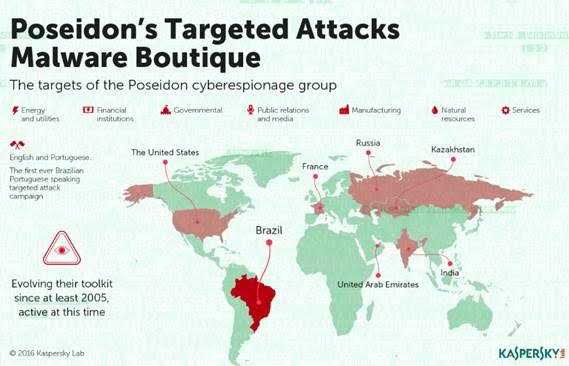
Image 1

One of the characteristics of the Poseidon Group is an active exploration of domain-based corporate networks. According to Kaspersky Lab’s analysis report, the Poseidon Group relies on spear-phishing e-mails with RTF/DOC files, usually with a human resources lure, that drop a malicious binary into the target’s system when clicked on. Another key finding is the presence of Brazilian-Portuguese language strings. The Group’s preference for Portuguese systems, as revealed by the samples, is a practice that has not previously been seen.

Once a computer is infected, the malware reports to the command and control servers before beginning a complex phase of lateral movement. This phase will often leverage a specialised tool that automatically and aggressively collects a wide array of information including credentials, group management policies, and even system logs to better hone further attacks and assure execution of the malware. By doing this, the attackers actually know what applications and commands they can use without alerting the network administrator during lateral movement and exfiltration.

The information gathered is then leveraged by a fronting business to manipulate victim companies into contracting the Poseidon Group as a security consultant under the threat of exploiting the stolen information in a series of shady business deals to benefit Poseidon.

“The Poseidon Group is a long-standing team operating on all domains: land, air and sea. Some of its command and control centers have been found inside ISPs providing Internet service to ships at sea, wireless connections as well as those inside traditional carriers,” said Dmitry Bestuzhev, Director, Global Research and Analysis Team, Kaspersky Lab Latin America. “In addition, several of its implants were found to have a very short life span which contributed to this Group being able to operate for such a long time without being detected.”

As the Poseidon Group has been active for at least ten years, the techniques used to design its implants have evolved, making it hard for many researchers to correlate indicators and put all of the pieces together. However, by carefully collecting all the evidence, working with the threat actor’s calligraphy and reconstructing the attacker’s timeline, Kaspersky Lab experts were able to establish by the middle of 2015 that previously detected but unidentified traces in fact belonged to the same threat actor, the Poseidon Group.[/su_note]

[su_box title=”About Kaspersky Lab” style=”noise” box_color=”#336588″]Kaspersky LabKaspersky Lab is a global cybersecurity company founded in 1997. Kaspersky Lab’s deep threat intelligence and security expertise is constantly transforming into security solutions and services to protect businesses, critical infrastructure, governments and consumers around the globe. The company’s comprehensive security portfolio includes leading endpoint protection and a number of specialized security solutions and services to fight sophisticated and evolving digital threats. Over 400 million users are protected by Kaspersky Lab technologies and we help 270,000 corporate clients protect what matters most to them.[/su_box]

ISBuzz Team
  • ISBuzz Team
    Air Canada Data Breach: BianLian Extortion Group Claims A Massive Heist Contrary To Airline’s Earlier Statement
  • ISBuzz Team
    Unprecedented DDoS Attack Rocks The Web: Tech Giants Reveal A Digital Tsunami
  • ISBuzz Team
    CISA Flags High-Severity Adobe Acrobat Reader Flaw Amid Active Exploits
  • ISBuzz Team
    Curl Security Alert: Patching A Critical Bug Averting Potential Cyber Catastrophe

The opinions expressed in this post belong to the individual contributors and do not necessarily reflect the views of Information Security Buzz.

Share. Facebook Twitter LinkedIn Email Copy Link

Related Posts

Exploited Faster, Patched Slower: Verizon DBIR 2026 Shows Security Teams Losing Ground

May 20, 20265 Mins Read

Security’s Blind Spot: The Threats Hiding in “Low-Severity” Alerts

May 6, 20265 Mins Read

Why OSINT deserves the same status as other intelligence disciplines

March 17, 20266 Mins Read
ISB-Bora-Side-Bar

 
ISB-Bora-Side-Bar
Black ISB Logo

Information Security Buzz is an independent resource that provides the experts’ comments, analysis, and opinion on the latest Cybersecurity news and topics

X (Twitter) LinkedIn Facebook RSS

Working With Us

  • About Us
  • Advertise With Us
  • Contact Us

Write For Us

  • How To Contribute

The Pages

  • Privacy Policy
  • Cookie Policy
  • AI Policy
  • Terms & Conditions
  • Copyright Notice

Information Security Buzz and all its contents are copyright © 2014-2025. All rights reserved. All third-party trademarks are recognized.

Type above and press Enter to search. Press Esc to cancel.

Manage Consent
To provide the best experiences, we use technologies like cookies to store and/or access device information. Consenting to these technologies will allow us to process data such as browsing behavior or unique IDs on this site. Not consenting or withdrawing consent, may adversely affect certain features and functions.
Functional Always active
The technical storage or access is strictly necessary for the legitimate purpose of enabling the use of a specific service explicitly requested by the subscriber or user, or for the sole purpose of carrying out the transmission of a communication over an electronic communications network.
Preferences
The technical storage or access is necessary for the legitimate purpose of storing preferences that are not requested by the subscriber or user.
Statistics
The technical storage or access that is used exclusively for statistical purposes. The technical storage or access that is used exclusively for anonymous statistical purposes. Without a subpoena, voluntary compliance on the part of your Internet Service Provider, or additional records from a third party, information stored or retrieved for this purpose alone cannot usually be used to identify you.
Marketing
The technical storage or access is required to create user profiles to send advertising, or to track the user on a website or across several websites for similar marketing purposes.
  • Manage options
  • Manage services
  • Manage {vendor_count} vendors
  • Read more about these purposes
View preferences
  • {title}
  • {title}
  • {title}