

Close Menu
  • Home
  • Articles
    • Attacks
      • BEC
      • Data Breach
      • DDoS
      • Evasion Attacks
      • Injection
      • Malware
      • MITM
      • Phishing
      • Ransomware
      • RCE
      • Social Engineering
      • Spoofing
      • Spyware
    • Business and Policy
      • BCP and DRP
      • GRC
      • Regulations
    • Data Protection
      • DLP
      • DRM
      • Encryption
      • IAM
    • Future, Trends and Insight
      • AI
      • Events & Community
      • Emerging Tech
      • Expert Panel
      • Interviews With Experts
      • Insights
      • Study & Research
    • Resources
      • Guides
      • Tools
      • Training & Education
    • Security
      • API
      • Apps
      • Cloud
      • Critical Infrastructure
      • Endpoint
      • Hardware
      • IoT
      • Mobile
      • Network
      • OT
      • Port Security
      • Security Architecture
      • Software Development
      • Supply Chain
      • Zero Trust
    • Threats and Vulnerabilities
      • Emerging Threats
      • Insider Threats
      • Risk Management
      • Threat Intelligence
      • Zero Day
  • News and Exclusives
    • Latest News
    • ISB Exclusive
    • Positive News
  • Who We Are
    • About Us
    • Information Security Buzz Expert Panel​
    • Write for Us
    • Media Pack
  • Contact Us
  • Newsletter
Facebook X (Twitter) LinkedIn
Information Security BuzzInformation Security Buzz
  • Home
  • Articles
    • Attacks
      • BEC
      • Data Breach
      • DDoS
      • Evasion Attacks
      • Injection
      • Malware
      • MITM
      • Phishing
      • Ransomware
      • RCE
      • Social Engineering
      • Spoofing
      • Spyware
    • Business and Policy
      • BCP and DRP
      • GRC
      • Regulations
    • Data Protection
      • DLP
      • DRM
      • Encryption
      • IAM
    • Future, Trends and Insight
      • AI
      • Events & Community
      • Emerging Tech
      • Expert Panel
      • Interviews With Experts
      • Insights
      • Study & Research
    • Resources
      • Guides
      • Tools
      • Training & Education
    • Security
      • API
      • Apps
      • Cloud
      • Critical Infrastructure
      • Endpoint
      • Hardware
      • IoT
      • Mobile
      • Network
      • OT
      • Port Security
      • Security Architecture
      • Software Development
      • Supply Chain
      • Zero Trust
    • Threats and Vulnerabilities
      • Emerging Threats
      • Insider Threats
      • Risk Management
      • Threat Intelligence
      • Zero Day
  • News and Exclusives
    • Latest News
    • ISB Exclusive
    • Positive News
  • Who We Are
    • About Us
    • Information Security Buzz Expert Panel​
    • Write for Us
    • Media Pack
  • Contact Us
  • Newsletter
Subscribe
Information Security BuzzInformation Security Buzz
Home - Study & Research - Almost 40 Per Cent Of Industrial Computers Faced A Cyberattack In The 2nd Half Of 2016
Study & Research

Almost 40 Per Cent Of Industrial Computers Faced A Cyberattack In The 2nd Half Of 2016

ISBuzz TeamBy ISBuzz TeamMarch 31, 20175 Mins Read
Share LinkedIn Twitter Facebook Copy Link Email
Share
Facebook Twitter LinkedIn Email Copy Link
Quick AI Summary
ChatGPTClaudeGeminiGrokPerplexityDeepSeekCopilot

On average two-in-five computers, related to the technological infrastructure of industrial enterprises, faced cyberattacks in the second half of 2016. This is a finding from Kaspersky Lab’s report “Threat Landscape for Industrial Automation Systems. The second half of 2016.” The percentage of industrial computers under attack grew from over 17 per cent in July 2016 to more than 24 per cent in December 2016, with the top three sources of infection being the Internet, removable storage devices, and malicious e-mail attachments and scripts embedded in the body of e-mails.

As the technology and corporate networks of industrial enterprises become increasingly integrated, more and more cybercriminals are turning their attention to industrial enterprises as potential targets. By exploiting vulnerabilities in the networks and software used by these enterprises, attackers could steal information related to the production process or even bring down manufacturing operations, leading to technogenic disaster.

In order to find out how widespread the threat is, Kaspersky Lab ICS CERT specialists have conducted dedicated research into the cyberthreat landscape faced by ICS systems.
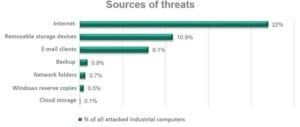
Sources of Threats

They discovered that in the second half of 2016 malware downloads and access to phishing web-pages were blocked on over 22 per cent of industrial computers. This means that almost every fifth machine at least once faced the risk of infection or credential compromise via the Internet.

The desktop computers of engineers and operators working directly with ICS do not usually have direct access to the Internet due to the limitations of the technology network in which they are located. However, there are other users that have simultaneous access to the Internet and ICS. According to Kaspersky Lab research, these computers – presumably used by system and network administrators, developers and integrators of industrial automation systems and third party contractors who connect to technology networks directly or remotely – can freely connect to the Internet because they are not tied to only one industrial network with its inherent limitations.

The Internet is not the only thing that threatens the cybersecurity of ICS systems. The danger of infected removable storage devices was another threat spotted by the company’s researchers. During the period of research, 10.9 per cent of computers with ICS software installed (or connected to those that have this software) showed traces of malware when a removable device was connected to them.

Malicious e-mail attachments and scripts embedded in the body of e-mails were blocked on 8.1 per cent of industrial computers, taking third place. In most cases, attackers use phishing e-mails to attract the user’s attention and disguise malicious files. Malware was most often distributed in the format of office documents such as MS Office and PDF files. Using various techniques, the criminals made sure that people downloaded and ran malware on the industrial organisation’s computers.

According to Kaspersky Lab research, malware, which poses a significant threat to companies around the world, is also dangerous to industrial enterprises. This includes spyware, backdoors, keyloggers, financial malware, ransomware, and wipers. These can completely paralyse the organisation’s control over its ICS or can be used for targeted attacks respectively. The latter is possible because of inherent functions that provide an attacker with lots of possibilities for remote control.

“Our analysis shows us that blind faith in technology networks’ isolation from the Internet doesn’t work anymore. The rise of cyberthreats to critical infrastructure indicates that ICS should be properly secured from malware both inside and outside the perimeter. It is also important to note that according to our observations, the attacks almost always start with the weakest link in any protection – people,” said Evgeny Goncharov, Head of Critical Infrastructure Defense Department, Kaspersky Lab.

The other findings of the Kaspersky Lab report “Industrial automation systems threat landscape in the second half of 2016” are:

  • Every fourth targeted-attackdetected by Kaspersky Lab in 2016 was aimed at industrial targets
  • About 20,000different malware samples were revealed in industrial automation systems belonging to over 2,000 different malware families
  • 75 vulnerabilitieswere revealed by Kaspersky Lab in 2016. 58 of them were marked as maximum critical vulnerabilities
  • Top three countrieswith attacked industrial computers: Vietnam (more than 66 per cent), Algeria (over 65 per cent), Morocco (60 per cent)

In order to protect the ICS environment from possible cyber-attacks, Kaspersky Lab security experts advise the following:

  • Conduct a security assessmentto identify and remove security loopholes
  • Request external intelligence: intelligence from reputable vendors helps organisations to predict future attacks on the company’s industrial infrastructure
  • Train your personnel
  • Provide protection inside and outside the perimeter. A proper security strategy has to devote significant resources to attack detection and response, to block an attack before it reaches critically important objects
  • Evaluate advanced methods of protection: A Default Deny scenario for SCADA systems, regular integrity checks for controllers, and specialised network monitoring to increase the overall security of a company will reduce the chances of a successful breach, even if some inherently vulnerable nodes cannot be patched or removed.

Read a summary of the Kaspersky Lab ICS CERT report for H2 2016 on Securelist.com. The full report is available on Kaspersky Lab ICS CERT website.

[su_box title=”About Kaspersky Lab” style=”noise” box_color=”#336588″][short_info id=’59584′ desc=”true” all=”false”][/su_box]

ISBuzz Team
  • ISBuzz Team
    Air Canada Data Breach: BianLian Extortion Group Claims A Massive Heist Contrary To Airline’s Earlier Statement
  • ISBuzz Team
    Unprecedented DDoS Attack Rocks The Web: Tech Giants Reveal A Digital Tsunami
  • ISBuzz Team
    CISA Flags High-Severity Adobe Acrobat Reader Flaw Amid Active Exploits
  • ISBuzz Team
    Curl Security Alert: Patching A Critical Bug Averting Potential Cyber Catastrophe

The opinions expressed in this post belong to the individual contributors and do not necessarily reflect the views of Information Security Buzz.

Share. Facebook Twitter LinkedIn Email Copy Link

Related Posts

New Phishing Kit Starkiller Defeats Multi-Factor Authentication

February 23, 20264 Mins Read

ReliaQuest Uncovers Social Media Phishing Campaign Built on Trusted Tools

January 22, 20266 Mins Read

What Happens after a Phishing Email Lands in Your Inbox?

January 5, 20266 Mins Read
ISB-Bora-Side-Bar

No se ha podido establecer conexión. Error 429

 
ISB-Bora-Side-Bar
Black ISB Logo

Information Security Buzz is an independent resource that provides the experts’ comments, analysis, and opinion on the latest Cybersecurity news and topics

X (Twitter) LinkedIn Facebook RSS

Working With Us

  • About Us
  • Advertise With Us
  • Contact Us

Write For Us

  • How To Contribute

The Pages

  • Privacy Policy
  • Cookie Policy
  • AI Policy
  • Terms & Conditions
  • Copyright Notice

Information Security Buzz and all its contents are copyright © 2014-2025. All rights reserved. All third-party trademarks are recognized.

Type above and press Enter to search. Press Esc to cancel.

Manage Consent
To provide the best experiences, we use technologies like cookies to store and/or access device information. Consenting to these technologies will allow us to process data such as browsing behavior or unique IDs on this site. Not consenting or withdrawing consent, may adversely affect certain features and functions.
Functional Always active
The technical storage or access is strictly necessary for the legitimate purpose of enabling the use of a specific service explicitly requested by the subscriber or user, or for the sole purpose of carrying out the transmission of a communication over an electronic communications network.
Preferences
The technical storage or access is necessary for the legitimate purpose of storing preferences that are not requested by the subscriber or user.
Statistics
The technical storage or access that is used exclusively for statistical purposes. The technical storage or access that is used exclusively for anonymous statistical purposes. Without a subpoena, voluntary compliance on the part of your Internet Service Provider, or additional records from a third party, information stored or retrieved for this purpose alone cannot usually be used to identify you.
Marketing
The technical storage or access is required to create user profiles to send advertising, or to track the user on a website or across several websites for similar marketing purposes.
  • Manage options
  • Manage services
  • Manage {vendor_count} vendors
  • Read more about these purposes
View preferences
  • {title}
  • {title}
  • {title}