


Close Menu
  • Home
  • Articles
    • Attacks
      • BEC
      • Data Breach
      • DDoS
      • Evasion Attacks
      • Injection
      • Malware
      • MITM
      • Phishing
      • Ransomware
      • RCE
      • Social Engineering
      • Spoofing
      • Spyware
    • Business and Policy
      • BCP and DRP
      • GRC
      • Regulations
    • Data Protection
      • DLP
      • DRM
      • Encryption
      • IAM
    • Future, Trends and Insight
      • AI
      • Events & Community
      • Emerging Tech
      • Expert Panel
      • Interviews With Experts
      • Insights
      • Study & Research
    • Resources
      • Guides
      • Tools
      • Training & Education
    • Security
      • API
      • Apps
      • Cloud
      • Critical Infrastructure
      • Endpoint
      • Hardware
      • IoT
      • Mobile
      • Network
      • OT
      • Port Security
      • Security Architecture
      • Software Development
      • Supply Chain
      • Zero Trust
    • Threats and Vulnerabilities
      • Emerging Threats
      • Insider Threats
      • Risk Management
      • Threat Intelligence
      • Zero Day
  • News and Exclusives
    • Latest News
    • ISB Exclusive
    • Positive News
  • Who We Are
    • About Us
    • Information Security Buzz Expert Panel​
    • Write for Us
    • Media Pack
  • Contact Us
  • Newsletter
Facebook X (Twitter) LinkedIn
Information Security BuzzInformation Security Buzz
  • Home
  • Articles
    • Attacks
      • BEC
      • Data Breach
      • DDoS
      • Evasion Attacks
      • Injection
      • Malware
      • MITM
      • Phishing
      • Ransomware
      • RCE
      • Social Engineering
      • Spoofing
      • Spyware
    • Business and Policy
      • BCP and DRP
      • GRC
      • Regulations
    • Data Protection
      • DLP
      • DRM
      • Encryption
      • IAM
    • Future, Trends and Insight
      • AI
      • Events & Community
      • Emerging Tech
      • Expert Panel
      • Interviews With Experts
      • Insights
      • Study & Research
    • Resources
      • Guides
      • Tools
      • Training & Education
    • Security
      • API
      • Apps
      • Cloud
      • Critical Infrastructure
      • Endpoint
      • Hardware
      • IoT
      • Mobile
      • Network
      • OT
      • Port Security
      • Security Architecture
      • Software Development
      • Supply Chain
      • Zero Trust
    • Threats and Vulnerabilities
      • Emerging Threats
      • Insider Threats
      • Risk Management
      • Threat Intelligence
      • Zero Day
  • News and Exclusives
    • Latest News
    • ISB Exclusive
    • Positive News
  • Who We Are
    • About Us
    • Information Security Buzz Expert Panel​
    • Write for Us
    • Media Pack
  • Contact Us
  • Newsletter
Subscribe
Information Security BuzzInformation Security Buzz
Home - Articles - Building the Case For SOC/NOC Integration
Articles

Building the Case For SOC/NOC Integration

ISBuzz TeamBy ISBuzz TeamNovember 20, 20184 Mins Read
Share LinkedIn Twitter Facebook Copy Link Email
Cybersecurity
Unveiling The Power Of Cybersecurity Monitoring Capability Guide
Share
Facebook Twitter LinkedIn Email Copy Link
Quick AI Summary
ChatGPTClaudeGeminiGrokPerplexityDeepSeekCopilot

SOC/NOC Integration Breeds Increased Efficiency and Effectiveness

SOCs (security operations centers) and NOCs (network operations centers) both serve vital functions in your network. And while each serves a different function, significant overlaps exist that can be leveraged to create more efficiency and effectiveness in your organization.

SOC staff must assess and respond to security events quickly to resolve cybersecurity issues before they can negatively impact the business, while NOC staff are responsible for making sure your network maximizes uptime and ensuring that bandwidth and demand can be managed properly.

Your SOC and NOC have demanding work that they need to deal with on a constant basis, but their goals are different. When your network has both types of operations centers, can they work together? Are there redundancies that can be dropped?

Maximize Focus: Identify and Eliminate SOC/NOC Redundancies

Redundancy is great when it comes to how many network appliances, servers and data storage devices you have. You should have some extra infrastructure, so you can continue to address network demands when a component fails, or to adequately manage through periods of high network demand.

But, when it comes to your SOC and NOC repeating tasks and functions, redundancy can be inefficient and costly for your organization. What if you integrated your SOC and NOC? Are there benefits?

Let’s say a network anomaly is discovered. A device stops working, for example. Someone who thinks like a SOC analyst will consider if the device was subject to a cyberattack. Someone who thinks like a NOC analyst will consider if the device failed for some non-cybersecurity related reason. If the SOC can’t find indications of a cyberattack, then they move on. If the device is malfunctioning because of a cyberattack, the NOC might not be equipped to recognize it.

In this case – and a myriad of others that occur daily in SOCs and NOCs around the globe – it would be much more efficient if the SOC and the NOC joined forces instead of duplicating efforts. Separately, security operations and network operations may fall prey to the problems of one hand not knowing what the other hand is doing. Together, an enterprise can save significantly on labor costs by combining the centers and improve its overall effectiveness.

Bringing Your NOC and SOC Together

Both NOCs and SOCs have incident and response teams, call centers and monitoring. Both centers work hard to assure the integrity and availability of your IT assets and can work well together, yet few enterprises truly integrate these functions.
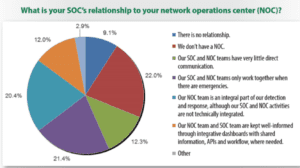
Source: Crowley/SANS 2017

Of course, how you go about bringing the two teams together determines your level of success.

A properly integrated SOC/NOC, otherwise known as an Integrated Operations Center (IOC), converges on three different levels:

  • Organizational level: entails cross-correlating, pattern identification from shared NOC/SOC monitoring tools, triaging and collaboration.
  • System level: entails standard operating procedures, process integration and service level agreements (SLAs.)
  • Asset level: entails the shared use of a common information aggregator that collects all of the pertinent network monitoring data and logs and distributes it through integrated tools and dashboards.

The potential for improved incident response and overall network efficiency should be obvious already. Let’s look at what it means for the various levels in the NOC and SOC.

The most integration can be done at tier one. This level has similar functions in both SOCs and NOCs – alert monitoring, alert triaging and monitoring the health of both network and security sensors.

Tiers two and three are where we start to see greater variation.

SOC NOC
Tier 2/Level 2 Security incident analysis, remediation advice and support for new methods of threat detection.

Coordination with network and infrastructure vendors, support for fault management and change execution.
Tier 3/Level 3 Incident hunting, developing new threat detection analytics, threat intelligence, forensics and malware reverse engineering Problem management, change validation and performance monitoring and reporting.

Even with these distinct functions at the higher levels, it is possible to create a cohesive integrated operations center through the use of a security orchestration platform that acts as a unifying fabric for the NOC and SOC. Applying security orchestration this way brings together the various technologies and processes used by both sides of the house to streamline day-to-day activities, resolve incidents faster and centralize collaboration.

ISBuzz Team
  • ISBuzz Team
    Air Canada Data Breach: BianLian Extortion Group Claims A Massive Heist Contrary To Airline’s Earlier Statement
  • ISBuzz Team
    Unprecedented DDoS Attack Rocks The Web: Tech Giants Reveal A Digital Tsunami
  • ISBuzz Team
    CISA Flags High-Severity Adobe Acrobat Reader Flaw Amid Active Exploits
  • ISBuzz Team
    Curl Security Alert: Patching A Critical Bug Averting Potential Cyber Catastrophe

The opinions expressed in this post belong to the individual contributors and do not necessarily reflect the views of Information Security Buzz.

Share. Facebook Twitter LinkedIn Email Copy Link

Related Posts

Exploited Faster, Patched Slower: Verizon DBIR 2026 Shows Security Teams Losing Ground

May 20, 20265 Mins Read

Security’s Blind Spot: The Threats Hiding in “Low-Severity” Alerts

May 6, 20265 Mins Read

Why OSINT deserves the same status as other intelligence disciplines

March 17, 20266 Mins Read
ISB-Bora-Side-Bar

 
ISB-Bora-Side-Bar
Black ISB Logo

Information Security Buzz is an independent resource that provides the experts’ comments, analysis, and opinion on the latest Cybersecurity news and topics

X (Twitter) LinkedIn Facebook RSS

Working With Us

  • About Us
  • Advertise With Us
  • Contact Us

Write For Us

  • How To Contribute

The Pages

  • Privacy Policy
  • Cookie Policy
  • AI Policy
  • Terms & Conditions
  • Copyright Notice

Information Security Buzz and all its contents are copyright © 2014-2025. All rights reserved. All third-party trademarks are recognized.

Type above and press Enter to search. Press Esc to cancel.

Manage Consent
To provide the best experiences, we use technologies like cookies to store and/or access device information. Consenting to these technologies will allow us to process data such as browsing behavior or unique IDs on this site. Not consenting or withdrawing consent, may adversely affect certain features and functions.
Functional Always active
The technical storage or access is strictly necessary for the legitimate purpose of enabling the use of a specific service explicitly requested by the subscriber or user, or for the sole purpose of carrying out the transmission of a communication over an electronic communications network.
Preferences
The technical storage or access is necessary for the legitimate purpose of storing preferences that are not requested by the subscriber or user.
Statistics
The technical storage or access that is used exclusively for statistical purposes. The technical storage or access that is used exclusively for anonymous statistical purposes. Without a subpoena, voluntary compliance on the part of your Internet Service Provider, or additional records from a third party, information stored or retrieved for this purpose alone cannot usually be used to identify you.
Marketing
The technical storage or access is required to create user profiles to send advertising, or to track the user on a website or across several websites for similar marketing purposes.
  • Manage options
  • Manage services
  • Manage {vendor_count} vendors
  • Read more about these purposes
View preferences
  • {title}
  • {title}
  • {title}