



Most teams already have cloud security tools in place. That’s not the issue. The problem is that those tools don’t give you any real control. Infrastructure is built fast, modified constantly, and touched by too many people to track. Code moves through CI pipelines and ends up in production before anyone from security even knows it changed.
Breaches linked to cloud misconfigurations cost organizations an average of $3.98 million. This is the baseline risk that comes with modern cloud operations. The attack surface is broad, ephemeral, and filled with gaps that most teams don’t see until someone else finds them first.
The attack surface is highly distributed and constantly changing. Most of them are small, made in isolation. No one’s trying to introduce risk. But without visibility into what’s changing and why, security ends up reacting after the fact. By then, it’s already in production and already a problem.
What Are Cloud Security Controls?
Cloud security controls are the specific rules, technical configurations, and automated procedures implemented to govern and protect a cloud environment.
The old model of building a network wall, the “castle-and-moat” approach, is no longer in use. The cloud has no single, definable perimeter. Assets are now temporary workloads, serverless functions, and globally distributed data stores. A constantly shifting set of human and machine identities allows them to access them from anywhere in the world.
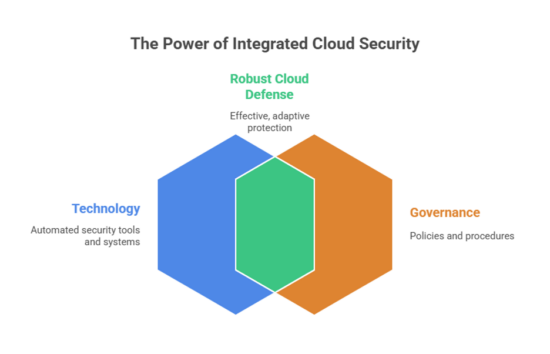
Robust security needs a blend of technology and governance. The technology, such as a vulnerability scanner, alerts you to critical flaws. Governance policies (for example, requiring flaws to be patched within seven days) drive timely action. Drop either layer, and your defenses fall short.
Three Types of Cloud Security Controls
A resilient security program comprises three types of controls that work in tandem.
1. Preventive Controls
Preventive controls eliminate risk conditions before they lead to exposure or compromise. Instead of responding to known threats, they enforce constraints that make certain classes of attacks impossible or significantly more challenging to execute.
What they do: Whether implemented through IAM policies, service control boundaries, or pre-deployment checks, the goal is to prevent insecure states from ever reaching production. This kind of embedded logic is also central when assessingAI agents for penetration testing, which must enforce guardrails proactively rather than reactively.
Examples:
- Identity & access management (IAM): IAM is the method of granting users and applications only the privileges they need to accomplish their activities. For example, a developer must not be given rights to delete from a database if their task is to read from it.
- Network rules: Utilize security groups to regulate the flow of incoming and outgoing traffic. A web server should be able to talk to the internet, but it probably shouldn’t be able to connect to your HR system. These rules stop that.
- Scanning in development: Before new code is released, it should be automatically scanned for security weaknesses. It identifies and resolves issues before they ever reach your live systems.
Why they matter: Every problem you prevent is one less emergency alert your team has to deal with. A modern Cloud Native Application Protection Platform can help automate these preventive steps, making it easier to be secure from the very beginning.
2. Detective Controls
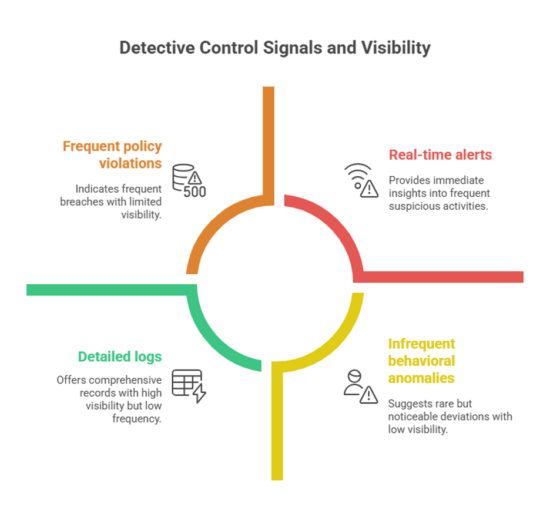
Detective controls are about seeing what’s happening in your environment, especially the things you didn’t expect. They’re designed to surface suspicious activity in real time or close to it, giving your team a chance to investigate and respond before damage spreads.
These controls don’t block threats directly. Instead, they generate signals, such as alerts, logs, policy violations, and behavioral anomalies. These signals point to possible compromise, misconfiguration, or abuse.
What they do: Detective controls give you operational visibility into your cloud systems. When tuned well, they help answer questions like:
- Who did what, and when?
- Is that behavior normal?
- Did something just change that shouldn’t have?
Examples:
- Logging and Monitoring. Logging alone doesn’t provide awareness. Until that data is parsed, correlated across services, and aligned with your architecture, it’s just noise. This kind of signal-to-noise imbalance is a recurring theme in WAF security testing, where surface-level metrics often obscure deeper visibility gaps. Visibility comes from making that stream coherent enough to show when something breaks the pattern.
- Threat Intelligence Integration. These systems ingest data on malicious, inadequate infrastructure, including IP addresses, domains, file hashes, and malware signatures. If your cloud instance starts communicating with an endpoint flagged in these feeds, that’s a signal. When used correctly, threat intelligence helps close the gap between global attack activity and your local exposure, especially when paired with threat detection tools that correlate malicious behavior across network and runtime layers.
- Configuration Drift Detection. In dynamic environments, misconfigurations are often introduced during legitimate changes. Detective controls continuously evaluate your environment against known-good baselines. If a database is left exposed to the internet or a bucket’s permission flips from private to public, you need to catch it quickly, especially if it wasn’t intentional.
Why They Matter
By the time a threat hits your preventive controls, it may already be too late. You miss the compromise if your detection lags or fails, and you only discover it during the post-mortem.
Detective controls won’t eliminate every risk. However, they provide you with the data and context to investigate. They trigger incident response. They create the feedback loop that strengthens your environment over time.
Without them, you’re operating blind.
3. Corrective Controls
When a security issue is identified, corrective controls apply predefined actions to contain and remediate it. These controls trigger on high-confidence signals mapped to known failure conditions, such as leaked credentials, privilege escalations, or config drift, scenarios that often stem from gaps invulnerability management practices when preventive measures fail or aren’t uniformly enforced.
They act without approval, executing scoped responses like key revocation or network isolation. Precision matters, and if the trigger logic is too broad, you create noise and break workflows, which is a challenge that grows with autonomous cybersecurity models, where remediation decisions are made dynamically and without human intervention.
What they do:
A corrective control runs when a specific condition is met that’s known to cause risk. It changes the system state in a way that has been tested in advance, such as revoking a key, disabling access, or resetting a configuration, so the issue is contained before it spreads, with no approval, no delay, and no people.
Examples:
- Automatic Key Rotation
If a secret key is exposed through a code commit, misconfigured service, or third-party leak, automated key management can revoke the credential and issue a new one. It limits the attacker’s ability to use the compromised key. - System Isolation
If a workload starts exhibiting signs of compromise, a rule can immediately cut its network access. Isolating the instance stops the spread and buys time for further investigation. - Rollback of Risky Changes
If a firewall rule, IAM policy, or other configuration introduces risk, an automated policy can revert the change to a previously known secure state. No ticket, no delay.
Why they matter: Response time determines impact. Automated remediation compresses response windows from hours to seconds. It ensures consistency, limits attacker dwell time, and prevents minor issues from escalating under load.
How Cloud Security Controls Map to the Shared Responsibility Model
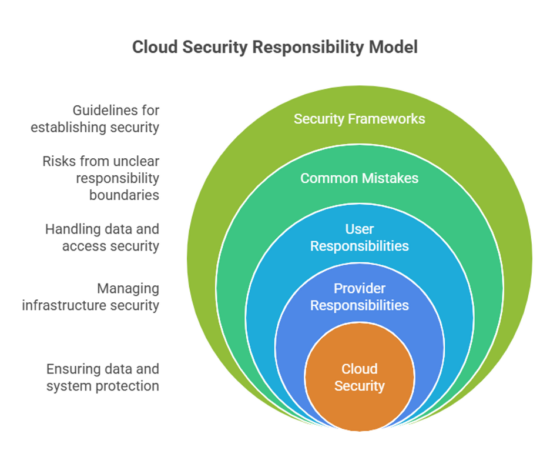
Using the cloud means splitting security responsibilities between you and the provider. They handle the infrastructure layer, including physical data centers, the network fabric, and the hypervisor stack. However, independent firewall performance tests highlight how provider-side assumptions can leave major blind spots if not properly scrutinized. Everything above that, from your workloads to your access controls, is on you. That boundary isn’t always clear in practice, which is where mistakes often occur.
Here are some of the most common.
- Leaving storage open to the public
- Not updating software with security patches
- Giving users and applications far more permissions than they need
- Saving passwords and secret keys directly in code
Security frameworks, such as NIST and ISO 27001, serve as blueprints for establishing your security requirements.
Building a Cloud Security Control Strategy
A good plan is not just about buying tools; it’s also about using them effectively. It is about having a straightforward approach. Here are four key parts of a strong security plan:
- See everything: You cannot protect a system if you do not know it exists. In the cloud, new services can be started in minutes. You need a way to discover and manage all your cloud assets automatically. If you don’t, hidden systems become your most significant security risk.
- Focus on real risks: You will get thousands of security alerts. You need to know which ones matter. A security flaw on a test server is not as urgent as the same flaw on a production database holding customer information. Your tools should help you see this difference; otherwise, your team will get burned out by false alarms.
- Automate as much as possible: Conducting security reviews manually is too slow. Security checks and fixes must be automated and built into your regular development process. If security is not automated, it will either be skipped or slow everything down.
- Check compliance regularly: A security audit that happens only once a year is not enough. Your security posture can change from safe to risky in minutes. You need tools that continuously monitor your security and compliance rules, 24/7.
Building Real Defense Is More than a Checklist
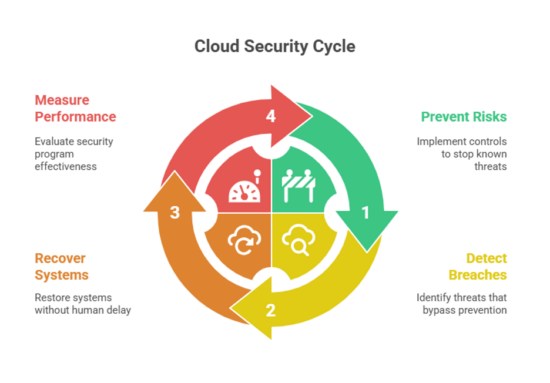
Modern cloud security isn’t about coverage on paper. It’s about how quickly your system can prevent known risks, surface what slips through, and recover without waiting on human intervention. That requires embedded, connected, and continuously enforced controls built into the architecture, not layered on after the fact.
Real security programs measure what matters: time to detect, time to contain, time to fix. If your environment can’t answer those questions quickly and consistently, it’s not ready.

Tyler Carrigan
Tyler is a Technical Marketing Engineer at Check Point Software Technologies. Prior to that he was a submarine sailor turned technical writer, turned cloud security professional. He now spends much of his time writing scripts to showcase cloud security products and enjoys the process of breaking down technical topics in a way that’s personal and easy to understand.
The opinions expressed in this post belong to the individual contributors and do not necessarily reflect the views of Information Security Buzz.