

Close Menu
  • Home
  • Articles
    • Attacks
      • BEC
      • Data Breach
      • DDoS
      • Evasion Attacks
      • Injection
      • Malware
      • MITM
      • Phishing
      • Ransomware
      • RCE
      • Social Engineering
      • Spoofing
      • Spyware
    • Business and Policy
      • BCP and DRP
      • GRC
      • Regulations
    • Data Protection
      • DLP
      • DRM
      • Encryption
      • IAM
    • Future, Trends and Insight
      • AI
      • Events & Community
      • Emerging Tech
      • Expert Panel
      • Interviews With Experts
      • Insights
      • Study & Research
    • Resources
      • Guides
      • Tools
      • Training & Education
    • Security
      • API
      • Apps
      • Cloud
      • Critical Infrastructure
      • Endpoint
      • Hardware
      • IoT
      • Mobile
      • Network
      • OT
      • Port Security
      • Security Architecture
      • Software Development
      • Supply Chain
      • Zero Trust
    • Threats and Vulnerabilities
      • Emerging Threats
      • Insider Threats
      • Risk Management
      • Threat Intelligence
      • Zero Day
  • News and Exclusives
    • Latest News
    • ISB Exclusive
    • Positive News
  • Who We Are
    • About Us
    • Information Security Buzz Expert Panel​
    • Write for Us
    • Media Pack
  • Contact Us
  • Newsletter
Facebook X (Twitter) LinkedIn
Information Security BuzzInformation Security Buzz
  • Home
  • Articles
    • Attacks
      • BEC
      • Data Breach
      • DDoS
      • Evasion Attacks
      • Injection
      • Malware
      • MITM
      • Phishing
      • Ransomware
      • RCE
      • Social Engineering
      • Spoofing
      • Spyware
    • Business and Policy
      • BCP and DRP
      • GRC
      • Regulations
    • Data Protection
      • DLP
      • DRM
      • Encryption
      • IAM
    • Future, Trends and Insight
      • AI
      • Events & Community
      • Emerging Tech
      • Expert Panel
      • Interviews With Experts
      • Insights
      • Study & Research
    • Resources
      • Guides
      • Tools
      • Training & Education
    • Security
      • API
      • Apps
      • Cloud
      • Critical Infrastructure
      • Endpoint
      • Hardware
      • IoT
      • Mobile
      • Network
      • OT
      • Port Security
      • Security Architecture
      • Software Development
      • Supply Chain
      • Zero Trust
    • Threats and Vulnerabilities
      • Emerging Threats
      • Insider Threats
      • Risk Management
      • Threat Intelligence
      • Zero Day
  • News and Exclusives
    • Latest News
    • ISB Exclusive
    • Positive News
  • Who We Are
    • About Us
    • Information Security Buzz Expert Panel​
    • Write for Us
    • Media Pack
  • Contact Us
  • Newsletter
Subscribe
Information Security BuzzInformation Security Buzz
Home - Articles - Cyber Attacks History In Higher Education
Articles

Cyber Attacks History In Higher Education

ISBuzz TeamBy ISBuzz TeamDecember 17, 2018Updated:December 4, 20245 Mins Read
Share LinkedIn Twitter Facebook Copy Link Email
Rapid Automation and Industrialization of Cyber Attacks
Share
Facebook Twitter LinkedIn Email Copy Link
Quick AI Summary
ChatGPTClaudeGeminiGrokPerplexityDeepSeekCopilot

The Higher Education sector increasingly attracts hackers due to huge amounts of critical information its systems store. This data refers to personal information of employees and students along with top universities’ research materials.

The research conducted by EdGuards Company, describing cybercrime development in the U.S. Higher Education sphere and notorious incidents caused by malefactors’ activity, reveals that a starting point of data breaches dates back to 2002.

Higher Education cyber attacks initiated
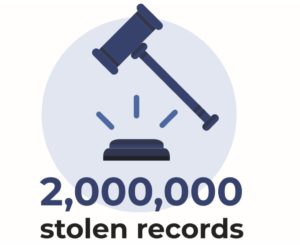
The first deal of cyber criminals in Higher Education was an attack on Yale’s system in 2002 by hackers from Princeton University. A target of the espionage was information on the admission decisions. In 2003, there were several attacks directed on students’ and staff members’ personal information. The statistics wasn’t upbeat – about 2,000,000 records of California universities were stolen within three breaches in 2004.

Personal data as the main target in the middle noughties

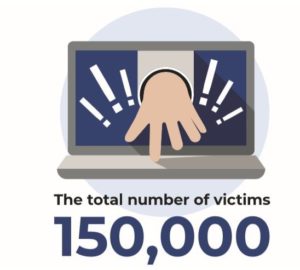
June 2005 left an indelible mark on the University of Hawaii – the personal data of 150,000 students, staff and library patrons was stolen by (you may not believe) a former librarian who compromised it in order to obtain fraudulent loans.
The University of Utah continued the library story – around 100,000 names and social security numbers of former employees were stolen from archival databases.

Next year, cyber attacks aimed at personal information increased dramatically. The breach of University of California at Los Angeles (UCLA) database caused the loss of nearly 800,000 records of faculty and staff, parents and student applicants.

Attackers focus on PeopleSoft system

Oracle’s PeopleSoft is a system that is broadly used by colleges and universities. The first attack on the PeopleSoft system that received wide media coverage happened in 2007. Three hackers used keylogging software on computers to steal passwords and then logged into the PeopleSoft system at Florida A&M University. The aim was changing the grades. The data was recovered but malefactors repeated their attack. As a result, the data of 90 students was modified by about 650 grade-changes.

In 2008, personal data was still the main aim of malefactors. However, the size of breaches increased significantly – from 70,000 stolen records to 700,000.

2012 was notorious due to a cyberattack on a PeopleSoft system. A student at the University of Nebraska compromised university’s PeopleSoft system and accessed the database so that critical information of 654,000 students and employees was exposed. Moreover, it led to leakage of the bank account details of 21,000 people. The stolen records included the information on 1985 spring alumni. Chadron State, Peru State, and Wayne State colleges were also impacted because two years earlier Nebraska college system started using NeSIS, a shared student information system. The former student pleaded guilty to one count intentionally damaging a protected computer while total harm was evaluated at $5,000. The university officials created a webpage devoted to the incident.

Another breach of PeopleSoft system happened a year later in Massachusetts Salem State University. The aim was erstwhile – personal data.

Higher Education cyber attacks size record

The personal data of 2.4 million current and former students and employees of the Maricopa County Community College District was compromised and then discovered by FBI on a website offering for sale.

A new stage of cybercrime development

During 2014-2016, not only the number of attacks rose significantly, but also breaches became more aggressive and advanced.

The main point of this period was a considerable increase in number of attacks. According to the statistic provided by Verizon’s annual Data Breach Investigations Report, the frequency of security breaches affecting universities multiplied almost ten times.

By 2017, the number of cyber attacks vastly grew to 393 (in 2012 there were only 5).

More than a data breach – cyber espionage campaign on Higher Education

In comparison with 2005, 2018 illustrates a tremendous increase in cybercrime sizes.
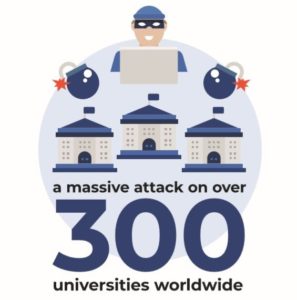
In March 2018, over 300 universities worldwide suffered from a giant cyberattack organized by nine Iranian hackers. According to the official information, 31 terabytes of “valuable intellectual property and data” was exposed. This case became one of the biggest hacker campaigns.

Summary

A short but intense history of cyber attacks in Higher Education has shown that attackers, who are becoming increasingly equipped and sophisticated, keep targeting universities. Business applications such as HR, Financial and Campus Solutions based on PeopleSoft or other systems are in the greatest risk because of critical data they store and process.

Despite the small number of stolen accounts, hackers’ goal remains personal data, social security numbers, and financial information. When storing massive archives of outdated information, universities put at risk data of former students and employees. Criminals may use data to open up a new credit card or collect taxes refund that makes the impact of breaches more destructive.

The constant development of technologies provides Higher Education with new challenges to face. In terms of cybersecurity, the overview of the previous experience is the initial stage of effective defense.

ISBuzz Team
  • ISBuzz Team
    Air Canada Data Breach: BianLian Extortion Group Claims A Massive Heist Contrary To Airline’s Earlier Statement
  • ISBuzz Team
    Unprecedented DDoS Attack Rocks The Web: Tech Giants Reveal A Digital Tsunami
  • ISBuzz Team
    CISA Flags High-Severity Adobe Acrobat Reader Flaw Amid Active Exploits
  • ISBuzz Team
    Curl Security Alert: Patching A Critical Bug Averting Potential Cyber Catastrophe

The opinions expressed in this post belong to the individual contributors and do not necessarily reflect the views of Information Security Buzz.

Share. Facebook Twitter LinkedIn Email Copy Link

Related Posts

Understanding Cloud Access Security Brokers (CASB)

March 28, 202410 Mins Read

Decoding Cloud Security Posture Management (CSPM)

March 28, 202411 Mins Read

Master Cloud Compliance Tools: Achieve Regulatory Success

March 28, 202411 Mins Read
ISB-Bora-Side-Bar

No se ha podido establecer conexión. Error 429

 
ISB-Bora-Side-Bar
Black ISB Logo

Information Security Buzz is an independent resource that provides the experts’ comments, analysis, and opinion on the latest Cybersecurity news and topics

X (Twitter) LinkedIn Facebook RSS

Working With Us

  • About Us
  • Advertise With Us
  • Contact Us

Write For Us

  • How To Contribute

The Pages

  • Privacy Policy
  • Cookie Policy
  • AI Policy
  • Terms & Conditions
  • Copyright Notice

Information Security Buzz and all its contents are copyright © 2014-2025. All rights reserved. All third-party trademarks are recognized.

Type above and press Enter to search. Press Esc to cancel.

Manage Consent
To provide the best experiences, we use technologies like cookies to store and/or access device information. Consenting to these technologies will allow us to process data such as browsing behavior or unique IDs on this site. Not consenting or withdrawing consent, may adversely affect certain features and functions.
Functional Always active
The technical storage or access is strictly necessary for the legitimate purpose of enabling the use of a specific service explicitly requested by the subscriber or user, or for the sole purpose of carrying out the transmission of a communication over an electronic communications network.
Preferences
The technical storage or access is necessary for the legitimate purpose of storing preferences that are not requested by the subscriber or user.
Statistics
The technical storage or access that is used exclusively for statistical purposes. The technical storage or access that is used exclusively for anonymous statistical purposes. Without a subpoena, voluntary compliance on the part of your Internet Service Provider, or additional records from a third party, information stored or retrieved for this purpose alone cannot usually be used to identify you.
Marketing
The technical storage or access is required to create user profiles to send advertising, or to track the user on a website or across several websites for similar marketing purposes.
  • Manage options
  • Manage services
  • Manage {vendor_count} vendors
  • Read more about these purposes
View preferences
  • {title}
  • {title}
  • {title}