


Close Menu
  • Home
  • Articles
    • Attacks
      • BEC
      • Data Breach
      • DDoS
      • Evasion Attacks
      • Injection
      • Malware
      • MITM
      • Phishing
      • Ransomware
      • RCE
      • Social Engineering
      • Spoofing
      • Spyware
    • Business and Policy
      • BCP and DRP
      • GRC
      • Regulations
    • Data Protection
      • DLP
      • DRM
      • Encryption
      • IAM
    • Future, Trends and Insight
      • AI
      • Events & Community
      • Emerging Tech
      • Expert Panel
      • Interviews With Experts
      • Insights
      • Study & Research
    • Resources
      • Guides
      • Tools
      • Training & Education
    • Security
      • API
      • Apps
      • Cloud
      • Critical Infrastructure
      • Endpoint
      • Hardware
      • IoT
      • Mobile
      • Network
      • OT
      • Port Security
      • Security Architecture
      • Software Development
      • Supply Chain
      • Zero Trust
    • Threats and Vulnerabilities
      • Emerging Threats
      • Insider Threats
      • Risk Management
      • Threat Intelligence
      • Zero Day
  • News and Exclusives
    • Latest News
    • ISB Exclusive
    • Positive News
  • Who We Are
    • About Us
    • Information Security Buzz Expert Panel​
    • Write for Us
    • Media Pack
  • Contact Us
  • Newsletter
Facebook X (Twitter) LinkedIn
Information Security BuzzInformation Security Buzz
  • Home
  • Articles
    • Attacks
      • BEC
      • Data Breach
      • DDoS
      • Evasion Attacks
      • Injection
      • Malware
      • MITM
      • Phishing
      • Ransomware
      • RCE
      • Social Engineering
      • Spoofing
      • Spyware
    • Business and Policy
      • BCP and DRP
      • GRC
      • Regulations
    • Data Protection
      • DLP
      • DRM
      • Encryption
      • IAM
    • Future, Trends and Insight
      • AI
      • Events & Community
      • Emerging Tech
      • Expert Panel
      • Interviews With Experts
      • Insights
      • Study & Research
    • Resources
      • Guides
      • Tools
      • Training & Education
    • Security
      • API
      • Apps
      • Cloud
      • Critical Infrastructure
      • Endpoint
      • Hardware
      • IoT
      • Mobile
      • Network
      • OT
      • Port Security
      • Security Architecture
      • Software Development
      • Supply Chain
      • Zero Trust
    • Threats and Vulnerabilities
      • Emerging Threats
      • Insider Threats
      • Risk Management
      • Threat Intelligence
      • Zero Day
  • News and Exclusives
    • Latest News
    • ISB Exclusive
    • Positive News
  • Who We Are
    • About Us
    • Information Security Buzz Expert Panel​
    • Write for Us
    • Media Pack
  • Contact Us
  • Newsletter
Subscribe
Information Security BuzzInformation Security Buzz
Home - News & Analysis - Don’t Get In A Flap About Android SMS Malware
News & Analysis

Don’t Get In A Flap About Android SMS Malware

ISBuzz TeamBy ISBuzz TeamFebruary 14, 2014Updated:July 3, 20244 Mins Read
Share LinkedIn Twitter Facebook Copy Link Email
Flappy Birds
Share
Facebook Twitter LinkedIn Email Copy Link
Quick AI Summary
ChatGPTClaudeGeminiGrokPerplexityDeepSeekCopilot

Panda Security, The Cloud Security Company, has identified malicious apps on Google Play that can sign users up to premium SMS subscription services without their permission. These new threats have been able to infect at least 300,000 users so far, although the number of malicious downloads could have reached 1,200,000.

“Easy Hairdos”, “Abs Diets”, “Workout Routines” and “Cupcake Recipes” are among the malicious apps available for download on Google Play.

In the case of “Abs Diets”, for example, once the app has been installed and the user has accepted the terms and conditions of use of the service, the following happens: Firstly, the app displays a series of tips to reduce abdominal fat. Secondly, and without the user’s knowledge, the app looks for the phone number of the mobile device, connects to a Web page and signs the victim up to a premium SMS subscription service. However, how do fraudsters obtain the phone number of the device? The number is ‘stolen’ from one of the world’s most popular apps: WhatsApp. As soon as the user opens WhatsApp, the malicious app will get the phone number and save it as part of the data it needs to synchronize the account.

According to data from Google Play, this app has been downloaded by between 50,000 and 100,000 users. The other apps work in exactly the same way, so it is safe to say that the four malicious apps may have infected between 300,000 and 1,200,000 users in total.

“The truth is that fraudsters are making insane amounts of money from these premium services. A conservative estimate of, let’s say, £20 paid by each user would result in a huge sum of 6 to 24 million pound stolen from victims”, said Luis Corrons, Technical Director of PandaLabs.

Don’t Get In a Flap Protecting Your Mobile Devices

Regardless of the security solution installed on their devices, users must always read the list of permissions requested by apps before installing them. If an app requires permissions to access the Internet or read SMS messages when there is no need for it, it should not be installed.

The Panda Mobile Security (v1.1) “Privacy Auditor” feature classifies apps with permissions to sign users up for premium SMS services under the “Cost Money” category, from where they can be easily removed.Panda Sec
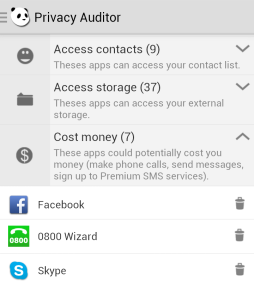
“Not every app that is included in that category is malicious, as it may need access to calls or SMSs to fulfill its primary function. Having said that, any app with permissions to act in the described manner could be considered dangerous, and if the user sees apps with permissions they should not have, they should remove them immediately”, explained Corrons.

“These apps might stay on Google Play for a long time as, in the end, it is the users themselves who willingly accept the apps’ terms of service, an aspect which might be used by fraudsters as a defense. A defense, in any case, not strong enough to prevent our solution Panda Mobile Security from identifying their intentions”, added Corrons.

Since its recent removal from the Google Play store the interest in the “Flappy Bird” app has gone through the roof leading to scammers launching fake “Flappy Bird” apps, identical to the original except they come with additional premium-SMS capabilities. If you are unable to locate “Flappy Bird” then there are a number of interesting alternatives including Sesame Street’s “Flappy Bert” and Fall Out Boy’s “Fall Out Bird”.

More info, in PandaLabs Blog.

About Panda Security

Founded in 1990, Panda Security is the world’s leading provider of cloud-based security solutions, with products available in more than 23 languages and millions of users located in 195 countries around the world. Panda Security was the first IT security company to harness the power of cloud computing with its Collective Intelligence technology. This innovative security model can automatically analyze and classify thousands of new malware samples every day, guaranteeing corporate customers and home users the most effective protection against Internet threats with minimum impact on system performance. Panda Security has 56 offices throughout the globe with US headquarters in Florida and European headquarters in Spain

Panda Security collaborates with The Stella Project, a program aimed at promoting the incorporation into the community and workplace of people with Down syndrome and other intellectual disabilities, as part of its Corporate Social Responsibility policy.

ISBuzz Team
  • ISBuzz Team
    Air Canada Data Breach: BianLian Extortion Group Claims A Massive Heist Contrary To Airline’s Earlier Statement
  • ISBuzz Team
    Unprecedented DDoS Attack Rocks The Web: Tech Giants Reveal A Digital Tsunami
  • ISBuzz Team
    CISA Flags High-Severity Adobe Acrobat Reader Flaw Amid Active Exploits
  • ISBuzz Team
    Curl Security Alert: Patching A Critical Bug Averting Potential Cyber Catastrophe

The opinions expressed in this post belong to the individual contributors and do not necessarily reflect the views of Information Security Buzz.

Share. Facebook Twitter LinkedIn Email Copy Link

Related Posts

The next phase of endpoint security starts with simplicity

June 24, 20266 Mins Read

Tenable warns AI adoption is outpacing governance as cloud exposure risks surge

May 15, 20264 Mins Read

Cloud Security Controls Explained: A Definitive Guide

March 19, 20269 Mins Read
ISB-Bora-Side-Bar

No se ha podido establecer conexión. Error 429

 
ISB-Bora-Side-Bar
Black ISB Logo

Information Security Buzz is an independent resource that provides the experts’ comments, analysis, and opinion on the latest Cybersecurity news and topics

X (Twitter) LinkedIn Facebook RSS

Working With Us

  • About Us
  • Advertise With Us
  • Contact Us

Write For Us

  • How To Contribute

The Pages

  • Privacy Policy
  • Cookie Policy
  • AI Policy
  • Terms & Conditions
  • Copyright Notice

Information Security Buzz and all its contents are copyright © 2014-2025. All rights reserved. All third-party trademarks are recognized.

Type above and press Enter to search. Press Esc to cancel.

Manage Consent
To provide the best experiences, we use technologies like cookies to store and/or access device information. Consenting to these technologies will allow us to process data such as browsing behavior or unique IDs on this site. Not consenting or withdrawing consent, may adversely affect certain features and functions.
Functional Always active
The technical storage or access is strictly necessary for the legitimate purpose of enabling the use of a specific service explicitly requested by the subscriber or user, or for the sole purpose of carrying out the transmission of a communication over an electronic communications network.
Preferences
The technical storage or access is necessary for the legitimate purpose of storing preferences that are not requested by the subscriber or user.
Statistics
The technical storage or access that is used exclusively for statistical purposes. The technical storage or access that is used exclusively for anonymous statistical purposes. Without a subpoena, voluntary compliance on the part of your Internet Service Provider, or additional records from a third party, information stored or retrieved for this purpose alone cannot usually be used to identify you.
Marketing
The technical storage or access is required to create user profiles to send advertising, or to track the user on a website or across several websites for similar marketing purposes.
  • Manage options
  • Manage services
  • Manage {vendor_count} vendors
  • Read more about these purposes
View preferences
  • {title}
  • {title}
  • {title}