


As one who travels to the UAE on very regular occasions, and who has visited Dubai, Abu Dhabi, and worked in the Saudi Arabian MOD complex in Riyadh, as well as working on Special Projects at the Malaysian Military Academy in Kuala Lumper, I like to consider myself well versed, and tuned into in the various region’s ways of working.
In fact, when I worked and travelled under the General Motors (GM) Flag, GM impressed on their international travelers the importance of tuning into the local culture of any country one may find themselves working in, and to ensure they gained a robust understanding of the local practices – no matter Italy, Germany, France, Venice, Turkey, the Netherlands, or even the US, as they (GM) reminded us, we were visitors, and entering their domiciles, their culture, and their way of doing business.
In the case of Mr. Mathew Hedges, who I am very pleased to see has been released under a Royal Pardon, multiple factors jump of the page which raise several personal security red-flags, the first of which would seem to be forgetting the rules of International Travel to show respect to the region in which one is working – we (as in the royal we) may not necessarily agree, shall we say, how some regions do business, but we need to remember that a) we are visitors to that region, and b) the UK Government (in this case), and other countries are trading partners with these regions, and so the forerunner here is set by those relationships, protocols and examples. However, in the case of being accused of Spying, one may also wish to consider the tone, and depth of any inferred, or actual interest which may raise the concerns of the region one is visiting, and it is here where I feel this case does hinge.
Over the preceding decade the wider UAE has encountered several challenges, both from internal and external forces, and has had to manage the overspill, and the association of the more rebellious regions who may tend to display a more sympathetic ear to the voice of terrorism – which I feel we all may agree is not good for anyone – and notwithstanding our own personal views, the UAE are important allies in the fight against global terror, and we do need to remember that. However, it is here where I feel the visit to their soil by an academic researching internal security protocols tipped the balance of posing a threat.
Like any country on the planet (e.g. the US), the UAE, and its multiple regions manage their own internal security, protect their boarders, and look to fend off any dangers that may give rise to internal tensions; or which may act as an initiator to spark some form of internal insurgence, which is where I feel their own concerns may have arisen in the case of Mr. Mathew Hedges!
Like most capable nations, the UAE use the available technologies to secure their own domicile – I know this first hand, as I have worked with their agencies on Open Source (OSINT) Projects, and Training – capabilities which I am sure, like any other nation, are used to assist their agencies and government to identify and manage any actual, inferred, passive, direct or indirect threat posed against their nation. It may be here where, rightly or wrongly several concerns were raised within the UAE from their OSINT output with the research that was being conducted on the soil of that region. And this, linked with a backdrop of previous published papers – one of which was entitled ‘The Muslim Brotherhood – what does the Future Hold’ (See image below) would possibly fan the fires of suspicion. And I believe that, aligned to the following profile may have just been enough to ring some alarm bells, be they false or otherwise:
“Mr. Hedges is an adviser at Gulf State Analytics (@GulfStateAnalyt), a Washington, DC-based geopolitical-risk consultancy and a PhD candidate and associate researcher at Durham University, United Kingdom.
The paper as indicated above was published in partnership with Giorgio Cafiero, the CEO of Gulf State Analytics who are based in Washington DC (a location by inference which may also raise an eyebrow, given its local proximity to US Intelligence Agencies). A selection of Mr. Cafiero’s published papers are listed against his own Linkedin Profiles and are as follows:
- What Bahrain’s opposition crackdown means for country’s Brotherhood
- Can Saudis ease Egypt-Qatar tension after Al Jazeera death sentences?
- The Price Bahrain Pays for Saudi Assistance
- Oman and Iran: Friends with Many Benefits
- Regional Turmoil Threatens Kuwait’s Calm
Example extracts from the ‘The Muslim Brotherhood – what does the Future Hold’ are as follows:
‘The formal rise to power of the Egyptian MB and the movement’s prominent influence in Jordanian, Libyan, Tunisian, Turkish and [1] Yemeni politics [1] have reemphasized the challenge to GCC rulers’
‘Saudi Arabia had generally poor relations with the Ikhwan, viewing it as a threat to the kingdom’s own Islamic legitimacy’
‘Gulf Arab leaders felt the winds of more political and social change blowing into the GCC. Bahrain, Kuwait, Oman and Saudi Arabia had experienced their own uprisings in 2011-12, with varying degrees of confrontation between security forces and demonstrators’
Don’t get me wrong here, I am neither agreeing, or disagreeing with these extracts, and the remainder of the paper from which they are drawn – it is just down to the fact they would seem to be critical, and an unwise comments to make, or be associated with, especially when on the local soil of that nation state and seeking to make friends in the Emirates.
And please do not mistake my sentiment here, as I fully respect and appreciate the value of any academic work which focuses on regional and international topics of interest. However, in the context of this case, I believe the mission set off on the wrong and very dangerous ill-advised foot, the consequences of which are now obvious to all. Whilst I am sure there was no intention to focus criticism on the UAE, its Rulers or Policies, if one looks at the profile of the concerned author, the locality in which a connected associate resides, and the published text which debate the very sensitive topic of regional unrest and challenge to its rulers – linked to titles such as geopolitical, then one may be wondering into the potential of uncharted dangerous waters.
We also need to be aware that the world is still suffering indignation post the Edward Snowdon leaks, and of course the long term detention of another British Citizen in the Middle East, so when such topics are researched and agreed by Universities, a Risk Assessment should be conducted prior to setting to sail, on what could look like or infer a profile of a version of a John le Carré new creation of a Little Drummer Boy. We should also consider the fact that, as a late journalist friend told me, you may notice that there are some well known security correspondents who always the only one who seem to get the hot, intelligence world topics before anyone else ever gets near them – why do you think that is? Could it be that actually have two positions to fill!
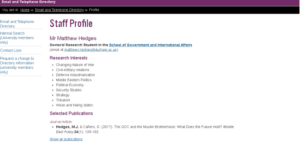
The overall conclusion is, any research which may be misinterpreted which may place an individual in danger should be well considered prior to it being agreed and put in motion. Furthermore, when we are traveling to any location, be that the UAE, China, or even the US, we need to be sensitive as to the extent of the poetic license we may seek to leverage when we pass comment on the workings of these localities – especially when we are standing on their front-door step.
[1] Yemeni politics are currently a very sensitive subject in that region

John is the Principle at Shadow-Intelligence (Si), partnering with PALISCOPE, BreachAware and iStorage. He is a Visiting Professor at the School of Science and Technology, Nottingham, Trent University (NTU) and holds the appointment of Editor in Chief for the International Journal of Cyber Forensics and Advanced Threat Investigations (CFATI). For the last decade he has delivered training courses in the Middle, and Far East to Commercial, Industrial, the Financial Services Sector, and Military Agencies, including the UAE, US, Pakistan, Saudi Arabia, Malaysia (KL), Singapore, Argentina, and Sao Paulo
He served in the Royal Air Force 22 years’, specialising in Counterintelligence, working with UK Agencies such as GCHQ/CESG, and others in the fields of SIGINT, COMINT and Satellite Communications, holding appointments such as System ITSO for a CIA SCIF.
In the commercials sectors of IT/Cyber he has worked for/with Logica, Bae, T5, GM, Experian, Betfair, Palace of Westminster, House of Lords/Commons, TSol (Treasury Solicitors) and provided Consultancy to the Saudi Arabian MOD, TRA (Telecommunications Authority (Dubai) and the Military Academy of Malaysia (KL) on SOC, CSIRT, Digital Forensics and OSINT. Within the last 5 years he has focused on Geopolitics, with global expertise around the UAE and Russia, Anti-Terrorist Operations (ATO), Cyber-Warfare, Dezinformatsiya (Disinformation) and Maskirovka (Military Deception).
The opinions expressed in this post belong to the individual contributors and do not necessarily reflect the views of Information Security Buzz.