


Close Menu
  • Home
  • Articles
    • Attacks
      • BEC
      • Data Breach
      • DDoS
      • Evasion Attacks
      • Injection
      • Malware
      • MITM
      • Phishing
      • Ransomware
      • RCE
      • Social Engineering
      • Spoofing
      • Spyware
    • Business and Policy
      • BCP and DRP
      • GRC
      • Regulations
    • Data Protection
      • DLP
      • DRM
      • Encryption
      • IAM
    • Future, Trends and Insight
      • AI
      • Events & Community
      • Emerging Tech
      • Expert Panel
      • Interviews With Experts
      • Insights
      • Study & Research
    • Resources
      • Guides
      • Tools
      • Training & Education
    • Security
      • API
      • Apps
      • Cloud
      • Critical Infrastructure
      • Endpoint
      • Hardware
      • IoT
      • Mobile
      • Network
      • OT
      • Port Security
      • Security Architecture
      • Software Development
      • Supply Chain
      • Zero Trust
    • Threats and Vulnerabilities
      • Emerging Threats
      • Insider Threats
      • Risk Management
      • Threat Intelligence
      • Zero Day
  • News and Exclusives
    • Latest News
    • ISB Exclusive
    • Positive News
  • Who We Are
    • About Us
    • Information Security Buzz Expert Panel​
    • Write for Us
    • Media Pack
  • Contact Us
  • Newsletter
Facebook X (Twitter) LinkedIn
Information Security BuzzInformation Security Buzz
  • Home
  • Articles
    • Attacks
      • BEC
      • Data Breach
      • DDoS
      • Evasion Attacks
      • Injection
      • Malware
      • MITM
      • Phishing
      • Ransomware
      • RCE
      • Social Engineering
      • Spoofing
      • Spyware
    • Business and Policy
      • BCP and DRP
      • GRC
      • Regulations
    • Data Protection
      • DLP
      • DRM
      • Encryption
      • IAM
    • Future, Trends and Insight
      • AI
      • Events & Community
      • Emerging Tech
      • Expert Panel
      • Interviews With Experts
      • Insights
      • Study & Research
    • Resources
      • Guides
      • Tools
      • Training & Education
    • Security
      • API
      • Apps
      • Cloud
      • Critical Infrastructure
      • Endpoint
      • Hardware
      • IoT
      • Mobile
      • Network
      • OT
      • Port Security
      • Security Architecture
      • Software Development
      • Supply Chain
      • Zero Trust
    • Threats and Vulnerabilities
      • Emerging Threats
      • Insider Threats
      • Risk Management
      • Threat Intelligence
      • Zero Day
  • News and Exclusives
    • Latest News
    • ISB Exclusive
    • Positive News
  • Who We Are
    • About Us
    • Information Security Buzz Expert Panel​
    • Write for Us
    • Media Pack
  • Contact Us
  • Newsletter
Subscribe
Information Security BuzzInformation Security Buzz
Home - News & Analysis - Excellent Job, Thanks’: You May Never Know About The Cybersecurity Incidents Caused By Your Employees
News & Analysis

Excellent Job, Thanks’: You May Never Know About The Cybersecurity Incidents Caused By Your Employees

ISBuzz TeamBy ISBuzz TeamJuly 11, 20175 Mins Read
Share LinkedIn Twitter Facebook Copy Link Email
Share
Facebook Twitter LinkedIn Email Copy Link
Quick AI Summary
ChatGPTClaudeGeminiGrokPerplexityDeepSeekCopilot

Employees hide IT security incidents in 40 per cent of businesses around the world – that’s according to a new report from Kaspersky Lab and B2B International, “Human Factor in IT Security: How Employees are Making Businesses Vulnerable from Within”. With 46 per cent of IT security incidents caused by employees each year, this business vulnerability must be addressed on many levels, not just through the IT security department.

Walking hackers to your door

Uninformed or careless employees are one of the most likely causes of a cybersecurity incident — second only to malware. While malware is becoming more and more sophisticated, the sad reality is that the evergreen human factor can pose an even greater danger.

In particular, employee carelessness is one of the biggest chinks in corporate cybersecurity armor when it comes to targeted attacks. While advanced hackers might always use custom-made malware and hi-tech techniques to plan a heist, they will likely start with exploiting the easiest entry point – human nature.

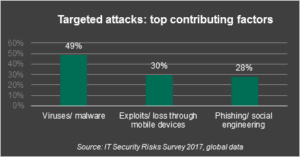
According to the research, every third (28 per cent) targeted attack on businesses in the last year had phishing/social engineering at its source. For example, a careless accountant could easily open a malicious file disguised as an invoice from one of a company’s numerous contractors. This could shut down the entire organisation’s infrastructure, making the accountant an unwitting accomplice to attackers.
“Cybercriminals often use employees as an entry point to get inside the corporate infrastructure. Phishing emails, weak passwords, fake calls from tech support – we’ve seen it all. Even an ordinary flash card dropped in the office parking lot or near the secretary’s desk could compromise the entire network — all you need is someone inside, who doesn’t know about, or pay attention to security, and that device could easily be connected to the network where it could reap havoc,” says David Emm, principal security researcher at Kaspersky Lab. 

Sophisticated targeted attacks do not happen to organisations every day – but conventional malware does strike at mass. Unfortunately though, the research also shows that even where malware is concerned, unaware and careless employees are also often involved, causing malware infections in 53 per cent of incidents.

Hide and seek: why HR and top management should get involved

Staff hiding the incidents they have been involved in may lead to dramatic consequences, increasing the overall damage caused. Even one unreported event could indicate a much larger breach, and security teams need to be able to quickly identify the threats they are up against to choose the right mitigation tactics.

But staff would rather put organisations at risk than report a problem because they fear punishment, or are embarrassed that they are responsible for something going wrong. Some companies have introduced strict rules and impose extra responsibility on employees, instead of encouraging them to simply be vigilant and cooperative. This means that cyber-protection not only lies in the realm of technology, but also in an organisation’s culture and training. That’s where top management and HR need to get involved.

“The problem of hiding incidents should be communicated not only to employees, but also to top management and HR departments. If employees are hiding incidents, there must be a reason why. In some cases, companies introduce strict, but unclear policies and put too much pressure on staff, warning them not to do this or that, or they will be held responsible if something goes wrong. Such policies foster fears, and leave employees with only one option — to avoid punishment whatever it takes. If your cybersecurity culture is positive, based on an educational approach instead of a restrictive one, from the top down, the results will be obvious,” comments Slava Borilin, security education program manager at Kaspersky Lab.

Borilin also recalls an industrial security model, where a reporting and ‘learn by mistake’ approach are at the heart of the business. For instance, in his recent statement, Tesla’s Elon Musk requested every incident affecting worker safety to be reported directly to him, so that he can play a central role in change.

The human factor: corporate climate and beyond

Organisations around the world are already waking up to the problem of their staff making their businesses vulnerable: 52 per cent of companies surveyed admit that staff are the biggest weakness in their IT security. The need to implement personnel-focused measures is becoming more and more evident: 35 per cent of businesses are looking to improve security through delivering training to staff, making this the second most popular method of cyber defense, second only to the deployment of more sophisticated software (43 per cent).

The best way of protecting organisations from human-related cyberthreats is to combine the right tools with the right practices. This should involve HR and management efforts, to motivate and encourage employees to be watchful and seek help in the case of an incident. Security awareness training for staff, delivering clear guidelines instead of multipage documents, building strong skills and motivation and fostering the right working atmosphere, are the first steps organisations should take.

In terms of security technologies, most of the threats aimed at targeting unaware or careless employees – including phishing – can be addressed with endpoint security solutions. These can cover the particular needs of SMB and enterprise companies in terms of functionality, pre-configured protection or advanced security settings, to minimise risks.

[su_box title=”About Kaspersky Lab” style=”noise” box_color=”#336588″][short_info id=’59584′ desc=”true” all=”false”][/su_box]

ISBuzz Team
  • ISBuzz Team
    Air Canada Data Breach: BianLian Extortion Group Claims A Massive Heist Contrary To Airline’s Earlier Statement
  • ISBuzz Team
    Unprecedented DDoS Attack Rocks The Web: Tech Giants Reveal A Digital Tsunami
  • ISBuzz Team
    CISA Flags High-Severity Adobe Acrobat Reader Flaw Amid Active Exploits
  • ISBuzz Team
    Curl Security Alert: Patching A Critical Bug Averting Potential Cyber Catastrophe

The opinions expressed in this post belong to the individual contributors and do not necessarily reflect the views of Information Security Buzz.

Share. Facebook Twitter LinkedIn Email Copy Link

Related Posts

New Phishing Kit Starkiller Defeats Multi-Factor Authentication

February 23, 20264 Mins Read

ReliaQuest Uncovers Social Media Phishing Campaign Built on Trusted Tools

January 22, 20266 Mins Read

What Happens after a Phishing Email Lands in Your Inbox?

January 5, 20266 Mins Read
ISB-Bora-Side-Bar

No se ha podido establecer conexión. Error 429

 
ISB-Bora-Side-Bar
Black ISB Logo

Information Security Buzz is an independent resource that provides the experts’ comments, analysis, and opinion on the latest Cybersecurity news and topics

X (Twitter) LinkedIn Facebook RSS

Working With Us

  • About Us
  • Advertise With Us
  • Contact Us

Write For Us

  • How To Contribute

The Pages

  • Privacy Policy
  • Cookie Policy
  • AI Policy
  • Terms & Conditions
  • Copyright Notice

Information Security Buzz and all its contents are copyright © 2014-2025. All rights reserved. All third-party trademarks are recognized.

Type above and press Enter to search. Press Esc to cancel.

Manage Consent
To provide the best experiences, we use technologies like cookies to store and/or access device information. Consenting to these technologies will allow us to process data such as browsing behavior or unique IDs on this site. Not consenting or withdrawing consent, may adversely affect certain features and functions.
Functional Always active
The technical storage or access is strictly necessary for the legitimate purpose of enabling the use of a specific service explicitly requested by the subscriber or user, or for the sole purpose of carrying out the transmission of a communication over an electronic communications network.
Preferences
The technical storage or access is necessary for the legitimate purpose of storing preferences that are not requested by the subscriber or user.
Statistics
The technical storage or access that is used exclusively for statistical purposes. The technical storage or access that is used exclusively for anonymous statistical purposes. Without a subpoena, voluntary compliance on the part of your Internet Service Provider, or additional records from a third party, information stored or retrieved for this purpose alone cannot usually be used to identify you.
Marketing
The technical storage or access is required to create user profiles to send advertising, or to track the user on a website or across several websites for similar marketing purposes.
  • Manage options
  • Manage services
  • Manage {vendor_count} vendors
  • Read more about these purposes
View preferences
  • {title}
  • {title}
  • {title}