

Close Menu
  • Home
  • Articles
    • Attacks
      • BEC
      • Data Breach
      • DDoS
      • Evasion Attacks
      • Injection
      • Malware
      • MITM
      • Phishing
      • Ransomware
      • RCE
      • Social Engineering
      • Spoofing
      • Spyware
    • Business and Policy
      • BCP and DRP
      • GRC
      • Regulations
    • Data Protection
      • DLP
      • DRM
      • Encryption
      • IAM
    • Future, Trends and Insight
      • AI
      • Events & Community
      • Emerging Tech
      • Expert Panel
      • Interviews With Experts
      • Insights
      • Study & Research
    • Resources
      • Guides
      • Tools
      • Training & Education
    • Security
      • API
      • Apps
      • Cloud
      • Critical Infrastructure
      • Endpoint
      • Hardware
      • IoT
      • Mobile
      • Network
      • OT
      • Port Security
      • Security Architecture
      • Software Development
      • Supply Chain
      • Zero Trust
    • Threats and Vulnerabilities
      • Emerging Threats
      • Insider Threats
      • Risk Management
      • Threat Intelligence
      • Zero Day
  • News and Exclusives
    • Latest News
    • ISB Exclusive
    • Positive News
  • Who We Are
    • About Us
    • Information Security Buzz Expert Panel​
    • Write for Us
    • Media Pack
  • Contact Us
  • Newsletter
Facebook X (Twitter) LinkedIn
Information Security BuzzInformation Security Buzz
  • Home
  • Articles
    • Attacks
      • BEC
      • Data Breach
      • DDoS
      • Evasion Attacks
      • Injection
      • Malware
      • MITM
      • Phishing
      • Ransomware
      • RCE
      • Social Engineering
      • Spoofing
      • Spyware
    • Business and Policy
      • BCP and DRP
      • GRC
      • Regulations
    • Data Protection
      • DLP
      • DRM
      • Encryption
      • IAM
    • Future, Trends and Insight
      • AI
      • Events & Community
      • Emerging Tech
      • Expert Panel
      • Interviews With Experts
      • Insights
      • Study & Research
    • Resources
      • Guides
      • Tools
      • Training & Education
    • Security
      • API
      • Apps
      • Cloud
      • Critical Infrastructure
      • Endpoint
      • Hardware
      • IoT
      • Mobile
      • Network
      • OT
      • Port Security
      • Security Architecture
      • Software Development
      • Supply Chain
      • Zero Trust
    • Threats and Vulnerabilities
      • Emerging Threats
      • Insider Threats
      • Risk Management
      • Threat Intelligence
      • Zero Day
  • News and Exclusives
    • Latest News
    • ISB Exclusive
    • Positive News
  • Who We Are
    • About Us
    • Information Security Buzz Expert Panel​
    • Write for Us
    • Media Pack
  • Contact Us
  • Newsletter
Subscribe
Information Security BuzzInformation Security Buzz
Home - Study & Research - Financial Threats In 2016: Every Second Phishing Attack Aims To Steal Your Money
Study & Research

Financial Threats In 2016: Every Second Phishing Attack Aims To Steal Your Money

ISBuzz TeamBy ISBuzz TeamFebruary 26, 20173 Mins Read
Share LinkedIn Twitter Facebook Copy Link Email
Share
Facebook Twitter LinkedIn Email Copy Link
Quick AI Summary
ChatGPTClaudeGeminiGrokPerplexityDeepSeekCopilot

Almost half of all phishing attacks (fraudulent email messages or copycat websites that appear legitimate) registered in 2016 by Kaspersky Lab’s heuristic detection technologies were aimed at stealing their victim’s money, according to an analysis of the financial threat landscape by the company’s experts. Compared to 2015, the amount of financial phishing attacks increased 13.14 percentage points in 2016 to comprise 47.48 per cent of all phishing attacks blocked by heuristic detection technologies.

In 2016 Kaspersky Lab’s anti-phishing technologies detected almost 155 million user attempts to visit different kinds of phishing pages. Of those, almost half of heuristic detections were attempts to visit a financial phishing page, i.e. where the aim was to obtain valuable personal information from users — such as their account numbers for banking, credit accounts, social security numbers, and the login and passwords they use to access online banking. The cybercriminals intended to use this information to steal money from their victims. This is the highest share of financial phishing registered to date by Kaspersky Lab.

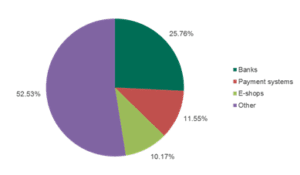
Banking phishing schemes are the absolute leaders among all types of financial phishing. Every fourth (25.76 per cent) attack used fake online banking information, or other content related to banks – a result that is 8.31 percentage points up on 2015. The share of phishing related to payment systems and e-shops accounted for 11.55 per cent and 10.14 per cent respectively, an increase of 3.75 p.p. and 1.09 p.p. compared to 2015. The share of financial phishing detected on MacOS computers was 31.38 per cent.
finecial

The distribution of different types of financial phishing in 2016

Financial phishers are particularly keen to use data related to top multi-national banks, popular payment systems and Internet shops and auctions from the US, China and Brazil in their scams. The list of brands used stays the same from year to year, as their popularity remains high and they are therefore a lucrative target for cybercriminals.

“Financial phishing has always been one of the easiest ways for cybercriminals to earn illegal money. You don’t have to be a skilled programmer, and you don’t have to invest lots of money into supporting infrastructure. Of course, most phishing schemes are easy to recognise and avoid, but judging by what we see in our statistics, lots of people are still not cautious enough when it comes to dealing with financial data online. Otherwise, we wouldn’t have seen so many attacks in 2016,” said Nadezhda Demidova, senior web content analyst at Kaspersky Lab.

In order to protect themselves from phishing, Kaspersky Lab experts advise users to take the following measures:

  • When paying online always check the legitimacy of the website. The connection should be protected with Https, and the domain should belong to the same organisation that you’re going to pay.
  • Always check the legitimacy of emails that you’re receiving from famous brands. Even if it urges you to do something urgently, like change your password etc. First, make sure that it was sent by a legitimate party – contact your bank or payment system representative to find out if the email really has been sent by them to you.
  • Don’t click the links in emails or web-pages if you have doubts about their legitimacy;
  • Use a proven security solution with behavior-based anti-phishing technologies. This will make it possible to identify even the most recent phishing scams which haven’t yet been added to anti-phishing databases.

To learn more about financial phishing and the other findings in the Financial Cyberthreats in 2016 report, read our blogpost on Securelist.com

[su_box title=”About Kaspersky Lab” style=”noise” box_color=”#336588″][short_info id=’59584′ desc=”true” all=”false”][/su_box]

ISBuzz Team
  • ISBuzz Team
    Air Canada Data Breach: BianLian Extortion Group Claims A Massive Heist Contrary To Airline’s Earlier Statement
  • ISBuzz Team
    Unprecedented DDoS Attack Rocks The Web: Tech Giants Reveal A Digital Tsunami
  • ISBuzz Team
    CISA Flags High-Severity Adobe Acrobat Reader Flaw Amid Active Exploits
  • ISBuzz Team
    Curl Security Alert: Patching A Critical Bug Averting Potential Cyber Catastrophe

The opinions expressed in this post belong to the individual contributors and do not necessarily reflect the views of Information Security Buzz.

Share. Facebook Twitter LinkedIn Email Copy Link

Related Posts

New Phishing Kit Starkiller Defeats Multi-Factor Authentication

February 23, 20264 Mins Read

ReliaQuest Uncovers Social Media Phishing Campaign Built on Trusted Tools

January 22, 20266 Mins Read

What Happens after a Phishing Email Lands in Your Inbox?

January 5, 20266 Mins Read
ISB-Bora-Side-Bar

 
ISB-Bora-Side-Bar
Black ISB Logo

Information Security Buzz is an independent resource that provides the experts’ comments, analysis, and opinion on the latest Cybersecurity news and topics

X (Twitter) LinkedIn Facebook RSS

Working With Us

  • About Us
  • Advertise With Us
  • Contact Us

Write For Us

  • How To Contribute

The Pages

  • Privacy Policy
  • Cookie Policy
  • AI Policy
  • Terms & Conditions
  • Copyright Notice

Information Security Buzz and all its contents are copyright © 2014-2025. All rights reserved. All third-party trademarks are recognized.

Type above and press Enter to search. Press Esc to cancel.

Manage Consent
To provide the best experiences, we use technologies like cookies to store and/or access device information. Consenting to these technologies will allow us to process data such as browsing behavior or unique IDs on this site. Not consenting or withdrawing consent, may adversely affect certain features and functions.
Functional Always active
The technical storage or access is strictly necessary for the legitimate purpose of enabling the use of a specific service explicitly requested by the subscriber or user, or for the sole purpose of carrying out the transmission of a communication over an electronic communications network.
Preferences
The technical storage or access is necessary for the legitimate purpose of storing preferences that are not requested by the subscriber or user.
Statistics
The technical storage or access that is used exclusively for statistical purposes. The technical storage or access that is used exclusively for anonymous statistical purposes. Without a subpoena, voluntary compliance on the part of your Internet Service Provider, or additional records from a third party, information stored or retrieved for this purpose alone cannot usually be used to identify you.
Marketing
The technical storage or access is required to create user profiles to send advertising, or to track the user on a website or across several websites for similar marketing purposes.
  • Manage options
  • Manage services
  • Manage {vendor_count} vendors
  • Read more about these purposes
View preferences
  • {title}
  • {title}
  • {title}