

Close Menu
  • Home
  • Articles
    • Attacks
      • BEC
      • Data Breach
      • DDoS
      • Evasion Attacks
      • Injection
      • Malware
      • MITM
      • Phishing
      • Ransomware
      • RCE
      • Social Engineering
      • Spoofing
      • Spyware
    • Business and Policy
      • BCP and DRP
      • GRC
      • Regulations
    • Data Protection
      • DLP
      • DRM
      • Encryption
      • IAM
    • Future, Trends and Insight
      • AI
      • Events & Community
      • Emerging Tech
      • Expert Panel
      • Interviews With Experts
      • Insights
      • Study & Research
    • Resources
      • Guides
      • Tools
      • Training & Education
    • Security
      • API
      • Apps
      • Cloud
      • Critical Infrastructure
      • Endpoint
      • Hardware
      • IoT
      • Mobile
      • Network
      • OT
      • Port Security
      • Security Architecture
      • Software Development
      • Supply Chain
      • Zero Trust
    • Threats and Vulnerabilities
      • Emerging Threats
      • Insider Threats
      • Risk Management
      • Threat Intelligence
      • Zero Day
  • News and Exclusives
    • Latest News
    • ISB Exclusive
    • Positive News
  • Who We Are
    • About Us
    • Information Security Buzz Expert Panel​
    • Write for Us
    • Media Pack
  • Contact Us
  • Newsletter
Facebook X (Twitter) LinkedIn
Information Security BuzzInformation Security Buzz
  • Home
  • Articles
    • Attacks
      • BEC
      • Data Breach
      • DDoS
      • Evasion Attacks
      • Injection
      • Malware
      • MITM
      • Phishing
      • Ransomware
      • RCE
      • Social Engineering
      • Spoofing
      • Spyware
    • Business and Policy
      • BCP and DRP
      • GRC
      • Regulations
    • Data Protection
      • DLP
      • DRM
      • Encryption
      • IAM
    • Future, Trends and Insight
      • AI
      • Events & Community
      • Emerging Tech
      • Expert Panel
      • Interviews With Experts
      • Insights
      • Study & Research
    • Resources
      • Guides
      • Tools
      • Training & Education
    • Security
      • API
      • Apps
      • Cloud
      • Critical Infrastructure
      • Endpoint
      • Hardware
      • IoT
      • Mobile
      • Network
      • OT
      • Port Security
      • Security Architecture
      • Software Development
      • Supply Chain
      • Zero Trust
    • Threats and Vulnerabilities
      • Emerging Threats
      • Insider Threats
      • Risk Management
      • Threat Intelligence
      • Zero Day
  • News and Exclusives
    • Latest News
    • ISB Exclusive
    • Positive News
  • Who We Are
    • About Us
    • Information Security Buzz Expert Panel​
    • Write for Us
    • Media Pack
  • Contact Us
  • Newsletter
Subscribe
Information Security BuzzInformation Security Buzz
Home - Study & Research - Hackers Exploit Covid-19 Vaccine Interest As Cover For Attacks
Study & Research

Hackers Exploit Covid-19 Vaccine Interest As Cover For Attacks

ISBuzz TeamBy ISBuzz TeamAugust 11, 20204 Mins Read
Share LinkedIn Twitter Facebook Copy Link Email
Share
Facebook Twitter LinkedIn Email Copy Link
Quick AI Summary
ChatGPTClaudeGeminiGrokPerplexityDeepSeekCopilot

Phishing emails with subject lines related to vaccines now being used to trick recipients into downloading malicious Windows, Word and Excel files designed to steal a person’s credentials 

  • Number of new, vaccine-related coronavirus domains double in June and July 2020
  • 1 out of every 25 malicious coronavirus-related websites’ landing pages is vaccine-related
  • Email (82%) dominates web (18%) as the attack-vector of choice for malicious files in the last 30 days

Researchers  at Check Point have observed a new trend of phishing emails exploiting interest in coronavirus vaccines. The primary attack method is email, which constituted 82% of all attack vectors for malicious files in the last 30 days. In these hacking campaigns, hackers craft email subject-lines that incorporate deceptive coronavirus vaccine-related content, while simultaneously lacing malicious links into the email bodies.

After clicking the malicious link, recipients inadvertently download a malicious file, typically in file type forms of .exe, .xls or .doc. Two examples found by Check Point researchers are.

Subject: Urgent Information Letter: Covid-19 New Approved Vaccines

In the first example, Check Point researchers cite a malspam campaign they caught with the email subject “URGENT INFORMATION LETTER: COVID-19 NEW APPROVED VACCINES”. The respective emails delivered malicious .EXE files with the name “Download_Covid 19 New approved vaccines.23.07.2020.exe”, that when clicked on, installs an InfoStealer capable of gathering information, such as login information, usernames and passwords from the user’s computer.

Subject: UK coronavirus vaccine effort is progressing

In the second example, Check Point researchers point to an email phishing campaign that sends the subject-line: “UK coronavirus vaccine effort is progressing badly appropriate, recruiting consequence and elder adults”. The mail contains a malicious link “surgicaltoll\.com/vy2g4b\.html”. Further investigation revealed that it was used to redirect traffic to a medical phishing website; “thelifestillgoeson[.]su”, which was trying to imitate a legitimate Canadian pharmacy.

Coronavirus-related attacks are dropping

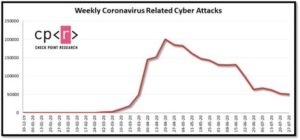
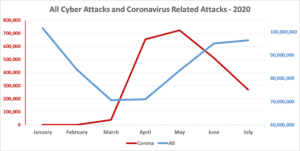
Although the number of general cyber-attacks remained high in July, the number of coronavirus-related attacks has dropped significantly. In July, Check Point researchers witnessed an weekly average of  61,000 coronavirus-related attacks, a decrease of over 50% when compared to the weekly average of 130,000 attacks in June.
Omer Dembinsky, Data Manager at Check Point said:  “Lately, we’re seeing a clear trend adopted by hackers:  deceive the masses by using their interest in coronavirus vaccines. Most of the campaigns involve a person’s inbox, which is concerning. Over 80% of attacks against organizations start from a malicious email. Email is the first link in a chain of attacks. Since email attacks usually involve the human factor, employees’ email inboxes are an organization’s weakest link. Closing this security gap requires protections against various threat vectors: phishing, malware, data theft and account-takeover. I strongly urge everyone to closely read the subject lines of emails coming in. If it has the word “vaccine” in it, think twice. Chances are that you are the threshold of being tricked into giving up your most sensitive, most private information.”

How to Protect Yourself

  • Check the full email address on any message and be alert to hyperlinks that may contain misspellings of the actual domain name.
  • Do not supply login credentials or personal information in response to a text or email.
  • Protect mobile and endpoint browsing with advanced cyber security solutions, which prevent browsing to phishing web sites, whether known or unknown
  • Use two-factor authentication to verify any change to account information or wire instructions.
  • Continuously educate your end users:  whenever irreversible actions such as money transfers are conducted, details of the transaction must be verified in additional means such as voice communication and must not exclusively rely on information from email correspondence.
  • Regularly monitor financial accounts.
  • Keep all software and systems up to date.
  • Make sure you are using an email security solution that blocks sophisticated phishing attacks like Business Email Compromise, in order to prevent them from reaching employees mailboxes to begin with
ISBuzz Team
  • ISBuzz Team
    Air Canada Data Breach: BianLian Extortion Group Claims A Massive Heist Contrary To Airline’s Earlier Statement
  • ISBuzz Team
    Unprecedented DDoS Attack Rocks The Web: Tech Giants Reveal A Digital Tsunami
  • ISBuzz Team
    CISA Flags High-Severity Adobe Acrobat Reader Flaw Amid Active Exploits
  • ISBuzz Team
    Curl Security Alert: Patching A Critical Bug Averting Potential Cyber Catastrophe

The opinions expressed in this post belong to the individual contributors and do not necessarily reflect the views of Information Security Buzz.

Share. Facebook Twitter LinkedIn Email Copy Link

Related Posts

New Phishing Kit Starkiller Defeats Multi-Factor Authentication

February 23, 20264 Mins Read

ReliaQuest Uncovers Social Media Phishing Campaign Built on Trusted Tools

January 22, 20266 Mins Read

What Happens after a Phishing Email Lands in Your Inbox?

January 5, 20266 Mins Read
ISB-Bora-Side-Bar

No se ha podido establecer conexión. Error 429

 
ISB-Bora-Side-Bar
Black ISB Logo

Information Security Buzz is an independent resource that provides the experts’ comments, analysis, and opinion on the latest Cybersecurity news and topics

X (Twitter) LinkedIn Facebook RSS

Working With Us

  • About Us
  • Advertise With Us
  • Contact Us

Write For Us

  • How To Contribute

The Pages

  • Privacy Policy
  • Cookie Policy
  • AI Policy
  • Terms & Conditions
  • Copyright Notice

Information Security Buzz and all its contents are copyright © 2014-2025. All rights reserved. All third-party trademarks are recognized.

Type above and press Enter to search. Press Esc to cancel.

Manage Consent
To provide the best experiences, we use technologies like cookies to store and/or access device information. Consenting to these technologies will allow us to process data such as browsing behavior or unique IDs on this site. Not consenting or withdrawing consent, may adversely affect certain features and functions.
Functional Always active
The technical storage or access is strictly necessary for the legitimate purpose of enabling the use of a specific service explicitly requested by the subscriber or user, or for the sole purpose of carrying out the transmission of a communication over an electronic communications network.
Preferences
The technical storage or access is necessary for the legitimate purpose of storing preferences that are not requested by the subscriber or user.
Statistics
The technical storage or access that is used exclusively for statistical purposes. The technical storage or access that is used exclusively for anonymous statistical purposes. Without a subpoena, voluntary compliance on the part of your Internet Service Provider, or additional records from a third party, information stored or retrieved for this purpose alone cannot usually be used to identify you.
Marketing
The technical storage or access is required to create user profiles to send advertising, or to track the user on a website or across several websites for similar marketing purposes.
  • Manage options
  • Manage services
  • Manage {vendor_count} vendors
  • Read more about these purposes
View preferences
  • {title}
  • {title}
  • {title}