


Close Menu
  • Home
  • Articles
    • Attacks
      • BEC
      • Data Breach
      • DDoS
      • Evasion Attacks
      • Injection
      • Malware
      • MITM
      • Phishing
      • Ransomware
      • RCE
      • Social Engineering
      • Spoofing
      • Spyware
    • Business and Policy
      • BCP and DRP
      • GRC
      • Regulations
    • Data Protection
      • DLP
      • DRM
      • Encryption
      • IAM
    • Future, Trends and Insight
      • AI
      • Events & Community
      • Emerging Tech
      • Expert Panel
      • Interviews With Experts
      • Insights
      • Study & Research
    • Resources
      • Guides
      • Tools
      • Training & Education
    • Security
      • API
      • Apps
      • Cloud
      • Critical Infrastructure
      • Endpoint
      • Hardware
      • IoT
      • Mobile
      • Network
      • OT
      • Port Security
      • Security Architecture
      • Software Development
      • Supply Chain
      • Zero Trust
    • Threats and Vulnerabilities
      • Emerging Threats
      • Insider Threats
      • Risk Management
      • Threat Intelligence
      • Zero Day
  • News and Exclusives
    • Latest News
    • ISB Exclusive
    • Positive News
  • Who We Are
    • About Us
    • Information Security Buzz Expert Panel​
    • Write for Us
    • Media Pack
  • Contact Us
  • Newsletter
Facebook X (Twitter) LinkedIn
Information Security BuzzInformation Security Buzz
  • Home
  • Articles
    • Attacks
      • BEC
      • Data Breach
      • DDoS
      • Evasion Attacks
      • Injection
      • Malware
      • MITM
      • Phishing
      • Ransomware
      • RCE
      • Social Engineering
      • Spoofing
      • Spyware
    • Business and Policy
      • BCP and DRP
      • GRC
      • Regulations
    • Data Protection
      • DLP
      • DRM
      • Encryption
      • IAM
    • Future, Trends and Insight
      • AI
      • Events & Community
      • Emerging Tech
      • Expert Panel
      • Interviews With Experts
      • Insights
      • Study & Research
    • Resources
      • Guides
      • Tools
      • Training & Education
    • Security
      • API
      • Apps
      • Cloud
      • Critical Infrastructure
      • Endpoint
      • Hardware
      • IoT
      • Mobile
      • Network
      • OT
      • Port Security
      • Security Architecture
      • Software Development
      • Supply Chain
      • Zero Trust
    • Threats and Vulnerabilities
      • Emerging Threats
      • Insider Threats
      • Risk Management
      • Threat Intelligence
      • Zero Day
  • News and Exclusives
    • Latest News
    • ISB Exclusive
    • Positive News
  • Who We Are
    • About Us
    • Information Security Buzz Expert Panel​
    • Write for Us
    • Media Pack
  • Contact Us
  • Newsletter
Subscribe
Information Security BuzzInformation Security Buzz
Home - Study & Research - The Hunt For The Dawn Of APTs: A 20 Year-Old Attack That Remains Relevant To A Modern APT
Study & Research

The Hunt For The Dawn Of APTs: A 20 Year-Old Attack That Remains Relevant To A Modern APT

ISBuzz TeamBy ISBuzz TeamApril 5, 20174 Mins Read
Share LinkedIn Twitter Facebook Copy Link Email
Share
Facebook Twitter LinkedIn Email Copy Link
Quick AI Summary
ChatGPTClaudeGeminiGrokPerplexityDeepSeekCopilot

Kaspersky Lab and Kings College London researchers, looking for a link between a modern threat actor and the Moonlight Maze attacks that targeted the Pentagon, NASA and more in the late 1990s, have unearthed samples, logs and artefacts belonging to the ancient APT. The findings show that a backdoor used in 1998 by Moonlight Maze to tunnel information out of victim networks connects to a backdoor used by Turla in 2011 and possibly as recently as 2017.  If the link between Turla and Moonlight Maze is proven, it would place the evolved threat actor alongside the Equation Grup in terms of its longevity, as some of Equation’s command-and-control servers date back to 1996.

Contemporary reports on Moonlight Maze show how, starting from 1996, US military and government networks, as well as universities, research institutions and even the Department of Energy began detecting breaches in their systems.In 1998, the FBI and the Department of Defense launched a massive investigation. The story became public in 1999, but much of the evidence has remained classified, leaving the details of Moonlight Maze shrouded in myth and secrecy.

Over the years, original investigators in three different countries have stated that Moonlight Maze evolved into Turla, a Russian-speaking threat actor also known as Snake, Uroburos, Venomous Bear, and Krypton. Turla is conventionally believed to have been active since 2007.

 The ‘Cupboard Samples’

In 2016, while researching his book, Rise of the Machines, Thomas Rid of Kings College London tracked down a former system administrator whose organisation’s server had been hijacked as a proxy by the Moonlight Maze attackers. This server, ‘HRTest’, had been used to launch attacks on the US. The now-retired IT professional had kept the original server and copies of everything relating to the attacks, and handed it to Kings College and Kaspersky Lab for further analysis.

Kaspersky Lab researchers, Juan Andres Guerrero-Saade and Costin Raiu, together with Thomas Rid and Danny Moore from Kings College, spent nine months undertaking a detailed technical analysis of these samples. They reconstructed the attackers’ operations, tools, and techniques, and conducted a parallel investigation to see if they could prove the claimed connection with Turla.

Moonlight Maze was an open-source Unix-based attack targeting Solaris systems, and the findings show that it made use of a backdoor based on LOKI2 (a program released in 1996 that enables users to extract data via covert channels). This led the researchers to take a second look at some rare Linux samples used by Turla that Kaspersky Lab had discovered in 2014. Named Penquin Turla, these samples are also based on LOKI2. Further, the re-analysis showed that all of them use code created between 1999 and 2004.

Remarkably, this code is still being used in attacks. It was spotted in the wild in 2011 when it was found in an attack on defense contractor Ruag in Switzerland that has been attributed to Turla.   Then, in March 2017, Kaspersky Lab researchers discovered a new sample of the Penquin Turla backdoor submitted from a system in Germany. It is possible that Turla uses the old code for attacks on highly secure entities that might be harder to breach using its more standard Windows toolset.

“In the late 1990s, no-one foresaw the reach and persistence of a coordinated cyberespionage campaign. We need to ask ourselves why it is that attackers are still able to successfully leverage ancient code in modern attacks. The analysis of the Moonlight Maze samples is not just a fascinating archaeological study; it is also a reminder that well-resourced adversaries aren’t going anywhere, it’s up to us to defend systems with skills to match,” said Juan Andres Guerrero-Saade, Senior Security Researcher, Global Research and Analysis Team Kaspersky Lab.

The newly unearthed Moonlight Maze files reveal many fascinating details about how the attacks were conducted using a complex network of proxies, and the high level of skills and tools used by the attackers.
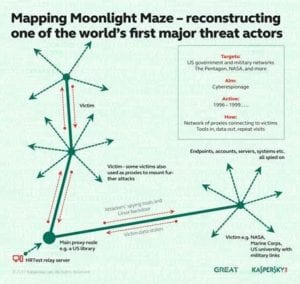
Mapping

Kaspersky Lab products successfully detect and block malware used by Moonlight Maze and Penquin Turla.

Details of the Cupboard Samples logs and scripts, as well as Indicators of Compromise and hashes to help organisations search for traces of these attack groups in their corporate networks are here.

Detailed advance intelligence on the latest threats and threat actors is available to customers of Kaspersky Lab APT Intelligence reporting service Learn more here.

[su_box title=”About Kaspersky Lab” style=”noise” box_color=”#336588″][short_info id=’59584′ desc=”true” all=”false”][/su_box]

ISBuzz Team
  • ISBuzz Team
    Air Canada Data Breach: BianLian Extortion Group Claims A Massive Heist Contrary To Airline’s Earlier Statement
  • ISBuzz Team
    Unprecedented DDoS Attack Rocks The Web: Tech Giants Reveal A Digital Tsunami
  • ISBuzz Team
    CISA Flags High-Severity Adobe Acrobat Reader Flaw Amid Active Exploits
  • ISBuzz Team
    Curl Security Alert: Patching A Critical Bug Averting Potential Cyber Catastrophe

The opinions expressed in this post belong to the individual contributors and do not necessarily reflect the views of Information Security Buzz.

Share. Facebook Twitter LinkedIn Email Copy Link

Related Posts

Exploited Faster, Patched Slower: Verizon DBIR 2026 Shows Security Teams Losing Ground

May 20, 20265 Mins Read

Security’s Blind Spot: The Threats Hiding in “Low-Severity” Alerts

May 6, 20265 Mins Read

Why OSINT deserves the same status as other intelligence disciplines

March 17, 20266 Mins Read
ISB-Bora-Side-Bar

No se ha podido establecer conexión. Error 429

 
ISB-Bora-Side-Bar
Black ISB Logo

Information Security Buzz is an independent resource that provides the experts’ comments, analysis, and opinion on the latest Cybersecurity news and topics

X (Twitter) LinkedIn Facebook RSS

Working With Us

  • About Us
  • Advertise With Us
  • Contact Us

Write For Us

  • How To Contribute

The Pages

  • Privacy Policy
  • Cookie Policy
  • AI Policy
  • Terms & Conditions
  • Copyright Notice

Information Security Buzz and all its contents are copyright © 2014-2025. All rights reserved. All third-party trademarks are recognized.

Type above and press Enter to search. Press Esc to cancel.

Manage Consent
To provide the best experiences, we use technologies like cookies to store and/or access device information. Consenting to these technologies will allow us to process data such as browsing behavior or unique IDs on this site. Not consenting or withdrawing consent, may adversely affect certain features and functions.
Functional Always active
The technical storage or access is strictly necessary for the legitimate purpose of enabling the use of a specific service explicitly requested by the subscriber or user, or for the sole purpose of carrying out the transmission of a communication over an electronic communications network.
Preferences
The technical storage or access is necessary for the legitimate purpose of storing preferences that are not requested by the subscriber or user.
Statistics
The technical storage or access that is used exclusively for statistical purposes. The technical storage or access that is used exclusively for anonymous statistical purposes. Without a subpoena, voluntary compliance on the part of your Internet Service Provider, or additional records from a third party, information stored or retrieved for this purpose alone cannot usually be used to identify you.
Marketing
The technical storage or access is required to create user profiles to send advertising, or to track the user on a website or across several websites for similar marketing purposes.
  • Manage options
  • Manage services
  • Manage {vendor_count} vendors
  • Read more about these purposes
View preferences
  • {title}
  • {title}
  • {title}