


Close Menu
  • Home
  • Articles
    • Attacks
      • BEC
      • Data Breach
      • DDoS
      • Evasion Attacks
      • Injection
      • Malware
      • MITM
      • Phishing
      • Ransomware
      • RCE
      • Social Engineering
      • Spoofing
      • Spyware
    • Business and Policy
      • BCP and DRP
      • GRC
      • Regulations
    • Data Protection
      • DLP
      • DRM
      • Encryption
      • IAM
    • Future, Trends and Insight
      • AI
      • Events & Community
      • Emerging Tech
      • Expert Panel
      • Interviews With Experts
      • Insights
      • Study & Research
    • Resources
      • Guides
      • Tools
      • Training & Education
    • Security
      • API
      • Apps
      • Cloud
      • Critical Infrastructure
      • Endpoint
      • Hardware
      • IoT
      • Mobile
      • Network
      • OT
      • Port Security
      • Security Architecture
      • Software Development
      • Supply Chain
      • Zero Trust
    • Threats and Vulnerabilities
      • Emerging Threats
      • Insider Threats
      • Risk Management
      • Threat Intelligence
      • Zero Day
  • News and Exclusives
    • Latest News
    • ISB Exclusive
    • Positive News
  • Who We Are
    • About Us
    • Information Security Buzz Expert Panel​
    • Write for Us
    • Media Pack
  • Contact Us
  • Newsletter
Facebook X (Twitter) LinkedIn
Information Security BuzzInformation Security Buzz
  • Home
  • Articles
    • Attacks
      • BEC
      • Data Breach
      • DDoS
      • Evasion Attacks
      • Injection
      • Malware
      • MITM
      • Phishing
      • Ransomware
      • RCE
      • Social Engineering
      • Spoofing
      • Spyware
    • Business and Policy
      • BCP and DRP
      • GRC
      • Regulations
    • Data Protection
      • DLP
      • DRM
      • Encryption
      • IAM
    • Future, Trends and Insight
      • AI
      • Events & Community
      • Emerging Tech
      • Expert Panel
      • Interviews With Experts
      • Insights
      • Study & Research
    • Resources
      • Guides
      • Tools
      • Training & Education
    • Security
      • API
      • Apps
      • Cloud
      • Critical Infrastructure
      • Endpoint
      • Hardware
      • IoT
      • Mobile
      • Network
      • OT
      • Port Security
      • Security Architecture
      • Software Development
      • Supply Chain
      • Zero Trust
    • Threats and Vulnerabilities
      • Emerging Threats
      • Insider Threats
      • Risk Management
      • Threat Intelligence
      • Zero Day
  • News and Exclusives
    • Latest News
    • ISB Exclusive
    • Positive News
  • Who We Are
    • About Us
    • Information Security Buzz Expert Panel​
    • Write for Us
    • Media Pack
  • Contact Us
  • Newsletter
Subscribe
Information Security BuzzInformation Security Buzz
Home - Articles - Kids go Digital too Early
Articles

Kids go Digital too Early

ISBuzz TeamBy ISBuzz TeamMarch 1, 2016Updated:July 4, 20243 Mins Read
Share LinkedIn Twitter Facebook Copy Link Email
Kids go Digital too Early
Share
Facebook Twitter LinkedIn Email Copy Link
Quick AI Summary
ChatGPTClaudeGeminiGrokPerplexityDeepSeekCopilot

Raising kids in the internet era? Five years of age is the digital turning point. Parental control tools popular among Brits, not so much with Germans, but all agree – kids go digital too early.

Nowadays, the internet and technology have become so important for business, travel and many other everyday tasks that they practically surround us all the time. This is true for the younger generation as well, including even the smallest children, but online surveys by ESET show that a majority of parents in Russia, the United Kingdom, Germany and the United States are not at all happy about this.

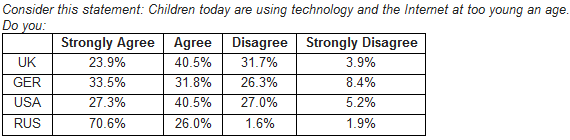
The polls show that an overwhelming 96.6% of Russian respondents agree (26%) or strongly agree (70.6%) with the claim that “children today are using technology and the internet at too young an age”. Only 3.4% say they think the opposite is true.

On the other hand, Germans seem to be more enthusiastic about the role modern technologies play in the lives of their children, with less than two thirds agreeing (31.8%) or agreeing strongly (33.5%) with the same statement.

Americans are slightly more conservative. More than two in three (67.8%) Americans thought that the internet and various technologies were present too early in the lives of kids today, with the rest being more positive about these influences.

With 40.5% agreeing and 23.9% strongly agreeing with the statement, British parents are marginally less reserved when it comes to the role of modern devices and online resources in the lives of the younger generation.

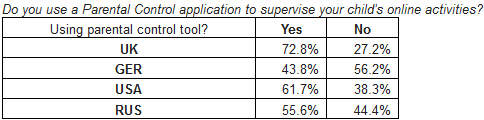
Interestingly, the British appear to be the strongest adopters of parental control tools like ESET Parental Control for Android among the four surveyed countries. As many as 73% of them stated that they use such a solution to monitor their children, leaving about one-quarter with no protection.

This contrasts with the situation in Germany, where ESET’s survey reveals that 56% opt for non-technological means to keep an eye on their offspring. This means that only 44% of German parents currently use technology to monitor what their kids are up to in the virtual world.

In the same online survey, 38% of parents in the United States said they don’t use any parental control solutions, followed by Russia on 44%.

The Internet surveys used to gather these statistics were carried out in January 2016. A thousand respondents participated in each national survey, which targeted British, American, German and Russian participants. UK, US and German data were provided by Google Consumer Surveys, and the Russian data by Merku.
2016-02-29_21-25-59

2016-02-29_21-23-32

The full story is available on ESET Ireland’s blog.

[su_box title=”About ESET” style=”noise” box_color=”#336588″]ESETSince 1987, ESET® has been developing award-winning security software that now helps over 100 million users to Enjoy Safer Technology. Its broad security product portfolio covers all popular platforms and provides businesses and consumers around the world with the perfect balance of performance and proactive protection. The company has a global sales network covering 180 countries, and regional offices in Bratislava, San Diego, Singapore and Buenos Aires.[/su_box]

ISBuzz Team
  • ISBuzz Team
    Air Canada Data Breach: BianLian Extortion Group Claims A Massive Heist Contrary To Airline’s Earlier Statement
  • ISBuzz Team
    Unprecedented DDoS Attack Rocks The Web: Tech Giants Reveal A Digital Tsunami
  • ISBuzz Team
    CISA Flags High-Severity Adobe Acrobat Reader Flaw Amid Active Exploits
  • ISBuzz Team
    Curl Security Alert: Patching A Critical Bug Averting Potential Cyber Catastrophe

The opinions expressed in this post belong to the individual contributors and do not necessarily reflect the views of Information Security Buzz.

Share. Facebook Twitter LinkedIn Email Copy Link

Related Posts

The next phase of endpoint security starts with simplicity

June 24, 20266 Mins Read

Klue supply chain breach exposes Salesforce data at several security firms

June 24, 20266 Mins Read

What Are AI SOC Agents? Use Cases, Architecture, and the Leading Vendors

June 19, 20266 Mins Read
ISB-Bora-Side-Bar

No se ha podido establecer conexión. Error 429

 
ISB-Bora-Side-Bar
Black ISB Logo

Information Security Buzz is an independent resource that provides the experts’ comments, analysis, and opinion on the latest Cybersecurity news and topics

X (Twitter) LinkedIn Facebook RSS

Working With Us

  • About Us
  • Advertise With Us
  • Contact Us

Write For Us

  • How To Contribute

The Pages

  • Privacy Policy
  • Cookie Policy
  • AI Policy
  • Terms & Conditions
  • Copyright Notice

Information Security Buzz and all its contents are copyright © 2014-2025. All rights reserved. All third-party trademarks are recognized.

Type above and press Enter to search. Press Esc to cancel.

Manage Consent
To provide the best experiences, we use technologies like cookies to store and/or access device information. Consenting to these technologies will allow us to process data such as browsing behavior or unique IDs on this site. Not consenting or withdrawing consent, may adversely affect certain features and functions.
Functional Always active
The technical storage or access is strictly necessary for the legitimate purpose of enabling the use of a specific service explicitly requested by the subscriber or user, or for the sole purpose of carrying out the transmission of a communication over an electronic communications network.
Preferences
The technical storage or access is necessary for the legitimate purpose of storing preferences that are not requested by the subscriber or user.
Statistics
The technical storage or access that is used exclusively for statistical purposes. The technical storage or access that is used exclusively for anonymous statistical purposes. Without a subpoena, voluntary compliance on the part of your Internet Service Provider, or additional records from a third party, information stored or retrieved for this purpose alone cannot usually be used to identify you.
Marketing
The technical storage or access is required to create user profiles to send advertising, or to track the user on a website or across several websites for similar marketing purposes.
  • Manage options
  • Manage services
  • Manage {vendor_count} vendors
  • Read more about these purposes
View preferences
  • {title}
  • {title}
  • {title}