

Close Menu
  • Home
  • Articles
    • Attacks
      • BEC
      • Data Breach
      • DDoS
      • Evasion Attacks
      • Injection
      • Malware
      • MITM
      • Phishing
      • Ransomware
      • RCE
      • Social Engineering
      • Spoofing
      • Spyware
    • Business and Policy
      • BCP and DRP
      • GRC
      • Regulations
    • Data Protection
      • DLP
      • DRM
      • Encryption
      • IAM
    • Future, Trends and Insight
      • AI
      • Events & Community
      • Emerging Tech
      • Expert Panel
      • Interviews With Experts
      • Insights
      • Study & Research
    • Resources
      • Guides
      • Tools
      • Training & Education
    • Security
      • API
      • Apps
      • Cloud
      • Critical Infrastructure
      • Endpoint
      • Hardware
      • IoT
      • Mobile
      • Network
      • OT
      • Port Security
      • Security Architecture
      • Software Development
      • Supply Chain
      • Zero Trust
    • Threats and Vulnerabilities
      • Emerging Threats
      • Insider Threats
      • Risk Management
      • Threat Intelligence
      • Zero Day
  • News and Exclusives
    • Latest News
    • ISB Exclusive
    • Positive News
  • Who We Are
    • About Us
    • Information Security Buzz Expert Panel​
    • Write for Us
    • Media Pack
  • Contact Us
  • Newsletter
Facebook X (Twitter) LinkedIn
Information Security BuzzInformation Security Buzz
  • Home
  • Articles
    • Attacks
      • BEC
      • Data Breach
      • DDoS
      • Evasion Attacks
      • Injection
      • Malware
      • MITM
      • Phishing
      • Ransomware
      • RCE
      • Social Engineering
      • Spoofing
      • Spyware
    • Business and Policy
      • BCP and DRP
      • GRC
      • Regulations
    • Data Protection
      • DLP
      • DRM
      • Encryption
      • IAM
    • Future, Trends and Insight
      • AI
      • Events & Community
      • Emerging Tech
      • Expert Panel
      • Interviews With Experts
      • Insights
      • Study & Research
    • Resources
      • Guides
      • Tools
      • Training & Education
    • Security
      • API
      • Apps
      • Cloud
      • Critical Infrastructure
      • Endpoint
      • Hardware
      • IoT
      • Mobile
      • Network
      • OT
      • Port Security
      • Security Architecture
      • Software Development
      • Supply Chain
      • Zero Trust
    • Threats and Vulnerabilities
      • Emerging Threats
      • Insider Threats
      • Risk Management
      • Threat Intelligence
      • Zero Day
  • News and Exclusives
    • Latest News
    • ISB Exclusive
    • Positive News
  • Who We Are
    • About Us
    • Information Security Buzz Expert Panel​
    • Write for Us
    • Media Pack
  • Contact Us
  • Newsletter
Subscribe
Information Security BuzzInformation Security Buzz
Home - Articles - Mobile Devices Deserve More Respect, Security
Articles

Mobile Devices Deserve More Respect, Security

Professor John WalkerBy Professor John WalkerAugust 25, 2014Updated:December 30, 20213 Mins Read
Share LinkedIn Twitter Facebook Copy Link Email
Share
Facebook Twitter LinkedIn Email Copy Link
Quick AI Summary
ChatGPTClaudeGeminiGrokPerplexityDeepSeekCopilot

Having just returned from the sunny dunes of a distant shore, I would like to share with you now a little insight about those insecurities that seem to follow us wherever we travel. OK, at the outset, I would like to state that to completely “unplug” when I go on vacation is very difficult. Therefore, if I see something interesting, I try to fill up my now freed-up time by commencing little investigations. On this occasion, one of the first observations I made was that of the public’s appetite to remain connected always, whether in their hotels, on the beach, or dining out.

The problem with this constant connectivity is of course that all of their connections’ access points were insecure; they could easily allow someone like me to trace down their device and prove, for example, that in a number of cases they were exposed to known exploits like FireSheep. In summary, my first observation is as follows: notwithstanding a paper I wrote some years back on WiFi security, things seem to be just as bad now as they were three years ago.
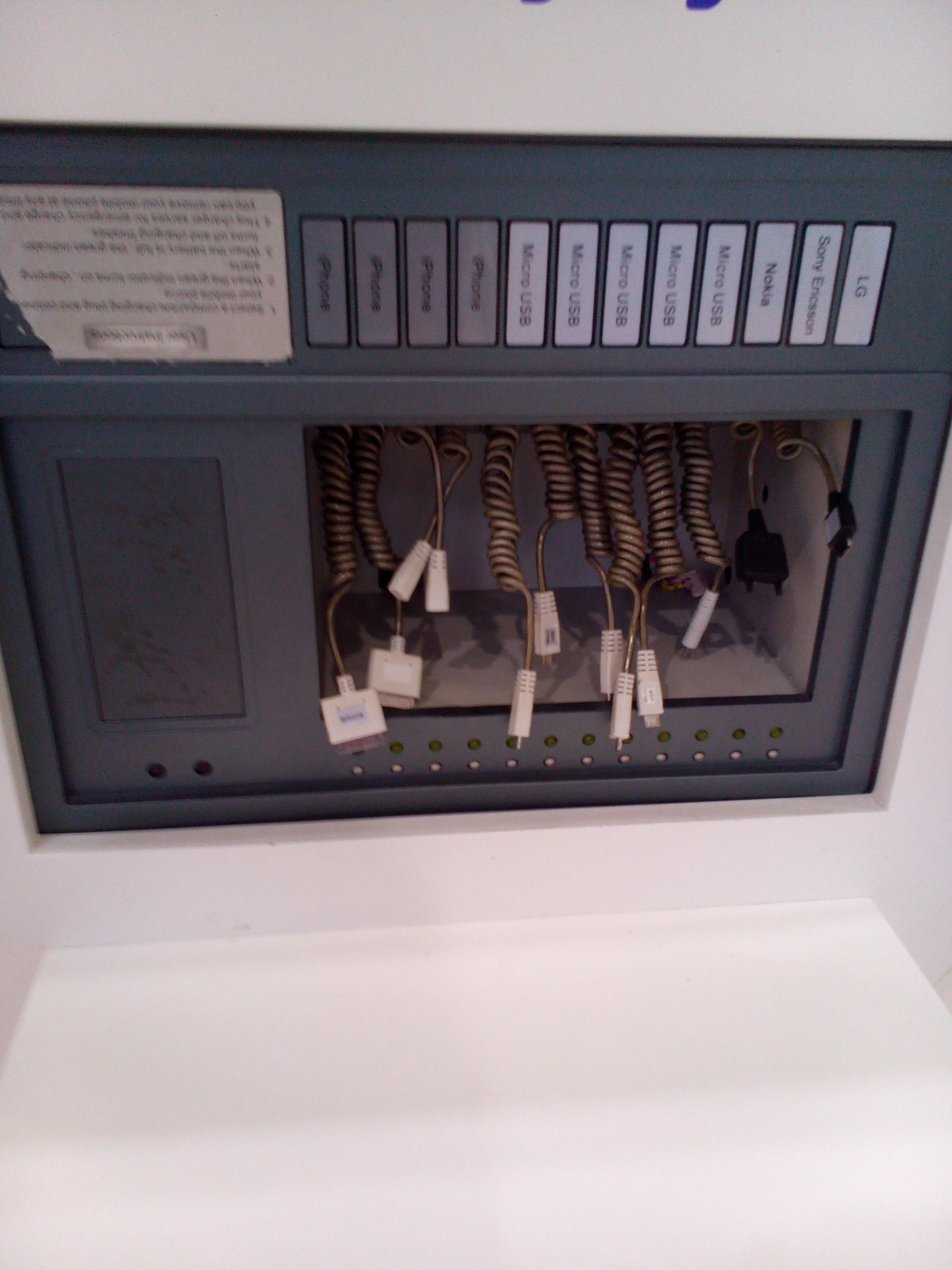
hand_held_communication_server

Image 1: Cell phone charging points

My second observation has to do with recharging your mobile devices. It may be that when you are travelling, your cell phone runs out of juice after uploading all those photographs of your beach getaway to Facebook. But never fear! With the advent of cell phone charging points, [See Image 1] you can simply connected your device via USB and re-energize its little power source. But how do you really know what this charger’s capabilities are? We’ve likely never interacted with that particular charger before. Can we as public users be sure that somewhere down the road, if not already, some nasty, imaginative individual hasn’t worked out some crafty means to circumvent our personal-cell security using these chargers?

The cell phone is no longer just some little hand held device which we use to send texts or make calls. It is a hand-held communications server that can do everything from facilitating our banking transactions to controlling our home heating systems. On that basis, I thinks this little tool deserves a tad more respect and certainly a lot more security.

[su_box title=”About Professor John Walker – FMFSoc FBCS FRSA CITP CISM CRISC ITPC
” style=”noise” box_color=”#336588″]

john_walkerVisiting Professor at the School of Science and Technology at Nottingham Trent University (NTU), Visiting Professor/Lecturer at the University of Slavonia [to 2015], Independent Consultant, Practicing Expert Witness, ENISA CEI Listed Expert, Editorial Member of the Cyber Security Research Institute (CRSI), Fellow of the British Computer Society (BCS), Fellow of the Royal Society of the Arts (RSA), Board Advisor to the Digital Trust, Writer for SC Magazine UK, Originator of DarkWeb Threat Intelligence, CSIRT, Attack Remediation and Cyber Training Service/Platform, Accreditation Assessor and Academic Practitioner and Accredited Advisor to the Chartered Society of Forensic Sciences in the area of Digital/Cyber Forensics.
Twitter: @SBLTD

John Walker is also our Panel member.  To find out more about our panel members visit the biographies page.[/su_box]


Professor John Walker

John is the Principle at Shadow-Intelligence (Si), partnering with PALISCOPE, BreachAware and iStorage. He is a Visiting Professor at the School of Science and Technology, Nottingham, Trent University (NTU) and holds the appointment of Editor in Chief for the International Journal of Cyber Forensics and Advanced Threat Investigations (CFATI). For the last decade he has delivered training courses in the Middle, and Far East to Commercial, Industrial, the Financial Services Sector, and Military Agencies, including the UAE, US, Pakistan, Saudi Arabia, Malaysia (KL), Singapore, Argentina, and Sao Paulo

He served in the Royal Air Force 22 years’, specialising in Counterintelligence, working with UK Agencies such as GCHQ/CESG, and others in the fields of SIGINT, COMINT and Satellite Communications, holding appointments such as System ITSO for a CIA SCIF.

In the commercials sectors of IT/Cyber he has worked for/with Logica, Bae, T5, GM, Experian, Betfair, Palace of Westminster, House of Lords/Commons, TSol (Treasury Solicitors) and provided Consultancy to the Saudi Arabian MOD, TRA (Telecommunications Authority (Dubai) and the Military Academy of Malaysia (KL) on SOC, CSIRT, Digital Forensics and OSINT. Within the last 5 years he has focused on Geopolitics, with global expertise around the UAE and Russia, Anti-Terrorist Operations (ATO), Cyber-Warfare, Dezinformatsiya (Disinformation) and Maskirovka (Military Deception).

  • Professor John Walker
    China Threat Recap: A Deeper Insight
  • Professor John Walker
    Missing The Point In The Current Age Of Cyber
  • Professor John Walker
    Part 1: Historic To 2022 – The APT And Logical Threats
  • Professor John Walker
    A Hairs Breadth

The opinions expressed in this post belong to the individual contributors and do not necessarily reflect the views of Information Security Buzz.

Share. Facebook Twitter LinkedIn Email Copy Link

Related Posts

Exploited Faster, Patched Slower: Verizon DBIR 2026 Shows Security Teams Losing Ground

May 20, 20265 Mins Read

Security’s Blind Spot: The Threats Hiding in “Low-Severity” Alerts

May 6, 20265 Mins Read

Why OSINT deserves the same status as other intelligence disciplines

March 17, 20266 Mins Read
ISB-Bora-Side-Bar

No se ha podido establecer conexión. Error 429

 
ISB-Bora-Side-Bar
Black ISB Logo

Information Security Buzz is an independent resource that provides the experts’ comments, analysis, and opinion on the latest Cybersecurity news and topics

X (Twitter) LinkedIn Facebook RSS

Working With Us

  • About Us
  • Advertise With Us
  • Contact Us

Write For Us

  • How To Contribute

The Pages

  • Privacy Policy
  • Cookie Policy
  • AI Policy
  • Terms & Conditions
  • Copyright Notice

Information Security Buzz and all its contents are copyright © 2014-2025. All rights reserved. All third-party trademarks are recognized.

Type above and press Enter to search. Press Esc to cancel.

Manage Consent
To provide the best experiences, we use technologies like cookies to store and/or access device information. Consenting to these technologies will allow us to process data such as browsing behavior or unique IDs on this site. Not consenting or withdrawing consent, may adversely affect certain features and functions.
Functional Always active
The technical storage or access is strictly necessary for the legitimate purpose of enabling the use of a specific service explicitly requested by the subscriber or user, or for the sole purpose of carrying out the transmission of a communication over an electronic communications network.
Preferences
The technical storage or access is necessary for the legitimate purpose of storing preferences that are not requested by the subscriber or user.
Statistics
The technical storage or access that is used exclusively for statistical purposes. The technical storage or access that is used exclusively for anonymous statistical purposes. Without a subpoena, voluntary compliance on the part of your Internet Service Provider, or additional records from a third party, information stored or retrieved for this purpose alone cannot usually be used to identify you.
Marketing
The technical storage or access is required to create user profiles to send advertising, or to track the user on a website or across several websites for similar marketing purposes.
  • Manage options
  • Manage services
  • Manage {vendor_count} vendors
  • Read more about these purposes
View preferences
  • {title}
  • {title}
  • {title}