


Close Menu
  • Home
  • Articles
    • Attacks
      • BEC
      • Data Breach
      • DDoS
      • Evasion Attacks
      • Injection
      • Malware
      • MITM
      • Phishing
      • Ransomware
      • RCE
      • Social Engineering
      • Spoofing
      • Spyware
    • Business and Policy
      • BCP and DRP
      • GRC
      • Regulations
    • Data Protection
      • DLP
      • DRM
      • Encryption
      • IAM
    • Future, Trends and Insight
      • AI
      • Events & Community
      • Emerging Tech
      • Expert Panel
      • Interviews With Experts
      • Insights
      • Study & Research
    • Resources
      • Guides
      • Tools
      • Training & Education
    • Security
      • API
      • Apps
      • Cloud
      • Critical Infrastructure
      • Endpoint
      • Hardware
      • IoT
      • Mobile
      • Network
      • OT
      • Port Security
      • Security Architecture
      • Software Development
      • Supply Chain
      • Zero Trust
    • Threats and Vulnerabilities
      • Emerging Threats
      • Insider Threats
      • Risk Management
      • Threat Intelligence
      • Zero Day
  • News and Exclusives
    • Latest News
    • ISB Exclusive
    • Positive News
  • Who We Are
    • About Us
    • Information Security Buzz Expert Panel​
    • Write for Us
    • Media Pack
  • Contact Us
  • Newsletter
Facebook X (Twitter) LinkedIn
Information Security BuzzInformation Security Buzz
  • Home
  • Articles
    • Attacks
      • BEC
      • Data Breach
      • DDoS
      • Evasion Attacks
      • Injection
      • Malware
      • MITM
      • Phishing
      • Ransomware
      • RCE
      • Social Engineering
      • Spoofing
      • Spyware
    • Business and Policy
      • BCP and DRP
      • GRC
      • Regulations
    • Data Protection
      • DLP
      • DRM
      • Encryption
      • IAM
    • Future, Trends and Insight
      • AI
      • Events & Community
      • Emerging Tech
      • Expert Panel
      • Interviews With Experts
      • Insights
      • Study & Research
    • Resources
      • Guides
      • Tools
      • Training & Education
    • Security
      • API
      • Apps
      • Cloud
      • Critical Infrastructure
      • Endpoint
      • Hardware
      • IoT
      • Mobile
      • Network
      • OT
      • Port Security
      • Security Architecture
      • Software Development
      • Supply Chain
      • Zero Trust
    • Threats and Vulnerabilities
      • Emerging Threats
      • Insider Threats
      • Risk Management
      • Threat Intelligence
      • Zero Day
  • News and Exclusives
    • Latest News
    • ISB Exclusive
    • Positive News
  • Who We Are
    • About Us
    • Information Security Buzz Expert Panel​
    • Write for Us
    • Media Pack
  • Contact Us
  • Newsletter
Subscribe
Information Security BuzzInformation Security Buzz
Home - Study & Research - Mobile Ransomware More Than Trebled In Q1, 2017
Study & Research

Mobile Ransomware More Than Trebled In Q1, 2017

ISBuzz TeamBy ISBuzz TeamMay 23, 20173 Mins Read
Share LinkedIn Twitter Facebook Copy Link Email
Share
Facebook Twitter LinkedIn Email Copy Link
Quick AI Summary
ChatGPTClaudeGeminiGrokPerplexityDeepSeekCopilot

The global nightmare of ransomware shows no sign of slowing down, with the volume of mobile ransomware rising over three-fold (3.5 times) during the first few months of the year, according to Kaspersky Lab’s Malware Report for Q1, 2017. The number of mobile ransomware files detected reached 218,625 during the quarter, compared to 61,832 in the previous quarter, with the Congur family accounting for more than 86 per cent. Ransomware targeting all devices, systems and networks also continued to grow, with 11 new cryptor families and 55,679 new modifications making their appearance in Q1.

Congur ransomware is primarily a blocker – setting or resetting the device PIN (passcode) so the requires the attackers to have administrator rights on the device, and some variants of the malware take further advantage of these rights to install their module into the system folder from where it is almost impossible to remove.

Despite the popularity of Congur, Trojan-Ransom.AndroidOS.Fusob.h remained the most widely used mobile ransomware, accounting for nearly 45 per cent of all users attacked by this threat during the quester. Once run, the Trojan requests administrator privileges, collects information about the device, including GPS coordinates and call history, and uploads the data to a malicious server. Based on what it receives, the server may send back a command to block the device.

The USA became the country hardest hit by mobile ransomware in Q1, with Svpeng ransomware the most widespread threat.
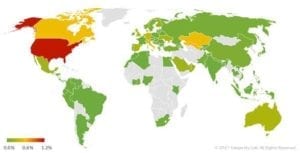
Geography of mobile Trojan-Ransomware in Q1 2017 (percentage of all users attacked)

In all, 55,679 new Windows ransomware modifications were detected during the quarter representing a near two-fold increase on Q4, 2016 (29,450). Most of these new modifications belonged to the Cerber family.

“The mobile threat landscape for ransomware was far from calm in Q1. Ransomware targeting mobile devices soared, with new ransomware families and modifications continuing to proliferate. People need to bear in mind that attackers can – and increasingly will – try to block access to their data not only on a PC but also on their mobile device,” notes Roman Unuchek, Senior Malware Analyst at Kaspersky Lab.

Other online threat statistics from the Q1, 2017 report include:  

  • Kaspersky Lab solutions detected and repelled 479,528,279 malicious attacks from online resources located in 190 countries all over the world.
  • 79,209,775 unique URLs were recognised as malicious by web antivirus components.
  • Attempted infections by malware that aims to steal money via online access to bank accounts were registered on 288,000 user computers.
  • Crypto-ransomware attacks were blocked on 240,799 computers of unique users.
  • Kaspersky Lab’s file antivirus detected a total of 174,989,956 unique malicious and potentially unwanted objects.
  • Kaspersky Lab mobile security products also detected:
    • 1,333,605 malicious installation packages;
    • 32,038 mobile banking Trojans (installation packages).

To reduce the risk of infection, users are advised to:

  • Use robust security solutions and make sure they keep all software up to date.
  • Regularly run a system scan to check for possible infection.
  • Stay wise while online. Do not enter personal information into a website if you are at all unsure or suspicious.
  • Back up valuable information.

[su_box title=”About Kaspersky Lab” style=”noise” box_color=”#336588″][short_info id=’59584′ desc=”true” all=”false”][/su_box]

ISBuzz Team
  • ISBuzz Team
    Air Canada Data Breach: BianLian Extortion Group Claims A Massive Heist Contrary To Airline’s Earlier Statement
  • ISBuzz Team
    Unprecedented DDoS Attack Rocks The Web: Tech Giants Reveal A Digital Tsunami
  • ISBuzz Team
    CISA Flags High-Severity Adobe Acrobat Reader Flaw Amid Active Exploits
  • ISBuzz Team
    Curl Security Alert: Patching A Critical Bug Averting Potential Cyber Catastrophe

The opinions expressed in this post belong to the individual contributors and do not necessarily reflect the views of Information Security Buzz.

Share. Facebook Twitter LinkedIn Email Copy Link

Related Posts

The Real Cost of Inconsistent Third-Party Access

December 18, 20255 Mins Read

What Happens When Devices Cross Borders? The Role of Geofencing in Global IT

August 7, 20256 Mins Read

The Evolving Importance of Identity Governance in FinTech

July 10, 20258 Mins Read
ISB-Bora-Side-Bar

No se ha podido establecer conexión. Error 429

 
ISB-Bora-Side-Bar
Black ISB Logo

Information Security Buzz is an independent resource that provides the experts’ comments, analysis, and opinion on the latest Cybersecurity news and topics

X (Twitter) LinkedIn Facebook RSS

Working With Us

  • About Us
  • Advertise With Us
  • Contact Us

Write For Us

  • How To Contribute

The Pages

  • Privacy Policy
  • Cookie Policy
  • AI Policy
  • Terms & Conditions
  • Copyright Notice

Information Security Buzz and all its contents are copyright © 2014-2025. All rights reserved. All third-party trademarks are recognized.

Type above and press Enter to search. Press Esc to cancel.

Manage Consent
To provide the best experiences, we use technologies like cookies to store and/or access device information. Consenting to these technologies will allow us to process data such as browsing behavior or unique IDs on this site. Not consenting or withdrawing consent, may adversely affect certain features and functions.
Functional Always active
The technical storage or access is strictly necessary for the legitimate purpose of enabling the use of a specific service explicitly requested by the subscriber or user, or for the sole purpose of carrying out the transmission of a communication over an electronic communications network.
Preferences
The technical storage or access is necessary for the legitimate purpose of storing preferences that are not requested by the subscriber or user.
Statistics
The technical storage or access that is used exclusively for statistical purposes. The technical storage or access that is used exclusively for anonymous statistical purposes. Without a subpoena, voluntary compliance on the part of your Internet Service Provider, or additional records from a third party, information stored or retrieved for this purpose alone cannot usually be used to identify you.
Marketing
The technical storage or access is required to create user profiles to send advertising, or to track the user on a website or across several websites for similar marketing purposes.
  • Manage options
  • Manage services
  • Manage {vendor_count} vendors
  • Read more about these purposes
View preferences
  • {title}
  • {title}
  • {title}