



Top findings from the report include:
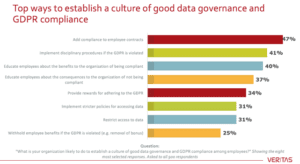
- 34% of respondents say they will reward employees for complying with GDPR policies
- 41% of respondents plan to implement employee disciplinary procedures if GDPR policies are violated
- A quarter of businesses would consider withholding benefits – including bonuses – from employees found to be non-compliant
71 Percent of Organisations Plan Bold Steps in Creating a Culture of GDPR-Compliance: Rewarding Employees Who Follow Policies, Penalising Those Who Don’t
The risk of losing benefits—including bonuses—for failure to comply with GDPR policies is a real possibility for employees at one in four organisations worldwide according to a study
A study from Veritas Technologies, a leader in multi-cloud data management, has found that the General Data Protection Regulation (GDPR) has the potential to drive major cultural changes in businesses worldwide. Nearly three in four respondents plan to incentivise employees to improve data hygiene and take accountability for data compliance.
According to The Veritas 2017 GDPR Report, 88 per cent of organisations around the world plan to drive employee GDPR behavioral changes through training, rewards, penalties and contracts. Almost half (47 per cent) of businesses will go so far as to add mandatory GDPR policy adherences into employment agreements.
Failure to adhere to contractual guidelines could have significant implications. Nearly half (41 per cent) of respondents also plan to implement employee disciplinary procedures if GDPR policies are violated. A quarter of businesses (25 per cent) would consider witholding benefits—including bonuses—from employees found to be non-compliant. At the same time, 34 per cent say they will reward employees for complying with GDPR policies, as those employees are helping to promote proper data governance within their organisations, which can lead to better business outcomes.
GDPR Driving Cultural Changes
The report found that the vast majority of respondents (91 per cent) admit that their organisation does not currently hold a culture of good data governance or GDPR compliance. However, as indicated above, companies understand that training is critical to driving cultural changes within their organisations.
The majority (63 per cent) of companies believe all employees must receive mandatory training on GDPR policies. However, respondents were also quick to identify the types of employees that should be trained: 86% believe the IT department must be prioritised, closely followed by business direction and strategy employees (85 per cent), business development/sales/channel employees (84 per cent), legal employees (82 per cent) and finance employees (82 per cent).
“Data is one of the most critical assets within an organisation, yet many businesses are struggling to implement good data hygiene practices—and that often starts with employees,” said Mike Palmer, executive vice president and chief product officer, Veritas. “However, our research shows that busiensses are getting serious about driving cultural change within their organisations.”
“As businesses consider deploying new processes and policies including training, rewards and updated contracts in support of GDPR compliance, more employees will understand the role they play in protecting their organisation’s data. And, for employees that fail to take matters seriously, their bonuses and benefits may be negatively impacted.”
Business Benefits of GDPR Compliance
While avoiding stringent regulatory penalties and fines is clearly a driver for improving an organisation’s compliance posture, many companies also see major business benefits that go well beyond avoiding such sanctions. The research shows that almost all businesses (95 per cent) see substantial business benefits to achieving GDPR compliance, including better data management across the entire organisation.
Specifically, organisations believe that once they have advanced their compliance standing, they are able to reap the following benefits:
- Improve data hygiene: 92 per cent of respondents believe that their organisation will benefit from good data hygiene, which helps drive trust in the data and improve data quality, accuracy and policy enforcement
- Generate more insights: 68 per cent believe that they will gather stronger data insights about their businesses through GDPR compliance, which can play a key role in delivering better customer experiences
- Save money: 68 per cent think that their organisation will save money
- Build brand reputation: 59 per cent believe that data compliance will also strengthen their reputation or relationships with their customers
- Protect data: 51 per cent of organisations believe they will be able to protect data more efficiently
- Increase revenues: 45 per cent expect to reduce costs, increase revenue or market share with better data management. One in five (22 per cent) think it will ultimately help their organisations have more disposable cash, which can be used to invest in research and development (R&D) or to deploy additional resources to drive innovation
- Hire more people: A quarter (25 per cent) say enhanced data compliance will allow the organisation to employ more staff to provide better customer service
“The GDPR will take effect on May 25, 2018 and will apply to any organisation—inside or outside the EU—that offers goods or services to EU residents, or monitors their behavior,” added Palmer. “Companies that adhere to compliance not only reduce their risks of fines, but have an opportunity to offer customers better experiences through proper data management, which can impact customer loyalty, revenues and brand reputation.”
Veritas will also announce today significant technology advancements that can help companies comply with the GDPR. Specifically, Veritas announced a key integration between its Classification Engine and its eDiscovery Platform that will help customers quickly scan and tag data, using a pre-designed set of classification policies, to ensure that sensitive or risky information is properly managed and protected.
And, for information on how Veritas can help your organisation become GDPR compliant visit https://www.veritas.com/gdpr
Methodology
Veritas commissioned independent technology market research specialist Vanson Bourne to undertake the research upon which this report is based.
A total of 900 business decision makers were interviewed in February and March across the US, the UK, France, Germany, Australia, Singapore, Japan and the Republic of Korea. The respondents were from organisations with at least 1,000 employees, and could be from any sector. To qualify for the research, respondents had to be from organisations that do at least some business with the EU.
Interviews were conducted online using a rigorous multi-level screening process to ensure that only suitable candidates had the opportunity to participate.

The opinions expressed in this post belong to the individual contributors and do not necessarily reflect the views of Information Security Buzz.