


Close Menu
  • Home
  • Articles
    • Attacks
      • BEC
      • Data Breach
      • DDoS
      • Evasion Attacks
      • Injection
      • Malware
      • MITM
      • Phishing
      • Ransomware
      • RCE
      • Social Engineering
      • Spoofing
      • Spyware
    • Business and Policy
      • BCP and DRP
      • GRC
      • Regulations
    • Data Protection
      • DLP
      • DRM
      • Encryption
      • IAM
    • Future, Trends and Insight
      • AI
      • Events & Community
      • Emerging Tech
      • Expert Panel
      • Interviews With Experts
      • Insights
      • Study & Research
    • Resources
      • Guides
      • Tools
      • Training & Education
    • Security
      • API
      • Apps
      • Cloud
      • Critical Infrastructure
      • Endpoint
      • Hardware
      • IoT
      • Mobile
      • Network
      • OT
      • Port Security
      • Security Architecture
      • Software Development
      • Supply Chain
      • Zero Trust
    • Threats and Vulnerabilities
      • Emerging Threats
      • Insider Threats
      • Risk Management
      • Threat Intelligence
      • Zero Day
  • News and Exclusives
    • Latest News
    • ISB Exclusive
    • Positive News
  • Who We Are
    • About Us
    • Information Security Buzz Expert Panel​
    • Write for Us
    • Media Pack
  • Contact Us
  • Newsletter
Facebook X (Twitter) LinkedIn
Information Security BuzzInformation Security Buzz
  • Home
  • Articles
    • Attacks
      • BEC
      • Data Breach
      • DDoS
      • Evasion Attacks
      • Injection
      • Malware
      • MITM
      • Phishing
      • Ransomware
      • RCE
      • Social Engineering
      • Spoofing
      • Spyware
    • Business and Policy
      • BCP and DRP
      • GRC
      • Regulations
    • Data Protection
      • DLP
      • DRM
      • Encryption
      • IAM
    • Future, Trends and Insight
      • AI
      • Events & Community
      • Emerging Tech
      • Expert Panel
      • Interviews With Experts
      • Insights
      • Study & Research
    • Resources
      • Guides
      • Tools
      • Training & Education
    • Security
      • API
      • Apps
      • Cloud
      • Critical Infrastructure
      • Endpoint
      • Hardware
      • IoT
      • Mobile
      • Network
      • OT
      • Port Security
      • Security Architecture
      • Software Development
      • Supply Chain
      • Zero Trust
    • Threats and Vulnerabilities
      • Emerging Threats
      • Insider Threats
      • Risk Management
      • Threat Intelligence
      • Zero Day
  • News and Exclusives
    • Latest News
    • ISB Exclusive
    • Positive News
  • Who We Are
    • About Us
    • Information Security Buzz Expert Panel​
    • Write for Us
    • Media Pack
  • Contact Us
  • Newsletter
Subscribe
Information Security BuzzInformation Security Buzz
Home - Study & Research - Online Shoppers In The UK At Risk Of Email Fraud This Black Friday And Cyber Monday
Study & Research

Online Shoppers In The UK At Risk Of Email Fraud This Black Friday And Cyber Monday

ISBuzz TeamBy ISBuzz TeamNovember 19, 20194 Mins Read
Share LinkedIn Twitter Facebook Copy Link Email
Share
Facebook Twitter LinkedIn Email Copy Link
Quick AI Summary
ChatGPTClaudeGeminiGrokPerplexityDeepSeekCopilot

60 percent of the UK’s top ten online retailers are not actively blocking fraudulent emails from reaching customers

Proofpoint, Inc., (NASDAQ: PFPT) a leading cyber security and compliance company, today released research identifying that only four of the top 10 (40 percent) online retailers in the UK have implemented the strictest level of DMARC (Domain-based Message Authentication, Reporting & Conformance) protection, making them susceptible to cybercriminals spoofing their identity and increasing the risk of email fraud for customers.  Worryingly, this leaves online shoppers at 60 percent of top retailers in the UK open to email fraud.

With Black Friday upon us, and over half of UK consumers set to shop on the day, shoppers will be scanning both the internet and their inboxes for the hottest deals. However, cybercriminals may capitalise on the anticipation of email communication from retailers to potentially trick shoppers with fraudulent emails.

“Online retailers may be exposing themselves and their customers to cybercriminals on the hunt for personal and financial data, by not implementing simple, yet effective email authentication best practices,” says Adenike Cosgrove, cybersecurity strategist, International, Proofpoint. “Email continues to be the vector of choice for cybercriminals and the retail industry remains a key target. In fact, Proofpoint researchers saw a 144 percent year-over-year increase in email fraud attacks on the retail industry in 2018.”

Key findings from the research include:

  • The UK is leading the charge with DMARC adoption in the ecommerce sector across Europe, with 100 percent of the top ten online retailers in the UK having a published a DMARC record.
  • However, only 40 percent have implemented the strictest level of DMARC protection, which actually blocks fraudulent emails from reaching their intended targets, meaning 60 percent are leaving customers open to email fraud.
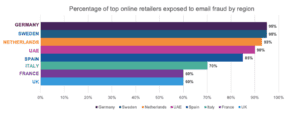
  • The UK’s adoption of the strictest level of DMARC protection in the eCommerce sector is stronger than the European-wide percentage: Only 15 percent of the top 20 European-wide online retailers are proactively blocking fraudulent emails from reaching customers, meaning 85 percent of Europe’s top online retailers are leaving customers open to email fraud.
  • Proofpoint analysed eight regions across EMEA in this study, see below for how they rank against each other:
“Organisations in all sectors should look to deploy authentication protocols, such as DMARC to shore up their email fraud defences. Cybercriminals will always leverage key events to drive targeted attacks using social engineering techniques such as impersonation and online retailers are no exception to this. Ahead of Black Friday, consumers must be vigilant in checking the validity of all emails, especially on a day when guards are down, and attentions are focused on grabbing seasonal bargains”, says Adenike Cosgrove, cybersecurity strategist, International, Proofpoint.

Proofpoint’s Domain Fraud Report 2019 also demonstrates how email is heavily used as a threat vector in the retail industry, with the report revealing that for fraudulent domains impersonating

highly recognisable retail brands, Proofpoint researchers observed much higher volumes of email, suggesting more broad-based attacks against customers and partners.

Proofpoint recommends consumers follow the below top tips to remain safe online while shopping for seasonal bargains:

  1. Use strong passwords:  Do not reuse the same password twice. Consider using a password manager to make your online experience seamless, whilst staying safe. Use multi-factor authentication for an added layer of security.
  2. Avoid Unprotected WiFi: Free/open-access WiFi is not secure: cybercriminals can intercept data transferred over unprotected WiFi, including credit card numbers, passwords, account information, and more.
  3. Watch out for “lookalike” sites: Attackers create “lookalike” sites imitating familiar brands. These fraudulent sites may sell counterfeit (or non-existent) goods, be infected with malware, or steal money or credentials.
  4. Dodge Potential Phishing and Smishing Attacks: Phishing emails lead to unsafe websites that gather personal data, like credentials and credit card data. Watch out for SMS phishing too —aka ‘smishing’ — or messages through social media.
  5. Don’t click on links: Go directly to the source of the advertised deal by typing a known website address directly into your browser. For special offer codes, enter them at the checkout to see if they are legitimate.
  6. Verify Before You Buy: Fraudulent ads, websites, and mobile apps can be hard to spot. When downloading a new app or visiting an unfamiliar site, take time to read online reviews and any customer complaints.
ISBuzz Team
  • ISBuzz Team
    Air Canada Data Breach: BianLian Extortion Group Claims A Massive Heist Contrary To Airline’s Earlier Statement
  • ISBuzz Team
    Unprecedented DDoS Attack Rocks The Web: Tech Giants Reveal A Digital Tsunami
  • ISBuzz Team
    CISA Flags High-Severity Adobe Acrobat Reader Flaw Amid Active Exploits
  • ISBuzz Team
    Curl Security Alert: Patching A Critical Bug Averting Potential Cyber Catastrophe

The opinions expressed in this post belong to the individual contributors and do not necessarily reflect the views of Information Security Buzz.

Share. Facebook Twitter LinkedIn Email Copy Link

Related Posts

New Phishing Kit Starkiller Defeats Multi-Factor Authentication

February 23, 20264 Mins Read

ReliaQuest Uncovers Social Media Phishing Campaign Built on Trusted Tools

January 22, 20266 Mins Read

What Happens after a Phishing Email Lands in Your Inbox?

January 5, 20266 Mins Read
ISB-Bora-Side-Bar

No se ha podido establecer conexión. Error 429

 
ISB-Bora-Side-Bar
Black ISB Logo

Information Security Buzz is an independent resource that provides the experts’ comments, analysis, and opinion on the latest Cybersecurity news and topics

X (Twitter) LinkedIn Facebook RSS

Working With Us

  • About Us
  • Advertise With Us
  • Contact Us

Write For Us

  • How To Contribute

The Pages

  • Privacy Policy
  • Cookie Policy
  • AI Policy
  • Terms & Conditions
  • Copyright Notice

Information Security Buzz and all its contents are copyright © 2014-2025. All rights reserved. All third-party trademarks are recognized.

Type above and press Enter to search. Press Esc to cancel.

Manage Consent
To provide the best experiences, we use technologies like cookies to store and/or access device information. Consenting to these technologies will allow us to process data such as browsing behavior or unique IDs on this site. Not consenting or withdrawing consent, may adversely affect certain features and functions.
Functional Always active
The technical storage or access is strictly necessary for the legitimate purpose of enabling the use of a specific service explicitly requested by the subscriber or user, or for the sole purpose of carrying out the transmission of a communication over an electronic communications network.
Preferences
The technical storage or access is necessary for the legitimate purpose of storing preferences that are not requested by the subscriber or user.
Statistics
The technical storage or access that is used exclusively for statistical purposes. The technical storage or access that is used exclusively for anonymous statistical purposes. Without a subpoena, voluntary compliance on the part of your Internet Service Provider, or additional records from a third party, information stored or retrieved for this purpose alone cannot usually be used to identify you.
Marketing
The technical storage or access is required to create user profiles to send advertising, or to track the user on a website or across several websites for similar marketing purposes.
  • Manage options
  • Manage services
  • Manage {vendor_count} vendors
  • Read more about these purposes
View preferences
  • {title}
  • {title}
  • {title}