


Close Menu
  • Home
  • Articles
    • Attacks
      • BEC
      • Data Breach
      • DDoS
      • Evasion Attacks
      • Injection
      • Malware
      • MITM
      • Phishing
      • Ransomware
      • RCE
      • Social Engineering
      • Spoofing
      • Spyware
    • Business and Policy
      • BCP and DRP
      • GRC
      • Regulations
    • Data Protection
      • DLP
      • DRM
      • Encryption
      • IAM
    • Future, Trends and Insight
      • AI
      • Events & Community
      • Emerging Tech
      • Expert Panel
      • Interviews With Experts
      • Insights
      • Study & Research
    • Resources
      • Guides
      • Tools
      • Training & Education
    • Security
      • API
      • Apps
      • Cloud
      • Critical Infrastructure
      • Endpoint
      • Hardware
      • IoT
      • Mobile
      • Network
      • OT
      • Port Security
      • Security Architecture
      • Software Development
      • Supply Chain
      • Zero Trust
    • Threats and Vulnerabilities
      • Emerging Threats
      • Insider Threats
      • Risk Management
      • Threat Intelligence
      • Zero Day
  • News and Exclusives
    • Latest News
    • ISB Exclusive
    • Positive News
  • Who We Are
    • About Us
    • Information Security Buzz Expert Panel​
    • Write for Us
    • Media Pack
  • Contact Us
  • Newsletter
Facebook X (Twitter) LinkedIn
Information Security BuzzInformation Security Buzz
  • Home
  • Articles
    • Attacks
      • BEC
      • Data Breach
      • DDoS
      • Evasion Attacks
      • Injection
      • Malware
      • MITM
      • Phishing
      • Ransomware
      • RCE
      • Social Engineering
      • Spoofing
      • Spyware
    • Business and Policy
      • BCP and DRP
      • GRC
      • Regulations
    • Data Protection
      • DLP
      • DRM
      • Encryption
      • IAM
    • Future, Trends and Insight
      • AI
      • Events & Community
      • Emerging Tech
      • Expert Panel
      • Interviews With Experts
      • Insights
      • Study & Research
    • Resources
      • Guides
      • Tools
      • Training & Education
    • Security
      • API
      • Apps
      • Cloud
      • Critical Infrastructure
      • Endpoint
      • Hardware
      • IoT
      • Mobile
      • Network
      • OT
      • Port Security
      • Security Architecture
      • Software Development
      • Supply Chain
      • Zero Trust
    • Threats and Vulnerabilities
      • Emerging Threats
      • Insider Threats
      • Risk Management
      • Threat Intelligence
      • Zero Day
  • News and Exclusives
    • Latest News
    • ISB Exclusive
    • Positive News
  • Who We Are
    • About Us
    • Information Security Buzz Expert Panel​
    • Write for Us
    • Media Pack
  • Contact Us
  • Newsletter
Subscribe
Information Security BuzzInformation Security Buzz
Home - Articles - Quarter of Employees would Sell Company Data for Cash
Articles

Quarter of Employees would Sell Company Data for Cash

ISBuzz TeamBy ISBuzz TeamAugust 5, 20154 Mins Read
Share LinkedIn Twitter Facebook Copy Link Email
1 in 3 employees will sell company data for cash
Share
Facebook Twitter LinkedIn Email Copy Link
Quick AI Summary
ChatGPTClaudeGeminiGrokPerplexityDeepSeekCopilot

Third of employees have their price for selling their company’s private data, 25% would sell critical business information for £5,000, with some open to bribing for as little as £100

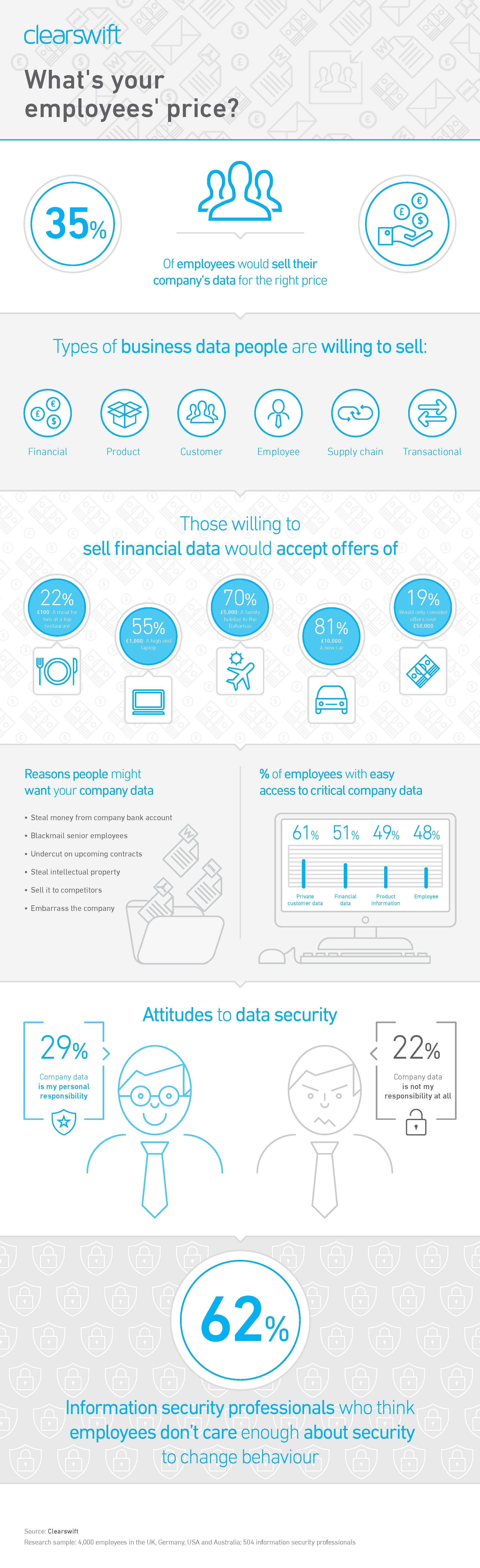
35% of employees would sell information on company patents, financial records and customer credit card details if the price was right.

New research by Clearswift amongst 4,000 employees in the UK, Germany, USA and Australia, found that for £5,000 – the price of a family Caribbean holiday or less than three months of the average UK monthly wage – 25% would sell such data and risk both their job and criminal convictions.

3% of employees would sell private information for as little as £100, rising to 18% who would accept an offer of £1,000. The number of employees open to bribes increases to 35% as the offer reaches £50,000.

Such information can prove very valuable to competitors and criminals, and employee bribery can be an easy way in, as security systems become more sophisticated.

Certain companies and even governments have long targeted patents and other intellectual property which can give them an edge, whilst competitors can benefit from information, such as when contracts are coming to an end. Criminals can use private information to steal money or bribe senior employees.

Heath Davies, Chief Executive at Clearswift, says: “Whilst people are generally taking security more seriously – 65% of employees said they wouldn’t sell data for any price – there is still a significant group of people who are willing to profit from selling something that doesn’t belong to them. This information can be worth millions of pounds.”
Sell company data for money


“A case in point of the true value of data is the recent Ashley Madison hack, where user data has been accessed by a member of their extended enterprise (part of their technical services) according to the site’s CEO; the effects of which have been monumental. The site announced earlier this year that it hoped to raise £130 million in an initial public offering in London this year and it may have lost out on this opportunity reducing the value of its entire business. The attack may have burned a hole in its prospects and has already had a ripple effect on its sister sites Cougar Life and Established Men. As such it is important for companies to understand the risk and address it appropriately – this research can help them do that.”

The opportunity to sell valuable information is exacerbated by the ready access most employees have to it. 61% of respondents said they had access to private customer data, 51%, to financial data such as company accounts or shareholder information, and 49% to sensitive product information such as planned launches and patents.

Attitudes to data security were mixed, with only 29% saying that company data was their personal responsibility, and 22% saying they didn’t feel it was their responsibility at all.

A corresponding Clearswift survey of 504 information security professionals found 62% think employees don’t care enough about the implications of a security breach to change their behaviour.

Davies concludes: “It is not good business to live in fear of your employees, especially as most can be trusted. Getting the balance right has always been hard. But truly understanding where the problems come from, combined with advances in technology which can adapt to respond differently to different threats, really changes the game here.”

Organisations need to find ways to control where sensitive data is stored and put safeguards in place which prevent it from leaving the company network. Many Companies do this but a lot of large companies with very valuable data do not”.[su_box title=”About Clearswift” style=”noise” box_color=”#336588″]ClearswiftClearswift is trusted by organisations globally to protect their critical information, giving them the freedom to securely collaborate and drive business growth. Our unique technology supports a straightforward and ‘adaptive’ data loss prevention solution, avoiding the risk of business interruption and enabling organisations to have 100% visibility of their critical information 100% of the time.[/su_box]

ISBuzz Team
  • ISBuzz Team
    Air Canada Data Breach: BianLian Extortion Group Claims A Massive Heist Contrary To Airline’s Earlier Statement
  • ISBuzz Team
    Unprecedented DDoS Attack Rocks The Web: Tech Giants Reveal A Digital Tsunami
  • ISBuzz Team
    CISA Flags High-Severity Adobe Acrobat Reader Flaw Amid Active Exploits
  • ISBuzz Team
    Curl Security Alert: Patching A Critical Bug Averting Potential Cyber Catastrophe

The opinions expressed in this post belong to the individual contributors and do not necessarily reflect the views of Information Security Buzz.

Share. Facebook Twitter LinkedIn Email Copy Link

Related Posts

Visual data is the blind spot in enterprise security: that’s about to change

May 4, 20267 Mins Read

Making stolen data worthless: why security must start with the data

March 30, 20265 Mins Read

Meta’s Smart Glasses Privacy Scandal Expands After Sama Credentials Found on the Dark Web

March 10, 20264 Mins Read
ISB-Bora-Side-Bar

No se ha podido establecer conexión. Error 429

 
ISB-Bora-Side-Bar
Black ISB Logo

Information Security Buzz is an independent resource that provides the experts’ comments, analysis, and opinion on the latest Cybersecurity news and topics

X (Twitter) LinkedIn Facebook RSS

Working With Us

  • About Us
  • Advertise With Us
  • Contact Us

Write For Us

  • How To Contribute

The Pages

  • Privacy Policy
  • Cookie Policy
  • AI Policy
  • Terms & Conditions
  • Copyright Notice

Information Security Buzz and all its contents are copyright © 2014-2025. All rights reserved. All third-party trademarks are recognized.

Type above and press Enter to search. Press Esc to cancel.

Manage Consent
To provide the best experiences, we use technologies like cookies to store and/or access device information. Consenting to these technologies will allow us to process data such as browsing behavior or unique IDs on this site. Not consenting or withdrawing consent, may adversely affect certain features and functions.
Functional Always active
The technical storage or access is strictly necessary for the legitimate purpose of enabling the use of a specific service explicitly requested by the subscriber or user, or for the sole purpose of carrying out the transmission of a communication over an electronic communications network.
Preferences
The technical storage or access is necessary for the legitimate purpose of storing preferences that are not requested by the subscriber or user.
Statistics
The technical storage or access that is used exclusively for statistical purposes. The technical storage or access that is used exclusively for anonymous statistical purposes. Without a subpoena, voluntary compliance on the part of your Internet Service Provider, or additional records from a third party, information stored or retrieved for this purpose alone cannot usually be used to identify you.
Marketing
The technical storage or access is required to create user profiles to send advertising, or to track the user on a website or across several websites for similar marketing purposes.
  • Manage options
  • Manage services
  • Manage {vendor_count} vendors
  • Read more about these purposes
View preferences
  • {title}
  • {title}
  • {title}