


Close Menu
  • Home
  • Articles
    • Attacks
      • BEC
      • Data Breach
      • DDoS
      • Evasion Attacks
      • Injection
      • Malware
      • MITM
      • Phishing
      • Ransomware
      • RCE
      • Social Engineering
      • Spoofing
      • Spyware
    • Business and Policy
      • BCP and DRP
      • GRC
      • Regulations
    • Data Protection
      • DLP
      • DRM
      • Encryption
      • IAM
    • Future, Trends and Insight
      • AI
      • Events & Community
      • Emerging Tech
      • Expert Panel
      • Interviews With Experts
      • Insights
      • Study & Research
    • Resources
      • Guides
      • Tools
      • Training & Education
    • Security
      • API
      • Apps
      • Cloud
      • Critical Infrastructure
      • Endpoint
      • Hardware
      • IoT
      • Mobile
      • Network
      • OT
      • Port Security
      • Security Architecture
      • Software Development
      • Supply Chain
      • Zero Trust
    • Threats and Vulnerabilities
      • Emerging Threats
      • Insider Threats
      • Risk Management
      • Threat Intelligence
      • Zero Day
  • News and Exclusives
    • Latest News
    • ISB Exclusive
    • Positive News
  • Who We Are
    • About Us
    • Information Security Buzz Expert Panel​
    • Write for Us
    • Media Pack
  • Contact Us
  • Newsletter
Facebook X (Twitter) LinkedIn
Information Security BuzzInformation Security Buzz
  • Home
  • Articles
    • Attacks
      • BEC
      • Data Breach
      • DDoS
      • Evasion Attacks
      • Injection
      • Malware
      • MITM
      • Phishing
      • Ransomware
      • RCE
      • Social Engineering
      • Spoofing
      • Spyware
    • Business and Policy
      • BCP and DRP
      • GRC
      • Regulations
    • Data Protection
      • DLP
      • DRM
      • Encryption
      • IAM
    • Future, Trends and Insight
      • AI
      • Events & Community
      • Emerging Tech
      • Expert Panel
      • Interviews With Experts
      • Insights
      • Study & Research
    • Resources
      • Guides
      • Tools
      • Training & Education
    • Security
      • API
      • Apps
      • Cloud
      • Critical Infrastructure
      • Endpoint
      • Hardware
      • IoT
      • Mobile
      • Network
      • OT
      • Port Security
      • Security Architecture
      • Software Development
      • Supply Chain
      • Zero Trust
    • Threats and Vulnerabilities
      • Emerging Threats
      • Insider Threats
      • Risk Management
      • Threat Intelligence
      • Zero Day
  • News and Exclusives
    • Latest News
    • ISB Exclusive
    • Positive News
  • Who We Are
    • About Us
    • Information Security Buzz Expert Panel​
    • Write for Us
    • Media Pack
  • Contact Us
  • Newsletter
Subscribe
Information Security BuzzInformation Security Buzz
Home - Articles - The Generic World Of Onions
Articles

The Generic World Of Onions

Professor John WalkerBy Professor John WalkerJuly 27, 2021Updated:January 17, 20234 Mins Read
Share LinkedIn Twitter Facebook Copy Link Email
Share
Facebook Twitter LinkedIn Email Copy Link
Quick AI Summary
ChatGPTClaudeGeminiGrokPerplexityDeepSeekCopilot

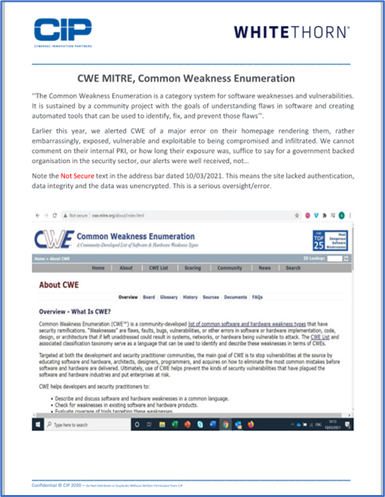
Earlier in 2021, Andrew Jenkinson the CEO of CIP issued an alert and notified the CWE Team that they were running with some security exposures, leaving their domain open to a higher potential of compromise and security exposure – something the staff at CWE were unaware of at that time – Andy Jenkinson has since published his assessment report on Linkedin today (26/07/21) as a matter of Public Awareness and Interest – See below at Fig 1.

As most readers will be aware, CWE, the ‘Common Weakness Enumeration’ is a category system for ‘software’ weaknesses and vulnerabilities which is supported out of a Community Project with the goals of understanding flaws in ‘software’ and creating automated tools which may be leveraged to identify, fix, and prevent such laws.

The upshot of the CIP conversation with the CWE Team alerted them of a major error associated with their homepage rendering the site, embarrassingly, exposed, vulnerable and exploitable to being compromised and infiltrated. Of course, the real issue here is, given the nature of the work CWE perform, would we, or should we not expect more from such organisations when it comes to knowing their onions, in the schema of Cyber Security? – I will come back to that rhetorical question later.

Fig 1 – Example of the CIP Report
But Onion factor does not stop there and continues into other areas and disciplines. For example, consider those service providers who report on Website SSL Certificates being A+ Graded, when in fact they are actually insecure and vulnerable – and feeding into the pot of confusion which leaves our CISO’s and Security Staff with a potentially false, dangerous vision of a suggested robust secure posture, when in fact it is anything but!

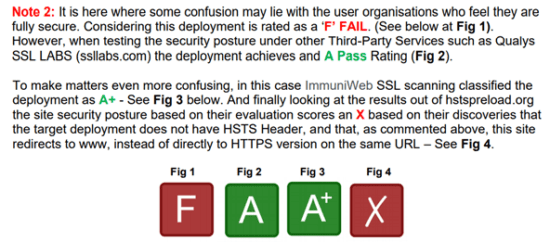
Take the confusing issue related to how Lloyds of London see their own security posture of a very bright Green Tick in the box, when in fact a Red Cross is more appropriate – possibly a case of don’t tell me bad news, when I can look to the corner of the much more convenient, and less troublesome  green light – see below as to one other example extract taken from the CIP ITR published in June 2021 at Fig 2.

Fig 2 – Extract from CIP ITR
The Generic World

To return to the question as to if CWE  know their onions, when if come to Cyber Security, the conclusion must be yes, they most certainly do! The real problematic root cause here is born out of the word Cyber. Going back pre this term entering the contextual language of the Cyber Expert, we had acknowledged Network Specialist, Firewall Administrators, Web Developers and so on, all highly focused and skilled in their own areas of wide and deep subject matter expertise. However, when the words ‘Cyber’ ‘Security’ ‘Expert’ (Cyber Security Expert) is linked in association – here the problem starts, out of what is being suggested an expert who knowns everything about everything! – and this imposition bleeds over into the operational world of truly understanding the contextual surfaces of weaknesses of the multi-disciplined world of technological complexity.  For example, the CWE Team do understand their own software onions when it comes to their disciplined cyber focus – as do others who provide an in-depth assessment as to the level of security associated with say a Certificate (X509), as opposed to a lite touch. Thus, the security hole open’s up by the very generic nature of the all-in-one, all-encompassing approach to understanding the real nature of security exposures and vulnerabilities in a focused, robust and specialised way.

Thus, CWE are reputable, and they most certainly do know their own security software onions – but as can be seen in the article Andy wrote, they do not, in this case recognise everything about everything in the basket filled full of complex Cyber Onion Challenges. It is thus in these instances where, for example, CIP listen to what CWE have to tell them when it comes to Applications and Software security– and in that same conversation, CWE and others should listen to the likes of CIP (and other such areas of security disciplined experts) to provide services which go well beyond the generic lite touch, and dig deeper to underpin very real opportunities to deliver informed security in a very dangerous world of recognised cyber exposures. In this case, CIP boast a specialisation in the arena of PKI and Encryption, and they most certainly do not claim to know everything about everything about every onion on the string – you may say, here we have a case of Horses for Courses.

Professor John Walker

John is the Principle at Shadow-Intelligence (Si), partnering with PALISCOPE, BreachAware and iStorage. He is a Visiting Professor at the School of Science and Technology, Nottingham, Trent University (NTU) and holds the appointment of Editor in Chief for the International Journal of Cyber Forensics and Advanced Threat Investigations (CFATI). For the last decade he has delivered training courses in the Middle, and Far East to Commercial, Industrial, the Financial Services Sector, and Military Agencies, including the UAE, US, Pakistan, Saudi Arabia, Malaysia (KL), Singapore, Argentina, and Sao Paulo

He served in the Royal Air Force 22 years’, specialising in Counterintelligence, working with UK Agencies such as GCHQ/CESG, and others in the fields of SIGINT, COMINT and Satellite Communications, holding appointments such as System ITSO for a CIA SCIF.

In the commercials sectors of IT/Cyber he has worked for/with Logica, Bae, T5, GM, Experian, Betfair, Palace of Westminster, House of Lords/Commons, TSol (Treasury Solicitors) and provided Consultancy to the Saudi Arabian MOD, TRA (Telecommunications Authority (Dubai) and the Military Academy of Malaysia (KL) on SOC, CSIRT, Digital Forensics and OSINT. Within the last 5 years he has focused on Geopolitics, with global expertise around the UAE and Russia, Anti-Terrorist Operations (ATO), Cyber-Warfare, Dezinformatsiya (Disinformation) and Maskirovka (Military Deception).

  • Professor John Walker
    China Threat Recap: A Deeper Insight
  • Professor John Walker
    Missing The Point In The Current Age Of Cyber
  • Professor John Walker
    Part 1: Historic To 2022 – The APT And Logical Threats
  • Professor John Walker
    A Hairs Breadth

The opinions expressed in this post belong to the individual contributors and do not necessarily reflect the views of Information Security Buzz.

Share. Facebook Twitter LinkedIn Email Copy Link

Related Posts

Visual data is the blind spot in enterprise security: that’s about to change

May 4, 20267 Mins Read

Making stolen data worthless: why security must start with the data

March 30, 20265 Mins Read

Meta’s Smart Glasses Privacy Scandal Expands After Sama Credentials Found on the Dark Web

March 10, 20264 Mins Read
ISB-Bora-Side-Bar

No se ha podido establecer conexión. Error 429

 
ISB-Bora-Side-Bar
Black ISB Logo

Information Security Buzz is an independent resource that provides the experts’ comments, analysis, and opinion on the latest Cybersecurity news and topics

X (Twitter) LinkedIn Facebook RSS

Working With Us

  • About Us
  • Advertise With Us
  • Contact Us

Write For Us

  • How To Contribute

The Pages

  • Privacy Policy
  • Cookie Policy
  • AI Policy
  • Terms & Conditions
  • Copyright Notice

Information Security Buzz and all its contents are copyright © 2014-2025. All rights reserved. All third-party trademarks are recognized.

Type above and press Enter to search. Press Esc to cancel.

Manage Consent
To provide the best experiences, we use technologies like cookies to store and/or access device information. Consenting to these technologies will allow us to process data such as browsing behavior or unique IDs on this site. Not consenting or withdrawing consent, may adversely affect certain features and functions.
Functional Always active
The technical storage or access is strictly necessary for the legitimate purpose of enabling the use of a specific service explicitly requested by the subscriber or user, or for the sole purpose of carrying out the transmission of a communication over an electronic communications network.
Preferences
The technical storage or access is necessary for the legitimate purpose of storing preferences that are not requested by the subscriber or user.
Statistics
The technical storage or access that is used exclusively for statistical purposes. The technical storage or access that is used exclusively for anonymous statistical purposes. Without a subpoena, voluntary compliance on the part of your Internet Service Provider, or additional records from a third party, information stored or retrieved for this purpose alone cannot usually be used to identify you.
Marketing
The technical storage or access is required to create user profiles to send advertising, or to track the user on a website or across several websites for similar marketing purposes.
  • Manage options
  • Manage services
  • Manage {vendor_count} vendors
  • Read more about these purposes
View preferences
  • {title}
  • {title}
  • {title}