


Close Menu
  • Home
  • Articles
    • Attacks
      • BEC
      • Data Breach
      • DDoS
      • Evasion Attacks
      • Injection
      • Malware
      • MITM
      • Phishing
      • Ransomware
      • RCE
      • Social Engineering
      • Spoofing
      • Spyware
    • Business and Policy
      • BCP and DRP
      • GRC
      • Regulations
    • Data Protection
      • DLP
      • DRM
      • Encryption
      • IAM
    • Future, Trends and Insight
      • AI
      • Events & Community
      • Emerging Tech
      • Expert Panel
      • Interviews With Experts
      • Insights
      • Study & Research
    • Resources
      • Guides
      • Tools
      • Training & Education
    • Security
      • API
      • Apps
      • Cloud
      • Critical Infrastructure
      • Endpoint
      • Hardware
      • IoT
      • Mobile
      • Network
      • OT
      • Port Security
      • Security Architecture
      • Software Development
      • Supply Chain
      • Zero Trust
    • Threats and Vulnerabilities
      • Emerging Threats
      • Insider Threats
      • Risk Management
      • Threat Intelligence
      • Zero Day
  • News and Exclusives
    • Latest News
    • ISB Exclusive
    • Positive News
  • Who We Are
    • About Us
    • Information Security Buzz Expert Panel​
    • Write for Us
    • Media Pack
  • Contact Us
  • Newsletter
Facebook X (Twitter) LinkedIn
Information Security BuzzInformation Security Buzz
  • Home
  • Articles
    • Attacks
      • BEC
      • Data Breach
      • DDoS
      • Evasion Attacks
      • Injection
      • Malware
      • MITM
      • Phishing
      • Ransomware
      • RCE
      • Social Engineering
      • Spoofing
      • Spyware
    • Business and Policy
      • BCP and DRP
      • GRC
      • Regulations
    • Data Protection
      • DLP
      • DRM
      • Encryption
      • IAM
    • Future, Trends and Insight
      • AI
      • Events & Community
      • Emerging Tech
      • Expert Panel
      • Interviews With Experts
      • Insights
      • Study & Research
    • Resources
      • Guides
      • Tools
      • Training & Education
    • Security
      • API
      • Apps
      • Cloud
      • Critical Infrastructure
      • Endpoint
      • Hardware
      • IoT
      • Mobile
      • Network
      • OT
      • Port Security
      • Security Architecture
      • Software Development
      • Supply Chain
      • Zero Trust
    • Threats and Vulnerabilities
      • Emerging Threats
      • Insider Threats
      • Risk Management
      • Threat Intelligence
      • Zero Day
  • News and Exclusives
    • Latest News
    • ISB Exclusive
    • Positive News
  • Who We Are
    • About Us
    • Information Security Buzz Expert Panel​
    • Write for Us
    • Media Pack
  • Contact Us
  • Newsletter
Subscribe
Information Security BuzzInformation Security Buzz
Home - Articles - No Ransom: The National High Tech Crime Unit of the Netherlands’ Police help Victims to Escape from CoinVault Ransomware
Articles

No Ransom: The National High Tech Crime Unit of the Netherlands’ Police help Victims to Escape from CoinVault Ransomware

ISBuzz TeamBy ISBuzz TeamApril 20, 2015Updated:July 4, 20243 Mins Read
Share LinkedIn Twitter Facebook Copy Link Email
Trojan-Ransom.Win32.Crypmodadv.cj
Share
Facebook Twitter LinkedIn Email Copy Link
Quick AI Summary
ChatGPTClaudeGeminiGrokPerplexityDeepSeekCopilot

Victims of CoinVault ransomware will be able to retrieve their data without paying the criminals, thanks to a repository of decryption keys and a decryption application made available online by Kaspersky Lab and the National High Tech Crime Unit (NHTCU) of the Netherlands’ police.The keys and the tool can be found on noransom.kaspersky.com, together with clear instructions on how to implement them.

CoinVault ransomware has been around for a while, encrypting victims’ files and demanding Bitcoins to unlock them.  In order to help victims recover from an attack, the NHTCU and the Netherlands’ National Prosecutors Office obtained a database from a CoinVault command & control sever.  This server contained Initialisation Vectors (IVs), Keys and private Bitcoin wallets and helped Kaspersky Lab and the NHTCU to create the special repository of decryption keys. As the investigation is ongoing, new keys will be added when available.

“If you get infected with the CoinVault ransomware, please check noransom.kaspersky.com. We have uploaded a huge number of keysonto the site. If we do not currently have records for a particular Bitcoin wallet, you can check again in the near future, because together with the National High Tech Crime Unit of the Netherlands’ police we are continuously updating the information,” – says Jornt van der Wiel, Security Researcher at Global Research and Analysis Team, Kaspersky Lab.

CoinVault has infected more than 1,000 Windows-based machines in over 20 countries, with the majority of victims in the Netherlands, Germany, the USA, France and the UK. Victims have also been registered in Belgium, Austria, Switzerland, Norway, Sweden, Luxemburg, Denmark, Slovakia, Slovenia, Spain, Italy, Hungary, Ireland, Croatia, Russia, Canada, Israel, the United Arab Emirates, China, Indonesia, Thailand, South Africa, Australia, New Zealand, Panama, the Dominican Republic, and Mexico.

“Nowadays, many believe that combatting cybercrime requires public-private partnerships. We do it. Just talk to your partners, identify how you can help each other achieve a mutual aim: helping cybersecurity.” explains Marijn Schuurbiers from the High Tech Crime Team of the Dutch Police.

Kaspersky Lab’s security experts also analysed the malware samples and designed and built a decryption tool that can unlock files and delete the CoinVault malicious program from infected computers.

If a PC has been infected with CoinVault, an image such as the following will appear on the screen:
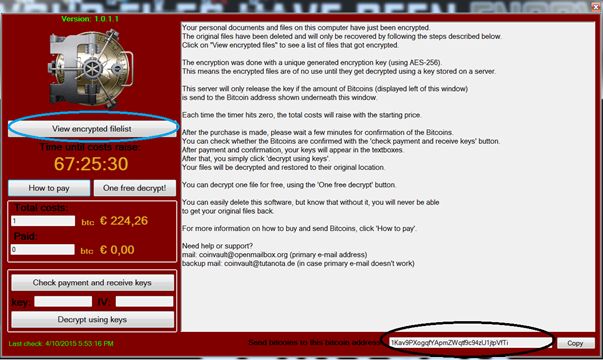
infected with CoinVault


To discover how to remove the CoinVault ransomware from your computer and restore your files, please visit HERE

How to avoid being infected? Keep your anti-malware suite updated and make a habit of backing up your most important files.

Duo Security RSAC 2015 – Register to win a free Quadcopter

Kaspersky detects this family as ‘Trojan-Ransom.Win32.Crypmodadv.cj’.

About Kaspersky Lab

Kaspersky Lab is the world’s largest privately held vendor of endpoint protection solutions. The company is ranked among the world’s top four vendors of security solutions for endpoint users*. Throughout its more than 17-year history Kaspersky Lab has remained an innovator in IT security and provides effective digital security solutions for large enterprises, SMBs and consumers. Kaspersky Lab, with its holding company registered in the United Kingdom, currently operates in almost 200 countries and territories across the globe, providing protection for over 300 million users worldwide. Learn more at www.kaspersky.com.

ISBuzz Team
  • ISBuzz Team
    Air Canada Data Breach: BianLian Extortion Group Claims A Massive Heist Contrary To Airline’s Earlier Statement
  • ISBuzz Team
    Unprecedented DDoS Attack Rocks The Web: Tech Giants Reveal A Digital Tsunami
  • ISBuzz Team
    CISA Flags High-Severity Adobe Acrobat Reader Flaw Amid Active Exploits
  • ISBuzz Team
    Curl Security Alert: Patching A Critical Bug Averting Potential Cyber Catastrophe

The opinions expressed in this post belong to the individual contributors and do not necessarily reflect the views of Information Security Buzz.

Share. Facebook Twitter LinkedIn Email Copy Link

Related Posts

Foxconn confirms cyberattack following Nitrogen ransomware claims

May 14, 20263 Mins Read

Lazarus Group Turns to Medusa Ransomware in Escalating Global Extortion Campaign

February 26, 20263 Mins Read

The Cyberattack That Exposed the Fragility of Digital Heritage

February 11, 20268 Mins Read
ISB-Bora-Side-Bar

No se ha podido establecer conexión. Error 429

 
ISB-Bora-Side-Bar
Black ISB Logo

Information Security Buzz is an independent resource that provides the experts’ comments, analysis, and opinion on the latest Cybersecurity news and topics

X (Twitter) LinkedIn Facebook RSS

Working With Us

  • About Us
  • Advertise With Us
  • Contact Us

Write For Us

  • How To Contribute

The Pages

  • Privacy Policy
  • Cookie Policy
  • AI Policy
  • Terms & Conditions
  • Copyright Notice

Information Security Buzz and all its contents are copyright © 2014-2025. All rights reserved. All third-party trademarks are recognized.

Type above and press Enter to search. Press Esc to cancel.

Manage Consent
To provide the best experiences, we use technologies like cookies to store and/or access device information. Consenting to these technologies will allow us to process data such as browsing behavior or unique IDs on this site. Not consenting or withdrawing consent, may adversely affect certain features and functions.
Functional Always active
The technical storage or access is strictly necessary for the legitimate purpose of enabling the use of a specific service explicitly requested by the subscriber or user, or for the sole purpose of carrying out the transmission of a communication over an electronic communications network.
Preferences
The technical storage or access is necessary for the legitimate purpose of storing preferences that are not requested by the subscriber or user.
Statistics
The technical storage or access that is used exclusively for statistical purposes. The technical storage or access that is used exclusively for anonymous statistical purposes. Without a subpoena, voluntary compliance on the part of your Internet Service Provider, or additional records from a third party, information stored or retrieved for this purpose alone cannot usually be used to identify you.
Marketing
The technical storage or access is required to create user profiles to send advertising, or to track the user on a website or across several websites for similar marketing purposes.
  • Manage options
  • Manage services
  • Manage {vendor_count} vendors
  • Read more about these purposes
View preferences
  • {title}
  • {title}
  • {title}