


Close Menu
  • Home
  • Articles
    • Attacks
      • BEC
      • Data Breach
      • DDoS
      • Evasion Attacks
      • Injection
      • Malware
      • MITM
      • Phishing
      • Ransomware
      • RCE
      • Social Engineering
      • Spoofing
      • Spyware
    • Business and Policy
      • BCP and DRP
      • GRC
      • Regulations
    • Data Protection
      • DLP
      • DRM
      • Encryption
      • IAM
    • Future, Trends and Insight
      • AI
      • Events & Community
      • Emerging Tech
      • Expert Panel
      • Interviews With Experts
      • Insights
      • Study & Research
    • Resources
      • Guides
      • Tools
      • Training & Education
    • Security
      • API
      • Apps
      • Cloud
      • Critical Infrastructure
      • Endpoint
      • Hardware
      • IoT
      • Mobile
      • Network
      • OT
      • Port Security
      • Security Architecture
      • Software Development
      • Supply Chain
      • Zero Trust
    • Threats and Vulnerabilities
      • Emerging Threats
      • Insider Threats
      • Risk Management
      • Threat Intelligence
      • Zero Day
  • News and Exclusives
    • Latest News
    • ISB Exclusive
    • Positive News
  • Who We Are
    • About Us
    • Information Security Buzz Expert Panel​
    • Write for Us
    • Media Pack
  • Contact Us
  • Newsletter
Facebook X (Twitter) LinkedIn
Information Security BuzzInformation Security Buzz
  • Home
  • Articles
    • Attacks
      • BEC
      • Data Breach
      • DDoS
      • Evasion Attacks
      • Injection
      • Malware
      • MITM
      • Phishing
      • Ransomware
      • RCE
      • Social Engineering
      • Spoofing
      • Spyware
    • Business and Policy
      • BCP and DRP
      • GRC
      • Regulations
    • Data Protection
      • DLP
      • DRM
      • Encryption
      • IAM
    • Future, Trends and Insight
      • AI
      • Events & Community
      • Emerging Tech
      • Expert Panel
      • Interviews With Experts
      • Insights
      • Study & Research
    • Resources
      • Guides
      • Tools
      • Training & Education
    • Security
      • API
      • Apps
      • Cloud
      • Critical Infrastructure
      • Endpoint
      • Hardware
      • IoT
      • Mobile
      • Network
      • OT
      • Port Security
      • Security Architecture
      • Software Development
      • Supply Chain
      • Zero Trust
    • Threats and Vulnerabilities
      • Emerging Threats
      • Insider Threats
      • Risk Management
      • Threat Intelligence
      • Zero Day
  • News and Exclusives
    • Latest News
    • ISB Exclusive
    • Positive News
  • Who We Are
    • About Us
    • Information Security Buzz Expert Panel​
    • Write for Us
    • Media Pack
  • Contact Us
  • Newsletter
Subscribe
Information Security BuzzInformation Security Buzz
Home - Articles - Two-thirds of Users Encountered Content Dangerous to Children on the Internet in 2014
Articles

Two-thirds of Users Encountered Content Dangerous to Children on the Internet in 2014

ISBuzz TeamBy ISBuzz TeamMarch 13, 2015Updated:January 5, 20264 Mins Read
Share LinkedIn Twitter Facebook Copy Link Email
Children and internet
Share
Facebook Twitter LinkedIn Email Copy Link
Quick AI Summary
ChatGPTClaudeGeminiGrokPerplexityDeepSeekCopilot

The Kaspersky Lab study ‘Children Online’ reveals that in 2014 more than two-thirds (68%) of users of Kaspersky Lab’s Parental Control technologies encountered inappropriate or dangerous content online. Adult content, gambling and sites carrying information about weapons were among the most prevalent threats detected by Kaspersky Lab’s protection technologies.

The main findings of the report are:

•        More than half (59.5%) of users encountered pornography; over a quarter (26.6%) landed on websites dedicated to gambling; every fifth user stumbled across sites featuring weapons; and almost the same number were confronted by strong language.

•        Websites carrying this kind of inappropriate content (pornography, gambling, weapons, strong language), along with others featuring drugs, tobacco and alcohol, were the ones blocked most often by Kaspersky Lab protection solutions.

•        China, the USA, Germany, the UK and Russia were the countries with the greatest frequency of detections registered by the Parental Control module of Kaspersky Lab’s protection solutions.

The Internet has long ceased to be a resource just for grown-ups. Children today are often far more active Internet users than their parents. But is it safe enough for children to use without fear of facing inappropriate content? Previous research carried out by Kaspersky Lab shows that  YouTube’s ‘suggested’ videos which sit visibly alongside clips or episodes of popular children’s television programmes such as Peppa Pig, Rastamouse and Dora the Explorer, actually mean that on average, children are just three clicks away from content better suited to a more mature audience. This may include music videos featuring violence, nudity or even car crash compilations, highlighting the importance of monitoring children whilst they are online. To delve deeper into this issue, Kaspersky Lab decided to investigate potential online threats to children, by analysing data from users of Kaspersky Lab products equipped with a Parental Control module.
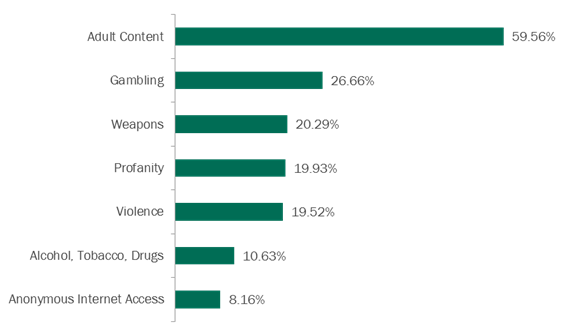
Dangerous contents and children

Following China, USA, Germany and Russia, France, Vietnam, Brazil and Algeria also ranked in the top ten in terms of inappropriate content detection – but were relatively safer due to a lower frequency of detection. Each of the top ten most affected countries has distinct characteristics when it comes to the prevailing online threats for children. For instance, adult content was the biggest threat to users in Germany (with 172 detections per user), China (144.18 detections per user), and the US (126.16 detections). Content about alcohol, tobacco and drugs was a major threat to users from Russia, Germany, the USA and France. The frequency of detection was especially high in these countries. This kind of content also proved popular in Brazil and the UK.

“To protect young people, we recommend that adults choose protection solutions with Parental Control technologies and make full use of safe “children” modes in search engines and applications that allow access to multimedia content and which are used by children. Although Parental Control technologies can block access to websites with content that is dangerous or distressing for children, they cannot offer reliable protection in situations where safe-by-default web services like social networks or chats are misused by predators or users conducting cyberbullying campaigns,” said Konstantin Ignatev, Web Content Analysts Group manager at Kaspersky Lab.

“Internet security deserves to be taken as seriously as real-life physical security. That’s why we urge parents to take an active part in their children’s real and digital lives.  Only then can they be sure that they won’t miss the moment when their child might need their support,” said Konstantin Ignatev.

Read more about online threats to children in full text of the research on Securelist.com.

The Parental Control module for Mac OS X and Windows is included in Kaspersky Lab’s consumer security products Kaspersky Internet Security – Multi-Device and Kaspersky Total Security – Multi-Device. The company also recently introduced a new standalone solution: Kaspersky Safe Kids Beta, which protects kids from inappropriate web content, potentially dangerous apps and other threats on Mac OS X, Windows, Android and iOS devices.

Free eBook: Two-Factor Authentication Evaluation Guide – Get your copy now.

About Kaspersky Lab

Kaspersky LabKaspersky Lab is the world’s largest privately held vendor of endpoint protection solutions. The company is ranked among the world’s top four vendors of security solutions for endpoint users*. Throughout its more than 17-year history Kaspersky Lab has remained an innovator in IT security and provides effective digital security solutions for large enterprises, SMBs and consumers. Kaspersky Lab, with its holding company registered in the United Kingdom, currently operates in almost 200 countries and territories across the globe, providing protection for over 300 million users worldwide. Learn more at www.kaspersky.com.

ISBuzz Team
  • ISBuzz Team
    Air Canada Data Breach: BianLian Extortion Group Claims A Massive Heist Contrary To Airline’s Earlier Statement
  • ISBuzz Team
    Unprecedented DDoS Attack Rocks The Web: Tech Giants Reveal A Digital Tsunami
  • ISBuzz Team
    CISA Flags High-Severity Adobe Acrobat Reader Flaw Amid Active Exploits
  • ISBuzz Team
    Curl Security Alert: Patching A Critical Bug Averting Potential Cyber Catastrophe

The opinions expressed in this post belong to the individual contributors and do not necessarily reflect the views of Information Security Buzz.

Share. Facebook Twitter LinkedIn Email Copy Link

Related Posts

The Real Cost of Inconsistent Third-Party Access

December 18, 20255 Mins Read

What Happens When Devices Cross Borders? The Role of Geofencing in Global IT

August 7, 20256 Mins Read

The Evolving Importance of Identity Governance in FinTech

July 10, 20258 Mins Read
ISB-Bora-Side-Bar

No se ha podido establecer conexión. Error 429

 
ISB-Bora-Side-Bar
Black ISB Logo

Information Security Buzz is an independent resource that provides the experts’ comments, analysis, and opinion on the latest Cybersecurity news and topics

X (Twitter) LinkedIn Facebook RSS

Working With Us

  • About Us
  • Advertise With Us
  • Contact Us

Write For Us

  • How To Contribute

The Pages

  • Privacy Policy
  • Cookie Policy
  • AI Policy
  • Terms & Conditions
  • Copyright Notice

Information Security Buzz and all its contents are copyright © 2014-2025. All rights reserved. All third-party trademarks are recognized.

Type above and press Enter to search. Press Esc to cancel.

Manage Consent
To provide the best experiences, we use technologies like cookies to store and/or access device information. Consenting to these technologies will allow us to process data such as browsing behavior or unique IDs on this site. Not consenting or withdrawing consent, may adversely affect certain features and functions.
Functional Always active
The technical storage or access is strictly necessary for the legitimate purpose of enabling the use of a specific service explicitly requested by the subscriber or user, or for the sole purpose of carrying out the transmission of a communication over an electronic communications network.
Preferences
The technical storage or access is necessary for the legitimate purpose of storing preferences that are not requested by the subscriber or user.
Statistics
The technical storage or access that is used exclusively for statistical purposes. The technical storage or access that is used exclusively for anonymous statistical purposes. Without a subpoena, voluntary compliance on the part of your Internet Service Provider, or additional records from a third party, information stored or retrieved for this purpose alone cannot usually be used to identify you.
Marketing
The technical storage or access is required to create user profiles to send advertising, or to track the user on a website or across several websites for similar marketing purposes.
  • Manage options
  • Manage services
  • Manage {vendor_count} vendors
  • Read more about these purposes
View preferences
  • {title}
  • {title}
  • {title}