

Close Menu
  • Home
  • Articles
    • Attacks
      • BEC
      • Data Breach
      • DDoS
      • Evasion Attacks
      • Injection
      • Malware
      • MITM
      • Phishing
      • Ransomware
      • RCE
      • Social Engineering
      • Spoofing
      • Spyware
    • Business and Policy
      • BCP and DRP
      • GRC
      • Regulations
    • Data Protection
      • DLP
      • DRM
      • Encryption
      • IAM
    • Future, Trends and Insight
      • AI
      • Events & Community
      • Emerging Tech
      • Expert Panel
      • Interviews With Experts
      • Insights
      • Study & Research
    • Resources
      • Guides
      • Tools
      • Training & Education
    • Security
      • API
      • Apps
      • Cloud
      • Critical Infrastructure
      • Endpoint
      • Hardware
      • IoT
      • Mobile
      • Network
      • OT
      • Port Security
      • Security Architecture
      • Software Development
      • Supply Chain
      • Zero Trust
    • Threats and Vulnerabilities
      • Emerging Threats
      • Insider Threats
      • Risk Management
      • Threat Intelligence
      • Zero Day
  • News and Exclusives
    • Latest News
    • ISB Exclusive
    • Positive News
  • Who We Are
    • About Us
    • Information Security Buzz Expert Panel​
    • Write for Us
    • Media Pack
  • Contact Us
  • Newsletter
Facebook X (Twitter) LinkedIn
Information Security BuzzInformation Security Buzz
  • Home
  • Articles
    • Attacks
      • BEC
      • Data Breach
      • DDoS
      • Evasion Attacks
      • Injection
      • Malware
      • MITM
      • Phishing
      • Ransomware
      • RCE
      • Social Engineering
      • Spoofing
      • Spyware
    • Business and Policy
      • BCP and DRP
      • GRC
      • Regulations
    • Data Protection
      • DLP
      • DRM
      • Encryption
      • IAM
    • Future, Trends and Insight
      • AI
      • Events & Community
      • Emerging Tech
      • Expert Panel
      • Interviews With Experts
      • Insights
      • Study & Research
    • Resources
      • Guides
      • Tools
      • Training & Education
    • Security
      • API
      • Apps
      • Cloud
      • Critical Infrastructure
      • Endpoint
      • Hardware
      • IoT
      • Mobile
      • Network
      • OT
      • Port Security
      • Security Architecture
      • Software Development
      • Supply Chain
      • Zero Trust
    • Threats and Vulnerabilities
      • Emerging Threats
      • Insider Threats
      • Risk Management
      • Threat Intelligence
      • Zero Day
  • News and Exclusives
    • Latest News
    • ISB Exclusive
    • Positive News
  • Who We Are
    • About Us
    • Information Security Buzz Expert Panel​
    • Write for Us
    • Media Pack
  • Contact Us
  • Newsletter
Subscribe
Information Security BuzzInformation Security Buzz
Home - Articles - Wireless Networks are the Weak Link In Security Chain
Articles

Wireless Networks are the Weak Link In Security Chain

John MaddisonBy John MaddisonJune 30, 2015Updated:January 7, 20223 Mins Read
Share LinkedIn Twitter Facebook Copy Link Email
Share
Facebook Twitter LinkedIn Email Copy Link
Quick AI Summary
ChatGPTClaudeGeminiGrokPerplexityDeepSeekCopilot

According to a May 2015 global survey of IT decision makers (ITDMs), wireless networks are a significant source of risk and vulnerability for their organizations. Among US respondents, in fact (as with their global counterparts), more ITDMs identified wireless networks as the most vulnerable part of the enterprise than any other component.

Wireless networks have traditionally been easy targets – easy targets for hackers and sketchy places for guests to conduct business. Yet they’re not only ubiquitous, but expected features on networks of all sizes. Reconciling security with ready access both for internal and external users is no easy task.

Take for example the current keyboard hack issue affecting the Samsung Galaxy line and nearly 600 million Samsung customers.  When a user is connected to a compromised wireless network, hackers (with the right tools) can gain access to their Galaxy device and all of the data – corporate or personal – connected to it.

To that end, LightSpeed GMI recently conducted a survey of almost 1500 IT decision makers (ITDMs) from mid-size and large organizations around the globe about their security concerns. The 375 U.S. respondents, like their global counterparts, identified one area above all others as the “most vulnerable” from a security standpoint: their wireless networks.

A closer look at the U.S. data, in particular, reveals that most ITDMs consider their wireless networks to be a weak link in their security, whether wireless was used exclusively for internal purposes or opened up for guest access. On a scale of 1-7, where 1 was “most vulnerable” and 7 was “least vulnerable,” more than half rated their wireless networks a 1 or 2. Almost 70% rated them 1, 2, or 3.

Compare those numbers to databases and applications, for example, and the picture becomes even clearer:
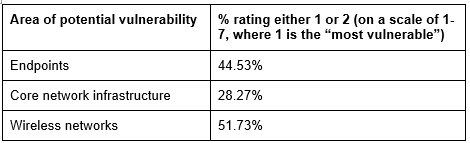
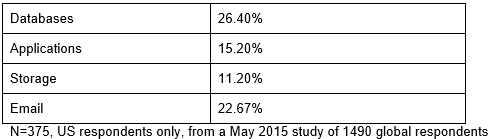
Image 1

Image 2

Only endpoints even come close in terms of concern for ITDMs.

Not surprisingly, organizations are taking steps to address these concerns, especially for wireless networks used for internal access. The majority of respondents had implemented firewalls, authentication measures, and anti-virus to secure their internal wireless networks. However, almost half of the U.S. respondents allow guest access to their wireless networks. Of these respondents, more than 16% use no authentication whatsoever. Another 16% use a captive portal with no registration, while another 22% use a shared username and password (the sort that gets posted on a conference room wall).

In this context, it’s no wonder that wireless networks have IT decision makers worried. Again, it’s no surprise that BYOD implementations further complicate matters. Over half of the respondents who reported allowing BYOD also allow personal devices to access sensitive corporate resources. This isn’t a problem in and of itself – BYOD programs are often hobbled by restrictions on the use of personal devices. However, without adequate security measures in place, the risk of malicious apps or careless employees exposing sensitive data remains high.

In fact, the loss of sensitive corporate and/or customer data was the top concern related to wireless security among both U.S. and international respondents. Industrial espionage was second, with regulatory compliance, reputation damage, and service disruption rounding out the major areas of concern.

So what can organizations do? Layered approaches to security, meant to protect the network from malicious attempts at every entry point, are an essential component of any security strategy, including those related to wireless networks. New advances in wireless controller and monitoring technologies can also bring robust security directly to the wireless networks themselves, improving both security and access for employees and guests alike.

John Maddison

John Maddison has more than 20 years experience in the telecommunication, IT Infrastructure and security industries. Previously he held positions as General Manager Data Center division and Senior Vice President Core Technology at Trend Micro. Before that John was Senior Director of Product Management at Lucent Technologies. He has lived and worked in Europe, Asia and the United States. John graduated with a Bachelor of Telecommunications Engineering degree from Plymouth University, United Kingdom.

  • John Maddison
    What Organizations Should Know About Advanced Persistent Threats

The opinions expressed in this post belong to the individual contributors and do not necessarily reflect the views of Information Security Buzz.

Share. Facebook Twitter LinkedIn Email Copy Link

Related Posts

The Real Cost of Inconsistent Third-Party Access

December 18, 20255 Mins Read

What Happens When Devices Cross Borders? The Role of Geofencing in Global IT

August 7, 20256 Mins Read

The Evolving Importance of Identity Governance in FinTech

July 10, 20258 Mins Read
ISB-Bora-Side-Bar

 
ISB-Bora-Side-Bar
Black ISB Logo

Information Security Buzz is an independent resource that provides the experts’ comments, analysis, and opinion on the latest Cybersecurity news and topics

X (Twitter) LinkedIn Facebook RSS

Working With Us

  • About Us
  • Advertise With Us
  • Contact Us

Write For Us

  • How To Contribute

The Pages

  • Privacy Policy
  • Cookie Policy
  • AI Policy
  • Terms & Conditions
  • Copyright Notice

Information Security Buzz and all its contents are copyright © 2014-2025. All rights reserved. All third-party trademarks are recognized.

Type above and press Enter to search. Press Esc to cancel.

Manage Consent
To provide the best experiences, we use technologies like cookies to store and/or access device information. Consenting to these technologies will allow us to process data such as browsing behavior or unique IDs on this site. Not consenting or withdrawing consent, may adversely affect certain features and functions.
Functional Always active
The technical storage or access is strictly necessary for the legitimate purpose of enabling the use of a specific service explicitly requested by the subscriber or user, or for the sole purpose of carrying out the transmission of a communication over an electronic communications network.
Preferences
The technical storage or access is necessary for the legitimate purpose of storing preferences that are not requested by the subscriber or user.
Statistics
The technical storage or access that is used exclusively for statistical purposes. The technical storage or access that is used exclusively for anonymous statistical purposes. Without a subpoena, voluntary compliance on the part of your Internet Service Provider, or additional records from a third party, information stored or retrieved for this purpose alone cannot usually be used to identify you.
Marketing
The technical storage or access is required to create user profiles to send advertising, or to track the user on a website or across several websites for similar marketing purposes.
  • Manage options
  • Manage services
  • Manage {vendor_count} vendors
  • Read more about these purposes
View preferences
  • {title}
  • {title}
  • {title}