


Close Menu
  • Home
  • Articles
    • Attacks
      • BEC
      • Data Breach
      • DDoS
      • Evasion Attacks
      • Injection
      • Malware
      • MITM
      • Phishing
      • Ransomware
      • RCE
      • Social Engineering
      • Spoofing
      • Spyware
    • Business and Policy
      • BCP and DRP
      • GRC
      • Regulations
    • Data Protection
      • DLP
      • DRM
      • Encryption
      • IAM
    • Future, Trends and Insight
      • AI
      • Events & Community
      • Emerging Tech
      • Expert Panel
      • Interviews With Experts
      • Insights
      • Study & Research
    • Resources
      • Guides
      • Tools
      • Training & Education
    • Security
      • API
      • Apps
      • Cloud
      • Critical Infrastructure
      • Endpoint
      • Hardware
      • IoT
      • Mobile
      • Network
      • OT
      • Port Security
      • Security Architecture
      • Software Development
      • Supply Chain
      • Zero Trust
    • Threats and Vulnerabilities
      • Emerging Threats
      • Insider Threats
      • Risk Management
      • Threat Intelligence
      • Zero Day
  • News and Exclusives
    • Latest News
    • ISB Exclusive
    • Positive News
  • Who We Are
    • About Us
    • Information Security Buzz Expert Panel​
    • Write for Us
    • Media Pack
  • Contact Us
  • Newsletter
Facebook X (Twitter) LinkedIn
Information Security BuzzInformation Security Buzz
  • Home
  • Articles
    • Attacks
      • BEC
      • Data Breach
      • DDoS
      • Evasion Attacks
      • Injection
      • Malware
      • MITM
      • Phishing
      • Ransomware
      • RCE
      • Social Engineering
      • Spoofing
      • Spyware
    • Business and Policy
      • BCP and DRP
      • GRC
      • Regulations
    • Data Protection
      • DLP
      • DRM
      • Encryption
      • IAM
    • Future, Trends and Insight
      • AI
      • Events & Community
      • Emerging Tech
      • Expert Panel
      • Interviews With Experts
      • Insights
      • Study & Research
    • Resources
      • Guides
      • Tools
      • Training & Education
    • Security
      • API
      • Apps
      • Cloud
      • Critical Infrastructure
      • Endpoint
      • Hardware
      • IoT
      • Mobile
      • Network
      • OT
      • Port Security
      • Security Architecture
      • Software Development
      • Supply Chain
      • Zero Trust
    • Threats and Vulnerabilities
      • Emerging Threats
      • Insider Threats
      • Risk Management
      • Threat Intelligence
      • Zero Day
  • News and Exclusives
    • Latest News
    • ISB Exclusive
    • Positive News
  • Who We Are
    • About Us
    • Information Security Buzz Expert Panel​
    • Write for Us
    • Media Pack
  • Contact Us
  • Newsletter
Subscribe
Information Security BuzzInformation Security Buzz
Home - Articles - Workflows, People and Processes
Articles

Workflows, People and Processes

ISBuzz TeamBy ISBuzz TeamMay 5, 2014Updated:December 4, 20245 Mins Read
Share LinkedIn Twitter Facebook Copy Link Email
Workflows, People & Processes
Share
Facebook Twitter LinkedIn Email Copy Link
Quick AI Summary
ChatGPTClaudeGeminiGrokPerplexityDeepSeekCopilot

In the world of business there seems to constantly be a battle for supremacy between People and Process. Both ideological camps put forth their ideas and justifications, much of which is based on research and founded through their own internal point of view.

Workflows

For me, both of these are important and for integral, yet separate parts of the overall success of a given system. Here’s a general overview of the interaction:

1) People discover a problem that needs to be solved.

2) They attempt to solve it using known methods.

3) As the problem becomes better understood, the people learn better how to solve it.

It is not uncommon for things to stop here. However, if the same or a similar problem is encountered in the future, this process can proceed into the following steps:

4) As the problem occurs multiple times, with luck a pattern begins to emerge.

5) Capitalizing on the pattern, a process is put in place to help streamline the solution finding.

6) The process is refined over time to become more efficient.

Now, at this point, a discussion often occurs along the lines of “Can we automate the process?”

The first rule of any technology used in a business is that automation applied to an efficient operation will magnify the efficiency. The second is that automation applied to an inefficient operation will magnify the inefficiency.
~ Bill Gates

If we are behaving rationally, we will at this point do an analysis to determine whether or not the time required to do the automation will result in an overall time savings—though I do know some who love to automate things just for the fact that they’re now automated.

7) The process is automated.

We’ve reached nirvana, right?

Understanding People in Process
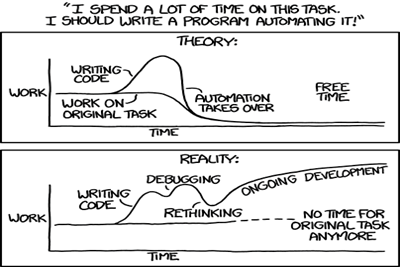
Process

xkcd: Automation

Not really. At least, if we aren’t careful, there’s still a pitfall.

Many of us in the technology fields love automation. We’re like the friends I mentioned before who love to automate things purely for the love of seeing something automated. Think about it. Computer programmers basically spend their entire career working out new and different ways to automate everything under the sun. That’s what they are trained to do.

There’s certainly a place for this–a very important place for this. But, it isn’t the whole story.

In almost every process out there (aside from some automated production), humans form an important part. The process is in place because it is solving a human-provided “problem.” In many cases, it is a person who is responsible for starting the process to begin with. Consider a person wanting an answer regarding the behavior of their customers. They could start off a process to collect, process and collate their customer data using Big Data tools.

Not only do humans often start processes in motion, but also they perform steps along the way. For example, a sports company may want to make a new golf club head. The decision to start this process begins with people. Then someone does the necessary work to set up the model in a computer. This model goes through parameter-sweep analysis utilizing their HPC resources. It then moves on to visualization, which is an inherent human-based process using technology-provided tools. And, in the end, many small details are human decisions for the design.

In both the above examples, people work hand-in-hand with technology and the process to achieve results and insights in their problem domain.

The Warning

Around the turn of the twentieth century, Georg Simmel said the following:

The individual has become a mere cog in an enormous organization of things and powers which tear from his hands all progress, spirituality, and value in order to transform them from their subjective form into the form of a purely objective life.

In our forever search for better efficiency it can become easy to equate the human steps with the automated steps in a process, or in other words, for consistency’s sake, there’s a desire to treat human steps like automated steps. Now, I’m not saying that we don’t want or need to optimize the human steps. We do. However, they can’t necessarily be automated in the same ways as the other types of steps in the process.

We must remember the ultimate goal of a process is to solve a problem presented by a person. Processes are the servants of mankind.

When people are steps in those processes, it’s best to remember Simmel’s warning. When we can automate steps to free humans to do more meaningful work, that is a win. In cases where we can’t, we want to provide tools to make the human-based steps more effective for the human. The efficiency of the overall workflow will then benefit as a result of a virtuous. Put the focus the other way around (process over person), and it will become its own tyranny.

The Vision

We are moving into an exciting new world. The computational power and available data promises to open new horizons of human understanding and ability.

We’re learning to tie different data sources and processing methodologies together into new and different workflows, which will lead to new insights and understanding. People will play important roles throughout these new workflows.

If we remember processes and workflows are our servants (not our masters) and we appropriately build them to leverage human potential, we will see the continuation of the fulfillment of Douglas F. Parkhill’s prediction that computers will multiply human ability a million-fold.

Welcome to the Age of Computer Evolution.

By Trev Harmon, Adaptive Computing

Adaptive Computing manages the world’s largest computing installations with its Moab® self-optimizing cloud management and HPC workload management solutions.  The patented Moab multi-dimensional decision engine delivers policy-based governance, allowing customers to consolidate resources, allocate and manage services, optimize service levels and reduce operational costs.  Our leadership in IT decision engine software has been recognized with over 45 patents and over a decade of battle-tested performance resulting in a solid Fortune 500 and Top500 supercomputing customer base.


ISBuzz Team
  • ISBuzz Team
    Air Canada Data Breach: BianLian Extortion Group Claims A Massive Heist Contrary To Airline’s Earlier Statement
  • ISBuzz Team
    Unprecedented DDoS Attack Rocks The Web: Tech Giants Reveal A Digital Tsunami
  • ISBuzz Team
    CISA Flags High-Severity Adobe Acrobat Reader Flaw Amid Active Exploits
  • ISBuzz Team
    Curl Security Alert: Patching A Critical Bug Averting Potential Cyber Catastrophe

The opinions expressed in this post belong to the individual contributors and do not necessarily reflect the views of Information Security Buzz.

Share. Facebook Twitter LinkedIn Email Copy Link

Related Posts

What Are AI SOC Agents? Use Cases, Architecture, and the Leading Vendors

June 19, 20266 Mins Read

AI-Powered Attacks Become Top Concern for Security Professionals, New Filigran Survey Reveals

June 19, 20265 Mins Read

ShinyHunters targets Oracle PeopleSoft customers through critical zero-day

June 19, 20263 Mins Read
ISB-Bora-Side-Bar

No se ha podido establecer conexión. Error 429

 
ISB-Bora-Side-Bar
Black ISB Logo

Information Security Buzz is an independent resource that provides the experts’ comments, analysis, and opinion on the latest Cybersecurity news and topics

X (Twitter) LinkedIn Facebook RSS

Working With Us

  • About Us
  • Advertise With Us
  • Contact Us

Write For Us

  • How To Contribute

The Pages

  • Privacy Policy
  • Cookie Policy
  • AI Policy
  • Terms & Conditions
  • Copyright Notice

Information Security Buzz and all its contents are copyright © 2014-2025. All rights reserved. All third-party trademarks are recognized.

Type above and press Enter to search. Press Esc to cancel.

Manage Consent
To provide the best experiences, we use technologies like cookies to store and/or access device information. Consenting to these technologies will allow us to process data such as browsing behavior or unique IDs on this site. Not consenting or withdrawing consent, may adversely affect certain features and functions.
Functional Always active
The technical storage or access is strictly necessary for the legitimate purpose of enabling the use of a specific service explicitly requested by the subscriber or user, or for the sole purpose of carrying out the transmission of a communication over an electronic communications network.
Preferences
The technical storage or access is necessary for the legitimate purpose of storing preferences that are not requested by the subscriber or user.
Statistics
The technical storage or access that is used exclusively for statistical purposes. The technical storage or access that is used exclusively for anonymous statistical purposes. Without a subpoena, voluntary compliance on the part of your Internet Service Provider, or additional records from a third party, information stored or retrieved for this purpose alone cannot usually be used to identify you.
Marketing
The technical storage or access is required to create user profiles to send advertising, or to track the user on a website or across several websites for similar marketing purposes.
  • Manage options
  • Manage services
  • Manage {vendor_count} vendors
  • Read more about these purposes
View preferences
  • {title}
  • {title}
  • {title}