


Close Menu
  • Home
  • Articles
    • Attacks
      • BEC
      • Data Breach
      • DDoS
      • Evasion Attacks
      • Injection
      • Malware
      • MITM
      • Phishing
      • Ransomware
      • RCE
      • Social Engineering
      • Spoofing
      • Spyware
    • Business and Policy
      • BCP and DRP
      • GRC
      • Regulations
    • Data Protection
      • DLP
      • DRM
      • Encryption
      • IAM
    • Future, Trends and Insight
      • AI
      • Events & Community
      • Emerging Tech
      • Expert Panel
      • Interviews With Experts
      • Insights
      • Study & Research
    • Resources
      • Guides
      • Tools
      • Training & Education
    • Security
      • API
      • Apps
      • Cloud
      • Critical Infrastructure
      • Endpoint
      • Hardware
      • IoT
      • Mobile
      • Network
      • OT
      • Port Security
      • Security Architecture
      • Software Development
      • Supply Chain
      • Zero Trust
    • Threats and Vulnerabilities
      • Emerging Threats
      • Insider Threats
      • Risk Management
      • Threat Intelligence
      • Zero Day
  • News and Exclusives
    • Latest News
    • ISB Exclusive
    • Positive News
  • Who We Are
    • About Us
    • Information Security Buzz Expert Panel​
    • Write for Us
    • Media Pack
  • Contact Us
  • Newsletter
Facebook X (Twitter) LinkedIn
Information Security BuzzInformation Security Buzz
  • Home
  • Articles
    • Attacks
      • BEC
      • Data Breach
      • DDoS
      • Evasion Attacks
      • Injection
      • Malware
      • MITM
      • Phishing
      • Ransomware
      • RCE
      • Social Engineering
      • Spoofing
      • Spyware
    • Business and Policy
      • BCP and DRP
      • GRC
      • Regulations
    • Data Protection
      • DLP
      • DRM
      • Encryption
      • IAM
    • Future, Trends and Insight
      • AI
      • Events & Community
      • Emerging Tech
      • Expert Panel
      • Interviews With Experts
      • Insights
      • Study & Research
    • Resources
      • Guides
      • Tools
      • Training & Education
    • Security
      • API
      • Apps
      • Cloud
      • Critical Infrastructure
      • Endpoint
      • Hardware
      • IoT
      • Mobile
      • Network
      • OT
      • Port Security
      • Security Architecture
      • Software Development
      • Supply Chain
      • Zero Trust
    • Threats and Vulnerabilities
      • Emerging Threats
      • Insider Threats
      • Risk Management
      • Threat Intelligence
      • Zero Day
  • News and Exclusives
    • Latest News
    • ISB Exclusive
    • Positive News
  • Who We Are
    • About Us
    • Information Security Buzz Expert Panel​
    • Write for Us
    • Media Pack
  • Contact Us
  • Newsletter
Subscribe
Information Security BuzzInformation Security Buzz
Home - News & Analysis - Is The World Economic Forum’s Web Infrastructure Insecure?
News & Analysis

Is The World Economic Forum’s Web Infrastructure Insecure?

ISBuzz TeamBy ISBuzz TeamJanuary 22, 2014Updated:July 3, 20244 Mins Read
Share LinkedIn Twitter Facebook Copy Link Email
World-Economic-Forum
Share
Facebook Twitter LinkedIn Email Copy Link
Quick AI Summary
ChatGPTClaudeGeminiGrokPerplexityDeepSeekCopilot

Last week High-Tech Bridge’s Security Research Team was preparing our web vulnerabilities statistics report for 2013 [to be published next week]. Critical web vulnerabilities such as SQL Injections or Remote Command Executions are becoming rare and difficult to exploit as web developers are more and more aware of them. However, the number of medium-risk vulnerabilities, such as XSS (Cross-Site Scripting) is permanently growing. Being a medium-risk vulnerability, XSS usually provides a larger number of attack and exploitation opportunities to hackers than other web vulnerabilities, as it does not target the web application, but rather website visitors and administrators. Stealing cookies, website’s credentials and browser history is probably the least harmful vector of XSS attack. However, drive-by attacks via XSS that can infect a website visitor’s machine and turn it into a zombie just by clicking on a specially crafted link on the vulnerable website are much more dangerous.

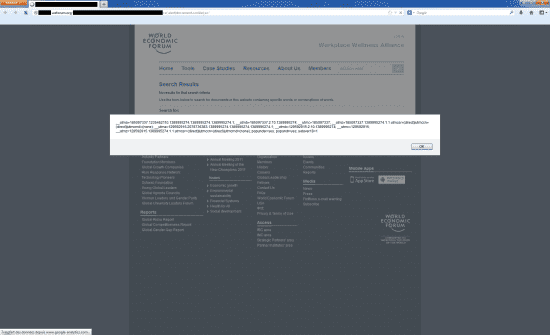
Last week while surfing the website of World Economic Forum (WEF) – world-known organization that is holding its annual meeting in Davos (Switzerland) these days (22-26 of January) – we unintentionally discovered an XSS vulnerability in one of their subdomains:
PoC-1
1. XSS vulnerability on a weforum.org subdomain

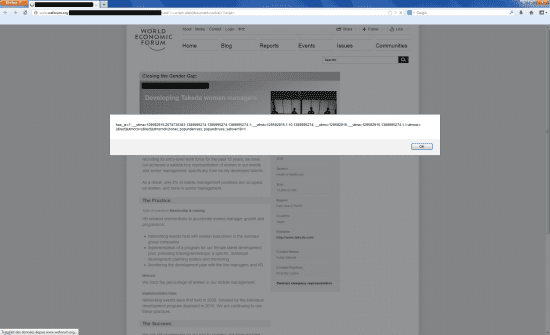
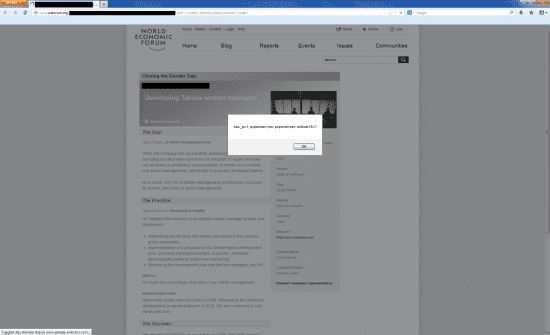
A quick and absolutely harmless test of their main website [www.weforum.org] revealed two more XSS vulnerabilities on it:
PoC-2
2. XSS vulnerability on www.weforum.org
PoC-3
3. XSS vulnerability on www.weforum.org

Being a bit surprised that such a respectable organization has security vulnerabilities on their website, we notified them via common security emails (abuse@, security@, admin@, etc) and all appropriate emails found on their website. As the WEF was already a victim of fictitious emails attack we expected a quick reply from them. However, on the fifth day since the notification we still didn’t get a single word from their side. We started searching for additional technical contacts so that we could reach them, but instead we found an additional quite serious information disclosure vulnerability.

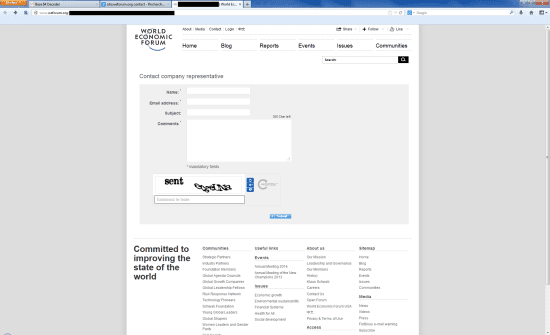
The WEF website has a function to contact a company representative via a web form without exposing his/her email address:
Information-Disclosure-1.png 4
4. Company representative сontact form

However, if you have a look into the HTML source code of the page – you will find a hidden HTTP parameter named “cr” that is encoded with Base64:
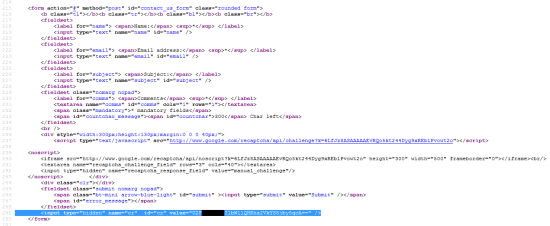
Information-Disclosure-2.png 5
5. Contact form page HTML source

Being curious, we decoded the parameter and to our surprise we got a personal email address of the person in plaintext. For each ID (HTTP “n” parameter) email address was unique and belonged to a different person. Guided by ethics we obviously didn’t make a full list of the emails (the largest ID we found was 106,515), but we can presume that at least several thousands of forum stakeholders’ emails can be disclosed to spammers because of this vulnerability. The biggest risk here is that these personal emails can be used by hackers to perform targeted attacks in pair with XSS vulnerabilities that make quite an explosive and efficient hacking cocktail. The screenshot below demonstrates several of randomly disclosed emails:
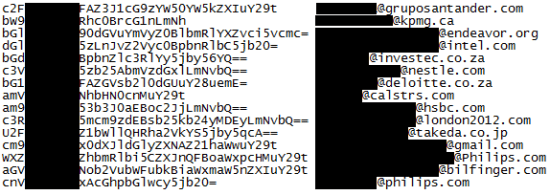
Information-Disclosure-3.png 6

6. Random user emails disclosed via vulnerability

Last but not least, the SSL certificate on the www.weforum.org is invalid and therefore cannot correctly encrypt the traffic between the end-users and the web server putting website visitors’ privacy at risk:
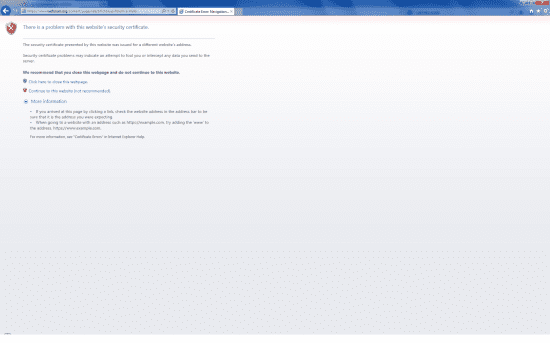
SSL-1.png 7

7. www.weforum.org SSL certificate error – Internet Explorer
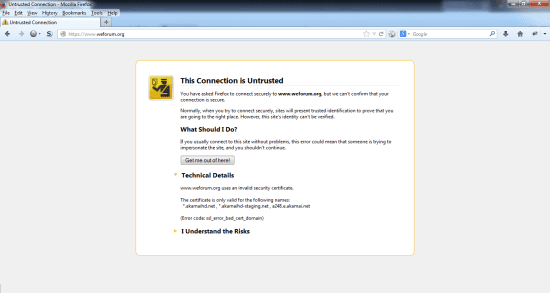
SSL-2.png 8
8. www.weforum.org SSL certificate error – Firefox

Ilia Kolochenko, High-Tech Bridge’s CEO, comments: “It’s regrettable that such respectable, large and important organizations like the WEF don’t pay enough attention to web security. This may not only put their own infrastructure at risk, but their stakeholders as well. Hopefully, they will change their security policy soon and provide security researchers with a responsive security contact, just like many other companies and organizations do today. Moreover, the vulnerabilities we reported are quite possibly just the tip of iceberg, as without their [WEF] permission we didn’t want to perform any further more “intrusive” security checks that can reveal much more serious vulnerabilities. I sincerely hope that these vulnerabilities were not exploited by hackers for whom WEF and its participants are very attractive targets.“

ISBuzz Team
  • ISBuzz Team
    Air Canada Data Breach: BianLian Extortion Group Claims A Massive Heist Contrary To Airline’s Earlier Statement
  • ISBuzz Team
    Unprecedented DDoS Attack Rocks The Web: Tech Giants Reveal A Digital Tsunami
  • ISBuzz Team
    CISA Flags High-Severity Adobe Acrobat Reader Flaw Amid Active Exploits
  • ISBuzz Team
    Curl Security Alert: Patching A Critical Bug Averting Potential Cyber Catastrophe

The opinions expressed in this post belong to the individual contributors and do not necessarily reflect the views of Information Security Buzz.

Share. Facebook Twitter LinkedIn Email Copy Link

Related Posts

Roundcube RCE Vulnerability Disclosed Early Amid Active Exploitation

June 10, 20255 Mins Read

Roblox Under Fire: Lawsuit Alleges Secret Data Tracking of Kids

May 13, 20254 Mins Read

Fake Indian Government Portal Used to Spread Cross-Platform Malware in Suspected APT36 Campaign

May 13, 20253 Mins Read
ISB-Bora-Side-Bar

 
ISB-Bora-Side-Bar
Black ISB Logo

Information Security Buzz is an independent resource that provides the experts’ comments, analysis, and opinion on the latest Cybersecurity news and topics

X (Twitter) LinkedIn Facebook RSS

Working With Us

  • About Us
  • Advertise With Us
  • Contact Us

Write For Us

  • How To Contribute

The Pages

  • Privacy Policy
  • Cookie Policy
  • AI Policy
  • Terms & Conditions
  • Copyright Notice

Information Security Buzz and all its contents are copyright © 2014-2025. All rights reserved. All third-party trademarks are recognized.

Type above and press Enter to search. Press Esc to cancel.

Manage Consent
To provide the best experiences, we use technologies like cookies to store and/or access device information. Consenting to these technologies will allow us to process data such as browsing behavior or unique IDs on this site. Not consenting or withdrawing consent, may adversely affect certain features and functions.
Functional Always active
The technical storage or access is strictly necessary for the legitimate purpose of enabling the use of a specific service explicitly requested by the subscriber or user, or for the sole purpose of carrying out the transmission of a communication over an electronic communications network.
Preferences
The technical storage or access is necessary for the legitimate purpose of storing preferences that are not requested by the subscriber or user.
Statistics
The technical storage or access that is used exclusively for statistical purposes. The technical storage or access that is used exclusively for anonymous statistical purposes. Without a subpoena, voluntary compliance on the part of your Internet Service Provider, or additional records from a third party, information stored or retrieved for this purpose alone cannot usually be used to identify you.
Marketing
The technical storage or access is required to create user profiles to send advertising, or to track the user on a website or across several websites for similar marketing purposes.
  • Manage options
  • Manage services
  • Manage {vendor_count} vendors
  • Read more about these purposes
View preferences
  • {title}
  • {title}
  • {title}