Close Menu
  • Home
  • Articles
    • Attacks
      • BEC
      • Data Breach
      • DDoS
      • Evasion Attacks
      • Injection
      • Malware
      • MITM
      • Phishing
      • Ransomware
      • RCE
      • Social Engineering
      • Spoofing
      • Spyware
    • Business and Policy
      • BCP and DRP
      • GRC
      • Regulations
    • Data Protection
      • DLP
      • DRM
      • Encryption
      • IAM
    • Future, Trends and Insight
      • AI
      • Events & Community
      • Emerging Tech
      • Expert Panel
      • Interviews With Experts
      • Insights
      • Study & Research
    • Resources
      • Guides
      • Tools
      • Training & Education
    • Security
      • API
      • Apps
      • Cloud
      • Critical Infrastructure
      • Endpoint
      • Hardware
      • IoT
      • Mobile
      • Network
      • OT
      • Port Security
      • Security Architecture
      • Software Development
      • Supply Chain
      • Zero Trust
    • Threats and Vulnerabilities
      • Emerging Threats
      • Insider Threats
      • Risk Management
      • Threat Intelligence
      • Zero Day
  • News and Exclusives
    • Latest News
    • ISB Exclusive
    • Positive News
  • Who We Are
    • About Us
    • Information Security Buzz Expert Panel​
    • Write for Us
    • Media Pack
  • Contact Us
  • Newsletter
Facebook X (Twitter) LinkedIn
Information Security BuzzInformation Security Buzz
  • Home
  • Articles
    • Attacks
      • BEC
      • Data Breach
      • DDoS
      • Evasion Attacks
      • Injection
      • Malware
      • MITM
      • Phishing
      • Ransomware
      • RCE
      • Social Engineering
      • Spoofing
      • Spyware
    • Business and Policy
      • BCP and DRP
      • GRC
      • Regulations
    • Data Protection
      • DLP
      • DRM
      • Encryption
      • IAM
    • Future, Trends and Insight
      • AI
      • Events & Community
      • Emerging Tech
      • Expert Panel
      • Interviews With Experts
      • Insights
      • Study & Research
    • Resources
      • Guides
      • Tools
      • Training & Education
    • Security
      • API
      • Apps
      • Cloud
      • Critical Infrastructure
      • Endpoint
      • Hardware
      • IoT
      • Mobile
      • Network
      • OT
      • Port Security
      • Security Architecture
      • Software Development
      • Supply Chain
      • Zero Trust
    • Threats and Vulnerabilities
      • Emerging Threats
      • Insider Threats
      • Risk Management
      • Threat Intelligence
      • Zero Day
  • News and Exclusives
    • Latest News
    • ISB Exclusive
    • Positive News
  • Who We Are
    • About Us
    • Information Security Buzz Expert Panel​
    • Write for Us
    • Media Pack
  • Contact Us
  • Newsletter
Subscribe
Information Security BuzzInformation Security Buzz
Home - Articles - Zscaler Find New Exploit Kits Leveraging Vulnerabilities In Web Browsers
Articles

Zscaler Find New Exploit Kits Leveraging Vulnerabilities In Web Browsers

ISBuzz TeamBy ISBuzz TeamSeptember 7, 20164 Mins Read
Share LinkedIn Twitter Facebook Copy Link Email
Share
Facebook Twitter LinkedIn Email Copy Link
Quick AI Summary
ChatGPTClaudeGeminiGrokPerplexityDeepSeekCopilot

Overview:

This is the second in a series of blogs collecting the recent activity of the current top exploit kits. Exploit kits are rapidly deployable software packages designed to leverage vulnerabilities in web browsers to deliver a malicious payload to a victim’s computer. Authors of exploit kits offer their services for sale, distributing malware for other malicious actors.

Find our previous round-up here (https://www.zscaler.com/blogs/research/top-exploit-kit-activity-roundup).

Neutrino Exploit Kit

In our previous roundup, we noted that the EITest campaign had begun redirecting primarily to Neutrino landing pages since Angler exploit kit activity abruptly stopped in early June 2016.

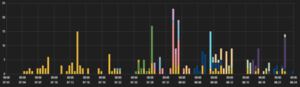
EITest gates have continued redirecting to Neutrino landing pages, as well as RIG, throughout Summer 2016.
1

(Neutrino hits)

2

(Neutrino heat map)

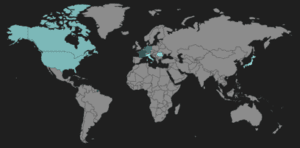
Neutrino landing pages still primarily use top TLD names and target Adobe Flash Player. The majority of Neutrino hosts observed were hosted in Western Europe and North America.

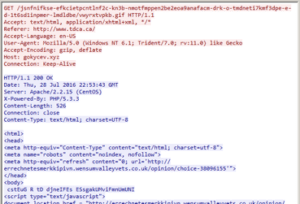
Starting in mid-June, the EITest Neutrino landing pages began distributing CryptXXX ransomware payloads. Prior to its shutdown, Angler was the main distributor of CryptXXX ransomware, and its stoppage caused a significant decline in CryptXXX infections. The increased usage of Neutrino to distribute CryptXXX helped fill the void left by Angler.
3

(EITest gate redirect to Neutrino landing page)

In late July, EITest Neutrino landing pages began delivering CrypMIC ransomware, a new variant of CryptXXX. Non-EITest Neutrino campaigns involving malvertising continue to drop Tofsee, Gamarue, and various ransomware payloads.
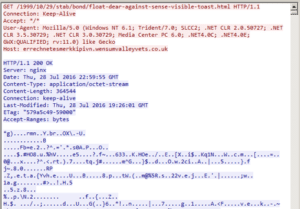
4

(CrypMIC payload from Neutrino infection chain)

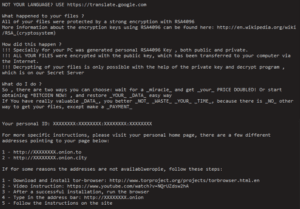
CrypMIC ransomware communicates with its C&C server via plain text over TCP port 443 (typically reserved for HTTPS/SSL traffic).
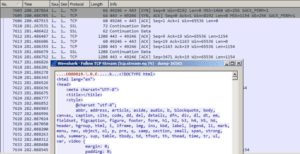
5

(CrypMIC callback and ransom page)

6

(Example CrypMIC ransom instructions)

RIG Exploit Kit

RIG remains active over several campaigns. The usual compromised sites and malvertising redirects are prevalent, as well as redirections to RIG from EITest gates.

77

(RIG hits)

Observed hits on RIG domains have been relatively consistent throughout the summer.
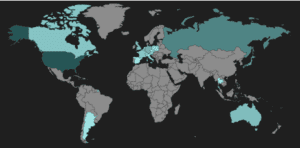
8

(RIG heat map)

The United States is still the largest host of RIG domains, though this summer we have seen an increase of hosts in Russia, as well as in several countries in Western Europe and the Americas.

The “topgunnphoto” gate mentioned in our previous round-up is still visible, but infection cycles from this gate declined through late July and early August. A thorough overview of recent RIG activity was published by Malwarebytes in late July, which illustrates several common RIG campaigns.

Not covered in the Malwarebytes article is a non-standard RIG campaign that originates with casino-themed malvertising. This campaign uses an atypical landing page URL scheme mentioned in the previous round-up, which breaks from the pattern of a two-character third-level domain.
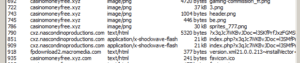
9

(RIG casino-based malvertising infection cycle)

RIG continues to drop Tofsee payloads and a new variant of Zeus, as we have previously described. Recently, RIG has started dropping the Gootkit banking trojan through the EITest campaign, as well as Vawtrak and Cerber payloads.

Other Exploit Kits

Magnitude

Magnitude is a long-running exploit kit that has been active since October 2013. Through summer, it has continued its recent trend of dropping Cerber ransomware payloads through malvertising campaigns.
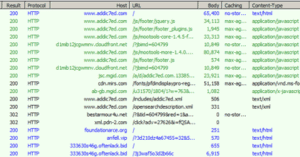
10

(Magnitude infection cycle)

Angler Exploit Kit

Angler EK shut down in early June 2016, and is now considered to be defunct. EITest gates which had been primarily redirecting to Angler landing pages have since begun redirecting to Neutrino and RIG landing pages

Nuclear Exploit Kit

Nuclear has had no activity since late April 2016, and is now considered to be defunct. Some compromised site injection artifacts are still observed, but no active redirectors or gates.

Sundown Exploit Kit

In early July, Zscaler’s ThreatLabZ published an article analysing the activity of Sundown over the previous month (https://www.zscaler.com/blogs/research/sundown-chronicles-observations-exploit-kits-evolution). Most recently, variations to Sundown’s landing page obfuscation structure have been observed, and Sundown has begun dropping a variant of the Kasidet backdoor with modified callback protocols.
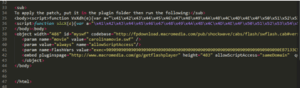
11

(Sundown landing page excerpt)

In early July, Sundown EK quickly integrated the recently-published exploit CVE-2016-0189 (https://web.nvd.nist.gov/view/vuln/detail?vulnId=CVE-2016-0189), a VBScript memory corruption vulnerability in IE11, into new landing pages. The standard Sundown landing page was replaced entirely with a modified version of the open source POC for the exploit.

12

(Sundown EK using CVE-2016-0189)

Conclusion

Exploit kits pose a significant threat to users during simple web browsing. In the case of ransomware infections, the result could be the inability of a user to access his or her files. The techniques exploit kit authors use to hide their activities are frequently changing, and security researchers work hard to analyse and block these new threats.

To help avoid infections such as these, users should always block untrusted third-party scripts and resources, and avoid clicking on suspicious advertisements. Zscaler’s ThreatLabZ has confirmed coverage for these top exploit kits and subsequent payloads, ensuring protection for organisations using Zscaler’s Internet security platform.

ISBuzz Team
  • ISBuzz Team
    Air Canada Data Breach: BianLian Extortion Group Claims A Massive Heist Contrary To Airline’s Earlier Statement
  • ISBuzz Team
    Unprecedented DDoS Attack Rocks The Web: Tech Giants Reveal A Digital Tsunami
  • ISBuzz Team
    CISA Flags High-Severity Adobe Acrobat Reader Flaw Amid Active Exploits
  • ISBuzz Team
    Curl Security Alert: Patching A Critical Bug Averting Potential Cyber Catastrophe

The opinions expressed in this post belong to the individual contributors and do not necessarily reflect the views of Information Security Buzz.

Share. Facebook Twitter LinkedIn Email Copy Link

Related Posts

The Real Cost of Inconsistent Third-Party Access

December 18, 20255 Mins Read

What Happens When Devices Cross Borders? The Role of Geofencing in Global IT

August 7, 20256 Mins Read

The Evolving Importance of Identity Governance in FinTech

July 10, 20258 Mins Read
ISB-Bora-Side-Bar

No se ha podido establecer conexión. Error 429

 
ISB-Bora-Side-Bar
Black ISB Logo

Information Security Buzz is an independent resource that provides the experts’ comments, analysis, and opinion on the latest Cybersecurity news and topics

X (Twitter) LinkedIn Facebook RSS

Working With Us

  • About Us
  • Advertise With Us
  • Contact Us

Write For Us

  • How To Contribute

The Pages

  • Privacy Policy
  • Cookie Policy
  • AI Policy
  • Terms & Conditions
  • Copyright Notice

Information Security Buzz and all its contents are copyright © 2014-2025. All rights reserved. All third-party trademarks are recognized.

Type above and press Enter to search. Press Esc to cancel.

Manage Consent
To provide the best experiences, we use technologies like cookies to store and/or access device information. Consenting to these technologies will allow us to process data such as browsing behavior or unique IDs on this site. Not consenting or withdrawing consent, may adversely affect certain features and functions.
Functional Always active
The technical storage or access is strictly necessary for the legitimate purpose of enabling the use of a specific service explicitly requested by the subscriber or user, or for the sole purpose of carrying out the transmission of a communication over an electronic communications network.
Preferences
The technical storage or access is necessary for the legitimate purpose of storing preferences that are not requested by the subscriber or user.
Statistics
The technical storage or access that is used exclusively for statistical purposes. The technical storage or access that is used exclusively for anonymous statistical purposes. Without a subpoena, voluntary compliance on the part of your Internet Service Provider, or additional records from a third party, information stored or retrieved for this purpose alone cannot usually be used to identify you.
Marketing
The technical storage or access is required to create user profiles to send advertising, or to track the user on a website or across several websites for similar marketing purposes.
  • Manage options
  • Manage services
  • Manage {vendor_count} vendors
  • Read more about these purposes
View preferences
  • {title}
  • {title}
  • {title}