


Close Menu
  • Home
  • Articles
    • Attacks
      • BEC
      • Data Breach
      • DDoS
      • Evasion Attacks
      • Injection
      • Malware
      • MITM
      • Phishing
      • Ransomware
      • RCE
      • Social Engineering
      • Spoofing
      • Spyware
    • Business and Policy
      • BCP and DRP
      • GRC
      • Regulations
    • Data Protection
      • DLP
      • DRM
      • Encryption
      • IAM
    • Future, Trends and Insight
      • AI
      • Events & Community
      • Emerging Tech
      • Expert Panel
      • Interviews With Experts
      • Insights
      • Study & Research
    • Resources
      • Guides
      • Tools
      • Training & Education
    • Security
      • API
      • Apps
      • Cloud
      • Critical Infrastructure
      • Endpoint
      • Hardware
      • IoT
      • Mobile
      • Network
      • OT
      • Port Security
      • Security Architecture
      • Software Development
      • Supply Chain
      • Zero Trust
    • Threats and Vulnerabilities
      • Emerging Threats
      • Insider Threats
      • Risk Management
      • Threat Intelligence
      • Zero Day
  • News and Exclusives
    • Latest News
    • ISB Exclusive
    • Positive News
  • Who We Are
    • About Us
    • Information Security Buzz Expert Panel​
    • Write for Us
    • Media Pack
  • Contact Us
  • Newsletter
Facebook X (Twitter) LinkedIn
Information Security BuzzInformation Security Buzz
  • Home
  • Articles
    • Attacks
      • BEC
      • Data Breach
      • DDoS
      • Evasion Attacks
      • Injection
      • Malware
      • MITM
      • Phishing
      • Ransomware
      • RCE
      • Social Engineering
      • Spoofing
      • Spyware
    • Business and Policy
      • BCP and DRP
      • GRC
      • Regulations
    • Data Protection
      • DLP
      • DRM
      • Encryption
      • IAM
    • Future, Trends and Insight
      • AI
      • Events & Community
      • Emerging Tech
      • Expert Panel
      • Interviews With Experts
      • Insights
      • Study & Research
    • Resources
      • Guides
      • Tools
      • Training & Education
    • Security
      • API
      • Apps
      • Cloud
      • Critical Infrastructure
      • Endpoint
      • Hardware
      • IoT
      • Mobile
      • Network
      • OT
      • Port Security
      • Security Architecture
      • Software Development
      • Supply Chain
      • Zero Trust
    • Threats and Vulnerabilities
      • Emerging Threats
      • Insider Threats
      • Risk Management
      • Threat Intelligence
      • Zero Day
  • News and Exclusives
    • Latest News
    • ISB Exclusive
    • Positive News
  • Who We Are
    • About Us
    • Information Security Buzz Expert Panel​
    • Write for Us
    • Media Pack
  • Contact Us
  • Newsletter
Subscribe
Information Security BuzzInformation Security Buzz
Home - Articles - Four Ways to Spot a Holiday Cyber Scam
Articles

Four Ways to Spot a Holiday Cyber Scam

ISBuzz TeamBy ISBuzz TeamDecember 9, 20154 Mins Read
Share LinkedIn Twitter Facebook Copy Link Email
Four Ways to Spot a Holiday Cyber Scam
Share
Facebook Twitter LinkedIn Email Copy Link
Quick AI Summary
ChatGPTClaudeGeminiGrokPerplexityDeepSeekCopilot

This season cybercriminals take advantage of online shoppers.

Below are four tips from Proofpoint cybersecurity experts on how to stay cyber safe this season.

  • Don’t let your guard down—and don’t click. Holidays are a time when consumers want the fastest route to their end goal, and as a result, they don’t slow down to really pay attention to what they are clicking or what website they are writing into the search bar.

This might seem obvious, but it’s surprising how many people open an email that appears to be from a retailer or type a website address too quickly—only to end up on a malicious site. The easiest thing consumers can do to protect themselves is to avoid clicking on any links embedded in emails. If you want to visit a site, go to the site directly. Do not go via a URL that is provided to you, whether that is via email, text message or social media. Also, be sure to watch the spelling of the website. Cybercriminal “typosquatters” are known to create fake pages with spellings similar to legitimate sites.

Recognizing a bad site or bad links has rapidly evolved past the point of simple human detection. If you click on the wrong link, by the time the web page is visible in your browser, you’ve been compromised—and you’ll probably never know it.

  • Mobile applications are convenient, but can cost your privacy. Proofpoint mobile application security specialists often find that people are unaware that the apps on their phone pose a serious security risk. A majority of these nefarious apps are out to steal information, mining private data and sending it to unauthorized servers around the world.

Before downloading an app make sure it has a privacy policy and confirm that the publisher is known. For example, verify that the publisher has an associated website and not just a Twitter feed. No legitimate application should ask for permissions to access data it shouldn’t need. For example, many apps ask for access to your location data, so it’s important to ask yourself whether the app really needs it. Also be sure to check the number of downloads for an app. If the number is low—stay away.

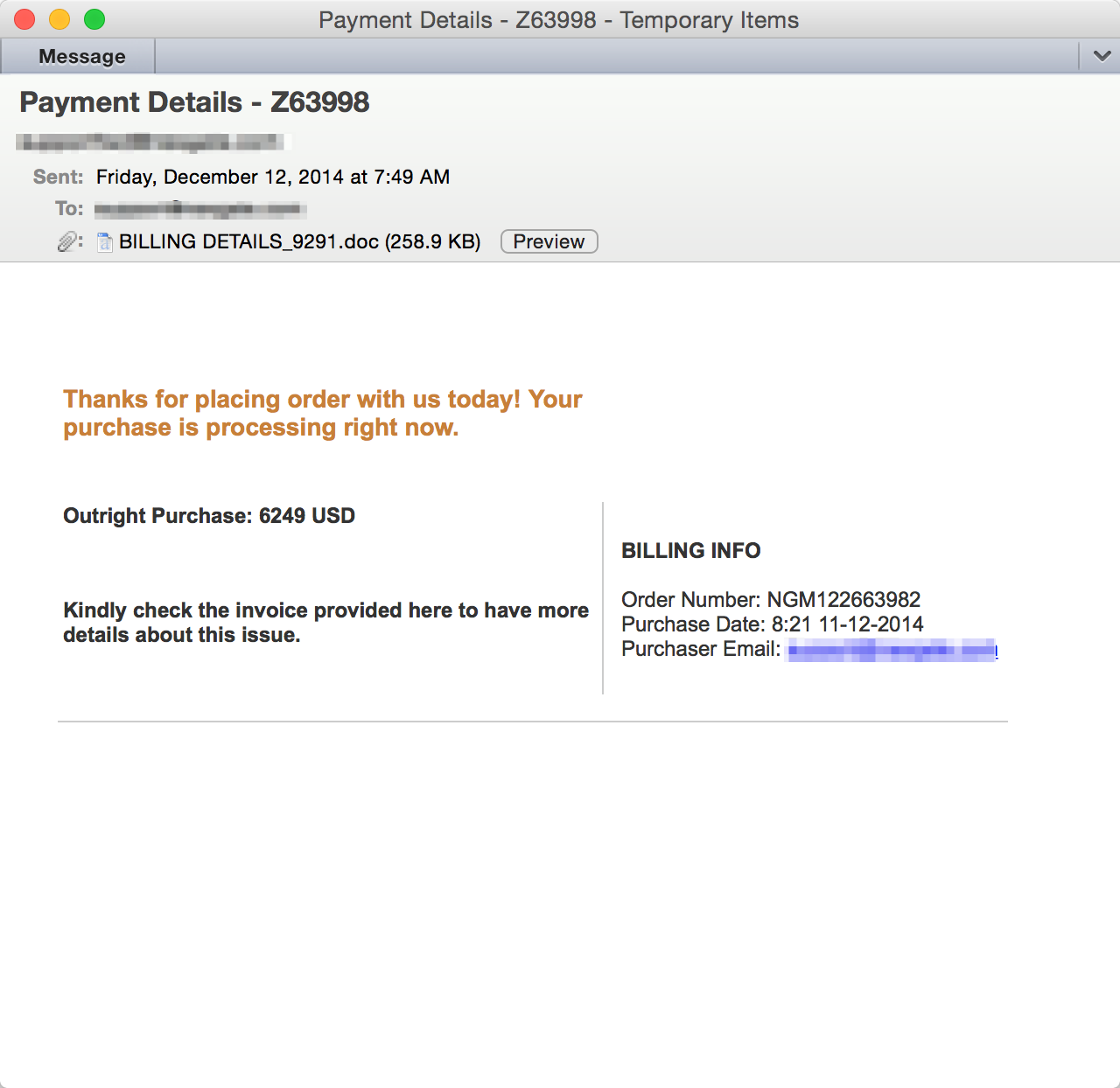
  • Watch out for email order confirmations. Great, you placed an order and checked one item off your list, right? Or maybe you received an order confirmation for something you don’t remember ordering? You still need to stay vigilant if you receive an order confirmation via email. Cybercriminals often research potential victims via social media and will send targeted emails with fake order confirmations (see our example below). Psychologically if you receive what appears to be an unsolicited gift, perhaps in the form of an order, package, airline ticket confirmation or similar, an instinctive action is often to click for more information. The best practice is to open a new browser window and visit the vendor’s website to check your order. Below is an example of a fake order confirmation that cybercriminals are actively using.
  • Social media isn’t always a friendly place. Watch out for fake brand social media accounts, fake gift card scams and fake customer service pages. We have identified many examples of cybercriminals actively creating fake accounts to lure fans, spam them with malicious links and attempt to extract confidential information. For example, cybercriminals actively creating fake customer service accounts on Twitter to solicit consumers for their financial information. The best practice is to visit the brand’s page and click on their social media links directly to ensure its safety.

[su_box title=”About Proofpoint” style=”noise” box_color=”#336588″]proofpoint_logoProofpoint Inc. (NASDAQ:PFPT) is a leading security-as-a-service provider that focuses on cloud-based solutions for threat protection, compliance, archiving & governance, and secure communications. Organizations around the world depend on Proofpoint’s expertise, patented technologies and on-demand delivery system to protect against phishing, malware and spam, safeguard privacy, encrypt sensitive information, and archive and govern messages and critical enterprise information.[/su_box]

ISBuzz Team
  • ISBuzz Team
    Air Canada Data Breach: BianLian Extortion Group Claims A Massive Heist Contrary To Airline’s Earlier Statement
  • ISBuzz Team
    Unprecedented DDoS Attack Rocks The Web: Tech Giants Reveal A Digital Tsunami
  • ISBuzz Team
    CISA Flags High-Severity Adobe Acrobat Reader Flaw Amid Active Exploits
  • ISBuzz Team
    Curl Security Alert: Patching A Critical Bug Averting Potential Cyber Catastrophe

The opinions expressed in this post belong to the individual contributors and do not necessarily reflect the views of Information Security Buzz.

Share. Facebook Twitter LinkedIn Email Copy Link

Related Posts

AppSec is dead, long live AI security

April 29, 20265 Mins Read

Managing App Access on Frontline Devices in an Always-On World

March 9, 20264 Mins Read

New Phishing Kit Starkiller Defeats Multi-Factor Authentication

February 23, 20264 Mins Read
ISB-Bora-Side-Bar

No se ha podido establecer conexión. Error 429

 
ISB-Bora-Side-Bar
Black ISB Logo

Information Security Buzz is an independent resource that provides the experts’ comments, analysis, and opinion on the latest Cybersecurity news and topics

X (Twitter) LinkedIn Facebook RSS

Working With Us

  • About Us
  • Advertise With Us
  • Contact Us

Write For Us

  • How To Contribute

The Pages

  • Privacy Policy
  • Cookie Policy
  • AI Policy
  • Terms & Conditions
  • Copyright Notice

Information Security Buzz and all its contents are copyright © 2014-2025. All rights reserved. All third-party trademarks are recognized.

Type above and press Enter to search. Press Esc to cancel.

Manage Consent
To provide the best experiences, we use technologies like cookies to store and/or access device information. Consenting to these technologies will allow us to process data such as browsing behavior or unique IDs on this site. Not consenting or withdrawing consent, may adversely affect certain features and functions.
Functional Always active
The technical storage or access is strictly necessary for the legitimate purpose of enabling the use of a specific service explicitly requested by the subscriber or user, or for the sole purpose of carrying out the transmission of a communication over an electronic communications network.
Preferences
The technical storage or access is necessary for the legitimate purpose of storing preferences that are not requested by the subscriber or user.
Statistics
The technical storage or access that is used exclusively for statistical purposes. The technical storage or access that is used exclusively for anonymous statistical purposes. Without a subpoena, voluntary compliance on the part of your Internet Service Provider, or additional records from a third party, information stored or retrieved for this purpose alone cannot usually be used to identify you.
Marketing
The technical storage or access is required to create user profiles to send advertising, or to track the user on a website or across several websites for similar marketing purposes.
  • Manage options
  • Manage services
  • Manage {vendor_count} vendors
  • Read more about these purposes
View preferences
  • {title}
  • {title}
  • {title}