


Close Menu
  • Home
  • Articles
    • Attacks
      • BEC
      • Data Breach
      • DDoS
      • Evasion Attacks
      • Injection
      • Malware
      • MITM
      • Phishing
      • Ransomware
      • RCE
      • Social Engineering
      • Spoofing
      • Spyware
    • Business and Policy
      • BCP and DRP
      • GRC
      • Regulations
    • Data Protection
      • DLP
      • DRM
      • Encryption
      • IAM
    • Future, Trends and Insight
      • AI
      • Events & Community
      • Emerging Tech
      • Expert Panel
      • Interviews With Experts
      • Insights
      • Study & Research
    • Resources
      • Guides
      • Tools
      • Training & Education
    • Security
      • API
      • Apps
      • Cloud
      • Critical Infrastructure
      • Endpoint
      • Hardware
      • IoT
      • Mobile
      • Network
      • OT
      • Port Security
      • Security Architecture
      • Software Development
      • Supply Chain
      • Zero Trust
    • Threats and Vulnerabilities
      • Emerging Threats
      • Insider Threats
      • Risk Management
      • Threat Intelligence
      • Zero Day
  • News and Exclusives
    • Latest News
    • ISB Exclusive
    • Positive News
  • Who We Are
    • About Us
    • Information Security Buzz Expert Panel​
    • Write for Us
    • Media Pack
  • Contact Us
  • Newsletter
Facebook X (Twitter) LinkedIn
Information Security BuzzInformation Security Buzz
  • Home
  • Articles
    • Attacks
      • BEC
      • Data Breach
      • DDoS
      • Evasion Attacks
      • Injection
      • Malware
      • MITM
      • Phishing
      • Ransomware
      • RCE
      • Social Engineering
      • Spoofing
      • Spyware
    • Business and Policy
      • BCP and DRP
      • GRC
      • Regulations
    • Data Protection
      • DLP
      • DRM
      • Encryption
      • IAM
    • Future, Trends and Insight
      • AI
      • Events & Community
      • Emerging Tech
      • Expert Panel
      • Interviews With Experts
      • Insights
      • Study & Research
    • Resources
      • Guides
      • Tools
      • Training & Education
    • Security
      • API
      • Apps
      • Cloud
      • Critical Infrastructure
      • Endpoint
      • Hardware
      • IoT
      • Mobile
      • Network
      • OT
      • Port Security
      • Security Architecture
      • Software Development
      • Supply Chain
      • Zero Trust
    • Threats and Vulnerabilities
      • Emerging Threats
      • Insider Threats
      • Risk Management
      • Threat Intelligence
      • Zero Day
  • News and Exclusives
    • Latest News
    • ISB Exclusive
    • Positive News
  • Who We Are
    • About Us
    • Information Security Buzz Expert Panel​
    • Write for Us
    • Media Pack
  • Contact Us
  • Newsletter
Subscribe
Information Security BuzzInformation Security Buzz
Home - Articles - The Google Docs Account Takeover Worm: What Could Happen And How To Protect Yourself
Articles

The Google Docs Account Takeover Worm: What Could Happen And How To Protect Yourself

ISBuzz TeamBy ISBuzz TeamMay 4, 20174 Mins Read
Share LinkedIn Twitter Facebook Copy Link Email
Share
Facebook Twitter LinkedIn Email Copy Link
Quick AI Summary
ChatGPTClaudeGeminiGrokPerplexityDeepSeekCopilot

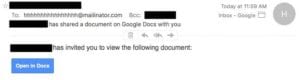
Today, cybercriminals launched a highly effective email scam that included a link to a Google Docs document that was in fact a link to a 3rd party app designed to steal information from the recipient. Worse, the email appears to come from someone known to the victim. Based on information from the Agari Trust Network, we saw more than 3,016 organizations compromised that sent 23,838 emails to Agari protected organizations. Based on social media posts and the number of Gmail/G-Suite users, the number of victims is likely unprecedented.
hhhhhhh

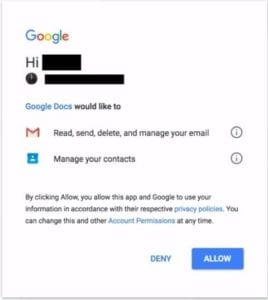
When users click on the Google doc link, the malicious site uses a Google API to prompt the user to give the attackers’ malicious app access to their email account, supposedly to access the document. When users allow access, the malicious app sends the same email to your contacts, spreading itself.
Google

What Should You Do If You Clicked on The Link?

For individual Gmail users:

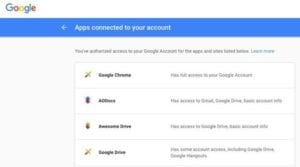
Go to your Google security setting at https://myaccount.google.com/permissions and remove any apps connected to your account that you don’t recognize. The malicious app was originally called “Google Docs”.
Apps

For G-Suite administrators at organizations:

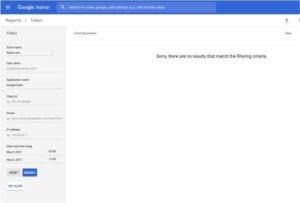
Go to the Google Admin page. You can go to reports>token and run a search for any apps installed on May 3rd and revoke that app. Unfortunately, you have to do this one user at a time if you use the Google admin interface but at least you can filter by the users who installed something on May 3rd. Alternatively, you could also use a command line tool like this one if you have a large number of users https://github.com/jay0lee/GAM/wiki/SecurityExamples
Google Admin

What’s Different About This Attack?
This attack is different and scary because of its ability to evade common defenses and leverage Google APIs to trick users into granting access. The attack didn’t directly try to steal usernames and passwords like a typical phishing scam but rather tricked users into allowing complete access to their email account. Typically, users have been trained to change their password when they think they have been a victim of a phishing scam. In this case, that would not solve the problem.

What could these Cybercriminals do with this access?
While we haven’t seen reports of fraud yet, the cybercriminals who launched the attack have access to all of the victims’ emails until the app is disabled. With that access, the criminals can use your identity to scam co-workers or relatives, reset your bank account password and steal money or harvest information to steal the victim’s identity. There are an infinite number of ways a cybercriminal can monetize this kind of access.

Why Didn’t Traditional Defenses Didn’t Stop This Attack?

  1. Two-Factor Authentication – Gmail and Gsuite have integrated two factor authentication. This attack didn’t steal a password. If you change your password, you are still vulnerable.
  2. Endpoint Security– There is no malware to detect or block using anti-virus or other endpoint security techniques.
  3. Secure Email Gateways– The URL used for the link had never been seen before and was an actual Google doc with a strong reputation.
  4. Email Authentication– This attack came from an authentic email account. It wasn’t spoofing and therefore wouldn’t fail email authentication.

Predictions About Future Attacks
This is likely the first of a new breed of attack. Next time, the attacker might be smarter and only mine the information while propagating slowly enough not to get caught the same day. Other email systems such as Office 365 have similar app plugin systems that could be used to mount similar attacks on larger enterprise organizations. I also believe we will see an increase in targeting to make attacks more credible; whether using account takeover (ATO), social networks, or just publicly available information. As a result, more emails will look “right” to the victim and fewer malicious emails will be reported. This will hamper traditional blacklisting-based methods, which depend on reporting.

ISBuzz Team
  • ISBuzz Team
    Air Canada Data Breach: BianLian Extortion Group Claims A Massive Heist Contrary To Airline’s Earlier Statement
  • ISBuzz Team
    Unprecedented DDoS Attack Rocks The Web: Tech Giants Reveal A Digital Tsunami
  • ISBuzz Team
    CISA Flags High-Severity Adobe Acrobat Reader Flaw Amid Active Exploits
  • ISBuzz Team
    Curl Security Alert: Patching A Critical Bug Averting Potential Cyber Catastrophe

The opinions expressed in this post belong to the individual contributors and do not necessarily reflect the views of Information Security Buzz.

Share. Facebook Twitter LinkedIn Email Copy Link

Related Posts

The next phase of endpoint security starts with simplicity

June 24, 20266 Mins Read

New Phishing Kit Starkiller Defeats Multi-Factor Authentication

February 23, 20264 Mins Read

ReliaQuest Uncovers Social Media Phishing Campaign Built on Trusted Tools

January 22, 20266 Mins Read
ISB-Bora-Side-Bar

No se ha podido establecer conexión. Error 429

 
ISB-Bora-Side-Bar
Black ISB Logo

Information Security Buzz is an independent resource that provides the experts’ comments, analysis, and opinion on the latest Cybersecurity news and topics

X (Twitter) LinkedIn Facebook RSS

Working With Us

  • About Us
  • Advertise With Us
  • Contact Us

Write For Us

  • How To Contribute

The Pages

  • Privacy Policy
  • Cookie Policy
  • AI Policy
  • Terms & Conditions
  • Copyright Notice

Information Security Buzz and all its contents are copyright © 2014-2025. All rights reserved. All third-party trademarks are recognized.

Type above and press Enter to search. Press Esc to cancel.

Manage Consent
To provide the best experiences, we use technologies like cookies to store and/or access device information. Consenting to these technologies will allow us to process data such as browsing behavior or unique IDs on this site. Not consenting or withdrawing consent, may adversely affect certain features and functions.
Functional Always active
The technical storage or access is strictly necessary for the legitimate purpose of enabling the use of a specific service explicitly requested by the subscriber or user, or for the sole purpose of carrying out the transmission of a communication over an electronic communications network.
Preferences
The technical storage or access is necessary for the legitimate purpose of storing preferences that are not requested by the subscriber or user.
Statistics
The technical storage or access that is used exclusively for statistical purposes. The technical storage or access that is used exclusively for anonymous statistical purposes. Without a subpoena, voluntary compliance on the part of your Internet Service Provider, or additional records from a third party, information stored or retrieved for this purpose alone cannot usually be used to identify you.
Marketing
The technical storage or access is required to create user profiles to send advertising, or to track the user on a website or across several websites for similar marketing purposes.
  • Manage options
  • Manage services
  • Manage {vendor_count} vendors
  • Read more about these purposes
View preferences
  • {title}
  • {title}
  • {title}