


Close Menu
  • Home
  • Articles
    • Attacks
      • BEC
      • Data Breach
      • DDoS
      • Evasion Attacks
      • Injection
      • Malware
      • MITM
      • Phishing
      • Ransomware
      • RCE
      • Social Engineering
      • Spoofing
      • Spyware
    • Business and Policy
      • BCP and DRP
      • GRC
      • Regulations
    • Data Protection
      • DLP
      • DRM
      • Encryption
      • IAM
    • Future, Trends and Insight
      • AI
      • Events & Community
      • Emerging Tech
      • Expert Panel
      • Interviews With Experts
      • Insights
      • Study & Research
    • Resources
      • Guides
      • Tools
      • Training & Education
    • Security
      • API
      • Apps
      • Cloud
      • Critical Infrastructure
      • Endpoint
      • Hardware
      • IoT
      • Mobile
      • Network
      • OT
      • Port Security
      • Security Architecture
      • Software Development
      • Supply Chain
      • Zero Trust
    • Threats and Vulnerabilities
      • Emerging Threats
      • Insider Threats
      • Risk Management
      • Threat Intelligence
      • Zero Day
  • News and Exclusives
    • Latest News
    • ISB Exclusive
    • Positive News
  • Who We Are
    • About Us
    • Information Security Buzz Expert Panel​
    • Write for Us
    • Media Pack
  • Contact Us
  • Newsletter
Facebook X (Twitter) LinkedIn
Information Security BuzzInformation Security Buzz
  • Home
  • Articles
    • Attacks
      • BEC
      • Data Breach
      • DDoS
      • Evasion Attacks
      • Injection
      • Malware
      • MITM
      • Phishing
      • Ransomware
      • RCE
      • Social Engineering
      • Spoofing
      • Spyware
    • Business and Policy
      • BCP and DRP
      • GRC
      • Regulations
    • Data Protection
      • DLP
      • DRM
      • Encryption
      • IAM
    • Future, Trends and Insight
      • AI
      • Events & Community
      • Emerging Tech
      • Expert Panel
      • Interviews With Experts
      • Insights
      • Study & Research
    • Resources
      • Guides
      • Tools
      • Training & Education
    • Security
      • API
      • Apps
      • Cloud
      • Critical Infrastructure
      • Endpoint
      • Hardware
      • IoT
      • Mobile
      • Network
      • OT
      • Port Security
      • Security Architecture
      • Software Development
      • Supply Chain
      • Zero Trust
    • Threats and Vulnerabilities
      • Emerging Threats
      • Insider Threats
      • Risk Management
      • Threat Intelligence
      • Zero Day
  • News and Exclusives
    • Latest News
    • ISB Exclusive
    • Positive News
  • Who We Are
    • About Us
    • Information Security Buzz Expert Panel​
    • Write for Us
    • Media Pack
  • Contact Us
  • Newsletter
Subscribe
Information Security BuzzInformation Security Buzz
Home - News & Analysis - Slava Ukraini: Dyre Returns
News & Analysis

Slava Ukraini: Dyre Returns

ISBuzz TeamBy ISBuzz TeamJuly 22, 2014Updated:January 5, 20264 Mins Read
Share LinkedIn Twitter Facebook Copy Link Email
Share
Facebook Twitter LinkedIn Email Copy Link
Quick AI Summary
ChatGPTClaudeGeminiGrokPerplexityDeepSeekCopilot

It has been a few weeks since the original discovery of the Dyre malware, and the attackers have sent another wave of phishing, reports PhishMe. This time, the phishing campaign only went to one senior level individual within the enterprise.

Here’s a screenshot of the phish:

Figure 1 – Phishing Email

In the last few campaigns, the attackers made it difficult to access their Google Analytics page. However, the attackers slipped up this time, making it possible to uncover how many potential victims have fallen for the link. This gives further insight into the geographical location they may be targeting as well.

Figure 2 – 109 Potential Victims

We can also see the country and browser that the individuals are using.

Figure 3 – Browser and Country Distribution

Once the zip file containing a screensaver file is downloaded and executed, several files are downloaded. The detection rate for the malware is very low, and starts out with the Upatre dropper with 12 out of 53 (at time of writing) AV vendors detecting the threat.

Another file, flagged as kegotip by the VirusTotal community, has an even lower detection ratio of 11 out of 54 AV vendors
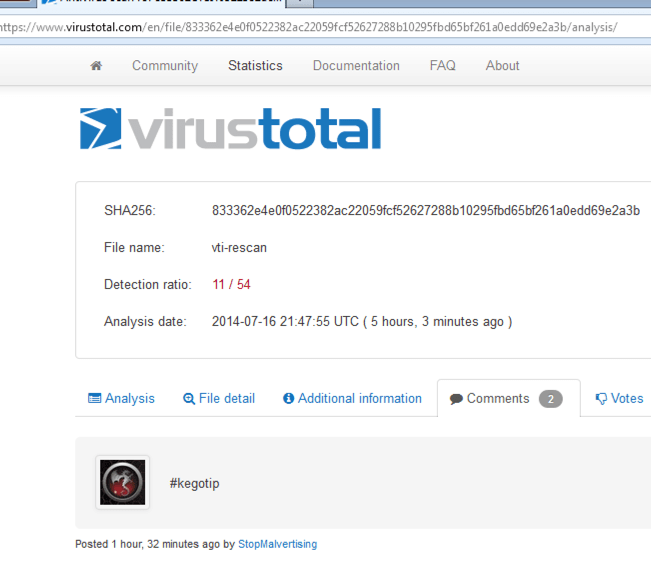
Figure 4 – VirusTotal analysis of kegotip sample

And for the third piece of malware, Dyre joins the show! At the time of this writing, this is only picked up by 10 of 54 AV vendors.

Figure 5 – Dyre malware

Based off the network data in Figure 6, it can be further confirmed that this is Dyre, as it matches the network traffic from PhishMe’s previous analysis.

Figure 6 – Dyre malware traffic

While googleupdaterr.exe is quick to exit, if you’re quicker, it is possible to obtain a memory dump via process explorer. (Author note: Volatility works too, but for brevity, process explorer approach may be preferable) In the previous variant of Dyre, the string “C:\CPP_PROJECTS_GIT\DYRE\x64\Release\iebattle.pdb” was observed as the project path. Performing strings on the memory dump does not show this existing.

However, by grepping for “DYRE”, the attackers have may have left the message of “I’m DYRE”. By looking before and after this string, the following phrase of “Slava Ukraini!” is there as well, which translates to “Glory to the Ukraine!”

Figure 7 – Hidden message in Dyre malware

By looking at the capitalization of the phrases, we can come up with many possible theories; unless the author provides more clues, he/she will remain unattributable. “I’m DYRE!” may show that the attacker is referred to as Dyre or wants the malware referred to as that, or it could be slang, such as rouji (肉鸡), that is common among attackers.

“Glory to Ukraine!” seems to have a deeper meaning to the malware author. This phrase is common in the Ukraine, and has even been referred to as the unofficial motto. Jared Leto also shouted “Glory to Ukraine” during a concert in Kiev, supporting the independence movement.

How to find this in your enterprise

Here are a few tips for finding this malware and preventing further infections:

– Look for zip files being downloaded that contain executables and screen savers.
– Search for email artifacts from figure 1 to help identify this one and variants.
– Kimberly at StopMalvertising has put together a very deep analysis of Dyre, as well as the new changes in the malware. (removal of compilation artifacts)

By Ronnie Tokazowski, security researcher at PhishMe

About PhishMe

PhishMePhishMe® provides organizations the ability to improve their employees’ resilience towards spear phishing, malware, and drive-by attacks. Our approach entails immersive training to effectively change employee behavior, empower users to detect and report targeted phishing attacks, and augment an organization’s existing security operations and incident response processes. With over 4 million individuals trained in 160 countries, PhishMe has been proven to reduce the threat of employees falling victim to advanced cyber-attacks by up to 80 percent. PhishMe works with Fortune 1,000 companies across many industries, including defense industrial base, energy, financial services, government, healthcare, and retail. For additional information, please visit: www.phishme.com.

ISBuzz Team
  • ISBuzz Team
    Air Canada Data Breach: BianLian Extortion Group Claims A Massive Heist Contrary To Airline’s Earlier Statement
  • ISBuzz Team
    Unprecedented DDoS Attack Rocks The Web: Tech Giants Reveal A Digital Tsunami
  • ISBuzz Team
    CISA Flags High-Severity Adobe Acrobat Reader Flaw Amid Active Exploits
  • ISBuzz Team
    Curl Security Alert: Patching A Critical Bug Averting Potential Cyber Catastrophe

The opinions expressed in this post belong to the individual contributors and do not necessarily reflect the views of Information Security Buzz.

Share. Facebook Twitter LinkedIn Email Copy Link

Related Posts

New Phishing Kit Starkiller Defeats Multi-Factor Authentication

February 23, 20264 Mins Read

ReliaQuest Uncovers Social Media Phishing Campaign Built on Trusted Tools

January 22, 20266 Mins Read

What Happens after a Phishing Email Lands in Your Inbox?

January 5, 20266 Mins Read
ISB-Bora-Side-Bar

No se ha podido establecer conexión. Error 429

 
ISB-Bora-Side-Bar
Black ISB Logo

Information Security Buzz is an independent resource that provides the experts’ comments, analysis, and opinion on the latest Cybersecurity news and topics

X (Twitter) LinkedIn Facebook RSS

Working With Us

  • About Us
  • Advertise With Us
  • Contact Us

Write For Us

  • How To Contribute

The Pages

  • Privacy Policy
  • Cookie Policy
  • AI Policy
  • Terms & Conditions
  • Copyright Notice

Information Security Buzz and all its contents are copyright © 2014-2025. All rights reserved. All third-party trademarks are recognized.

Type above and press Enter to search. Press Esc to cancel.

Manage Consent
To provide the best experiences, we use technologies like cookies to store and/or access device information. Consenting to these technologies will allow us to process data such as browsing behavior or unique IDs on this site. Not consenting or withdrawing consent, may adversely affect certain features and functions.
Functional Always active
The technical storage or access is strictly necessary for the legitimate purpose of enabling the use of a specific service explicitly requested by the subscriber or user, or for the sole purpose of carrying out the transmission of a communication over an electronic communications network.
Preferences
The technical storage or access is necessary for the legitimate purpose of storing preferences that are not requested by the subscriber or user.
Statistics
The technical storage or access that is used exclusively for statistical purposes. The technical storage or access that is used exclusively for anonymous statistical purposes. Without a subpoena, voluntary compliance on the part of your Internet Service Provider, or additional records from a third party, information stored or retrieved for this purpose alone cannot usually be used to identify you.
Marketing
The technical storage or access is required to create user profiles to send advertising, or to track the user on a website or across several websites for similar marketing purposes.
  • Manage options
  • Manage services
  • Manage {vendor_count} vendors
  • Read more about these purposes
View preferences
  • {title}
  • {title}
  • {title}